



Fluorescent Dye
Fluorescence is a phenomenon of photoluminescence in luminescence. When an atom is irradiated by light, some electrons around the nucleus jump from their original orbitals to higher energy orbitals under the influence of light energy, i.e., from the ground state to the first or second excited single-line state, etc. Due to the instability of the first or second excited singlet state, the electron returns from the excited singlet state to the ground state accompanied by released energy, resulting in fluorescence.
Fluorescent dyes can be covalently bound or physically adsorbed in the structure of the substance. The fluorescence properties allow for the characterization, localization and quantitative analysis of the labeled object. Fluorescent dyes have shown great potential for the detection of proteins, nucleic acids, cells, and immunoassays, attributed to the advantages in non-radioactive contamination, simple experimental operation and easy observation.
Fluorescent dyes have penetrated many fields such as pharmacology, physiology, environmental science, and information science, as well as functional studies of proteins and drug screening.
All Product Categories
-
Fluorescent Dye Related Products (4914)
Related Products (4914)

-
Antibodies (4)
-
Cy3 labled Salanersen sodium
 0 ImagesCat. No.: HY-177661DCy3 labled Salanersen sodium is a Cy3 labled Salanersen sodium.
-
India Ink
 0 ImagesCat. No.: HY-DY2048India Ink is a negative staining agent. India Ink creates contrast against the polysaccharide capsule of Cryptococcus neoformans to enable visualization. India Ink enables automated measurement of Cryptococcus neoformans capsule diameter using computational image analysis. India Ink can be used for the research of cryptococcosis.
-
FAM labled Cevolisiran sodium
 0 ImagesCat. No.: HY-177621CFAM labled Cevolisiran sodiumis a FAM labled Cevolisiran sodium.
-
ACu1
 0 ImagesCat. No.: HY-D3267CAS No.: 1314527-28-0ACu1 is a copper (I)-selective two-photon fluorescent probe that enables the visual imaging of Cu+ distribution in living cells and tissues.
-
Maclura Pomifera Lectin
 0 ImagesCat. No.: HY-NP074Synonyms: MPLMaclura Pomifera Lectin (MPL) is a plant lectin that can be used as a probe to specifically bind biomolecules (such as polysaccharides, peptides, etc.).Maclura Pomifera Lectin (MPL) is a biological material or organic compound that can be used in life science research.
-
FITC-HA (MW 200000)
 0 ImagesCat. No.: HY-D2836BSynonyms: FITC-Hyaluronate (MW 200000)FITC-HA (MW 200000) is hyaluronic acid (HA) (HY-B0633A) labeled with FITC (HY-66019). FITC-HA retains the ability of HA to bind to receptors (such as CD44) and form extracellular matrices, while it can be detected by fluorescence microscopy or flow cytometry for tracing the localization, binding, internalization and metabolic pathways of HA in cells, tissues or living organisms (Ex/Em ≈ 490/520 nM).

-
D-Luciferin phosphate trisodium
 0 ImagesCat. No.: HY-148843CAS No.: 145613-12-3D-Luciferin phosphate trisodium is a synthetic and bioluminescent substrate for firefly luciferase. D-Luciferin phosphate trisodium is dephosphorylated in the presence of alkaline phosphatase, releasing the free D-fluorescein. D-Luciferin phosphate trisodium is mainly used for highly sensitive detection of phosphatase.
-
Brown Y
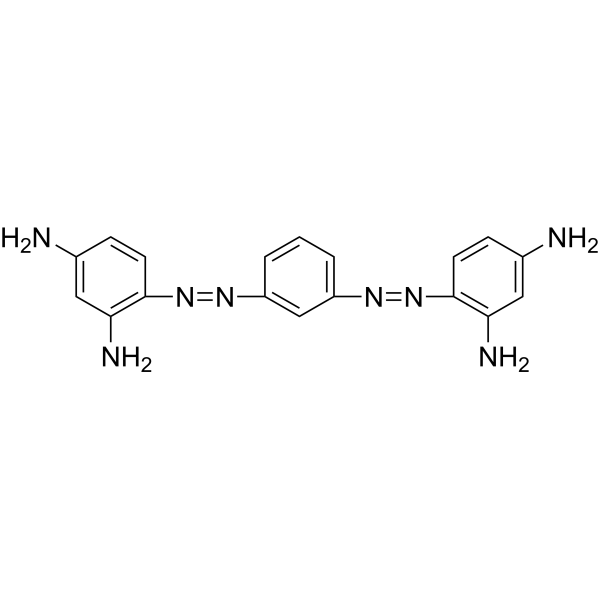 0 ImagesBrown Y is a multifunctional dye. Dyes are important tools in biological experiments. They can help researchers observe and analyze cell structures, track biomolecules, evaluate cell functions, distinguish cell types, detect biomolecules, study tissue pathology and monitor microorganisms. Their applications range from basic scientific research to clinical A wide range of diagnostics. Dyes are also widely used in traditional fields such as textile dyeing, as well as in emerging fields such as functional textile processing, food pigments and dye-sensitized solar cells.
-
Biotin-11-dUTP
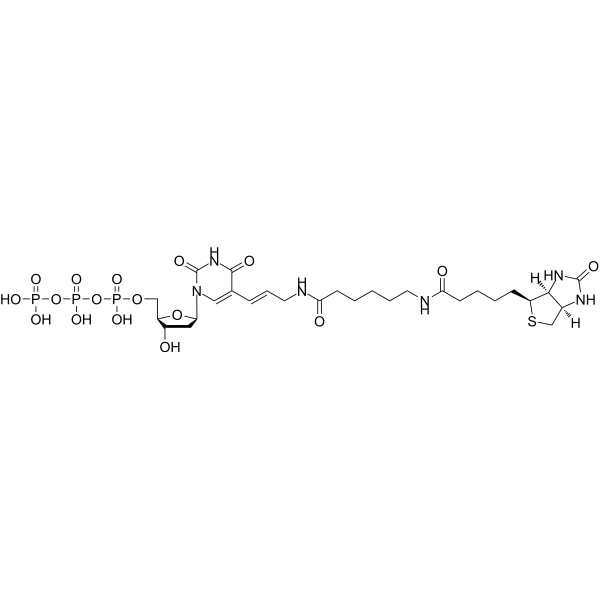 0 ImagesCat. No.: HY-D1029CAS No.: 86303-25-5Biotin-11-dUTP is a fluorescent substitute for dTTP.

-
INDO 1 pentasodium
 0 ImagesCat. No.: HY-D0121BINDO 1 pentasodium is a cell-impermeable, dual-emission ratiometric fluorescent calcium indicator with a KD·β value of 0.44 μM. INDO 1 pentasodium binds to intracellular free calcium ions and undergoes wavelength-dependent fluorescence changes. In the unbound state (free form) without Ca2+, its fluorescence emission peak is at 485 nm upon excitation with ultraviolet light (350 nm). When INDO 1 pentasodium binds to Ca2+ (bound state), the emission peak shifts to 405 nm (Ex = 350 nm; dual emission at Em= 405/485 nm).
-
4-Aminodiphenylamine sulfate
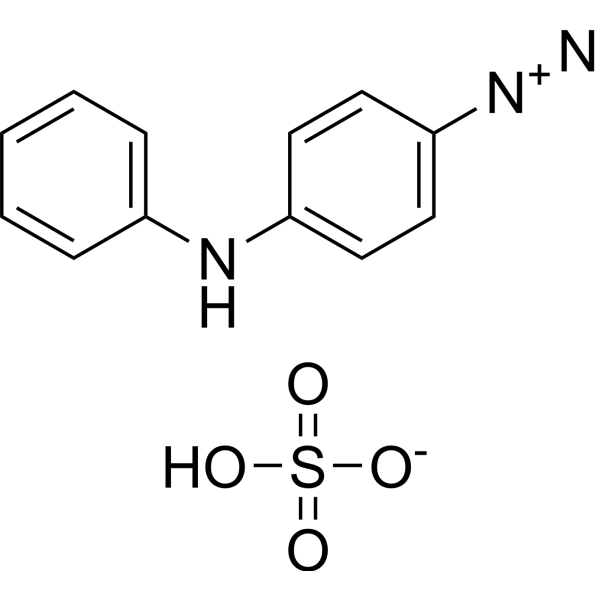 0 Images4-Aminodiphenylamine sulfate (Variamine Blue RT sulfate) is a multifunctional dye. Dyes are important tools in biological experiments. They can help researchers observe and analyze cell structures, track biomolecules, evaluate cell functions, distinguish cell types, detect biomolecules, study tissue pathology and monitor microorganisms. Their applications range from basic scientific research to clinical A wide range of diagnostics. Dyes are also widely used in traditional fields such as textile dyeing, as well as in emerging fields such as functional textile processing, food pigments and dye-sensitized solar cells.
-
5-Carboxy-2′,7′-dichlorosulfonefluorescein
 0 ImagesCat. No.: HY-D3433CAS No.: 222159-75-3Synonyms: CDCSF5-Carboxy-2′,7′-dichlorosulfonefluorescein (CDCSF) is a fluorescein derivative-based fluorescent probe. 5-Carboxy-2′,7′-dichlorosulfonefluorescein serves as a fluorescent substrate for the organic anion transporting polypeptide OATP2B1, and is specifically recognized and transported into cells by OATP2B1 under acidic pH conditions, making it suitable for in vitro high-throughput screening of drug-drug interactions (DDI) and food-drug interactions (FDI) (Ex/Em = 485/535 nm).
-
6-DTAF hydrochloride
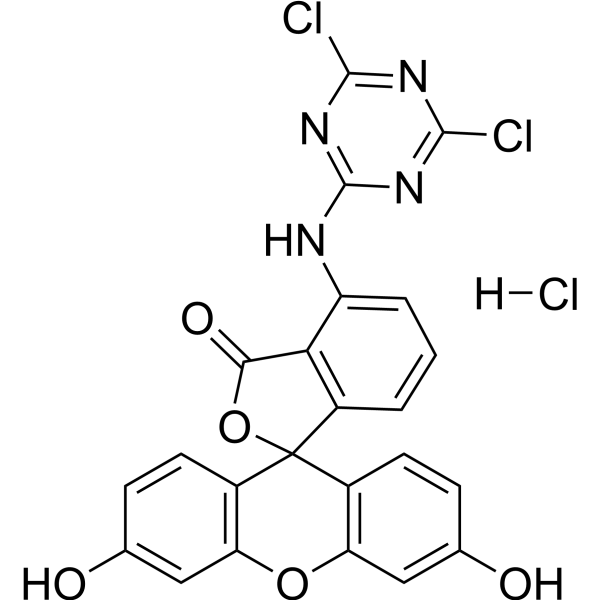 0 ImagesCat. No.: HY-D1081CAS No.: 118357-32-76-DTAF hydrochloride is a fluorescein that can be used to label peptides and nucleotides.
-
Wisteria Floribunda Lectin (Fluorescein)
 0 ImagesCat. No.: HY-NP0148Synonyms: WFA (Fluorescein)Wisteria Floribunda Lectin (WFA) Fluorescein is a plant lectin that can be used as a probe to specifically bind biomolecules (such as polysaccharides, peptides, etc.).Wisteria Floribunda Lectin (WFA) Fluorescein is a biological material or organic compound that can be used in life science research.
-
HMRG
 0 ImagesCat. No.: HY-D2379CAS No.: 1629965-68-9HMRG is a fluorescent dye, which serves as the fluorescent active product generated by enzyme-activated fluorescent probes targeting proteases and glycosidases. Its detection mechanism relies on the intramolecular spirocyclization equilibrium: HMRG itself exists in an open non-spirocyclic structure under physiological pH, which maintains a conjugated π system and produces strong fluorescence; whereas its probe precursors (such as Leu-HMRG, Ac-GlyPro-HMRG and βGal-HMRG) exist in a closed spirocyclic form and show no fluorescence due to the disruption of the π-conjugated system; when the target enzyme cleaves the substrate fragment linked to the probe precursor, the closed spirocyclic structure converts to the open structure of HMRG, restoring the conjugated system and generating a strong fluorescent signal. Its detection wavelength is Ex/Em = 501/524 nm.
-
Cy7.5 tetrazine tetrafluoroborate
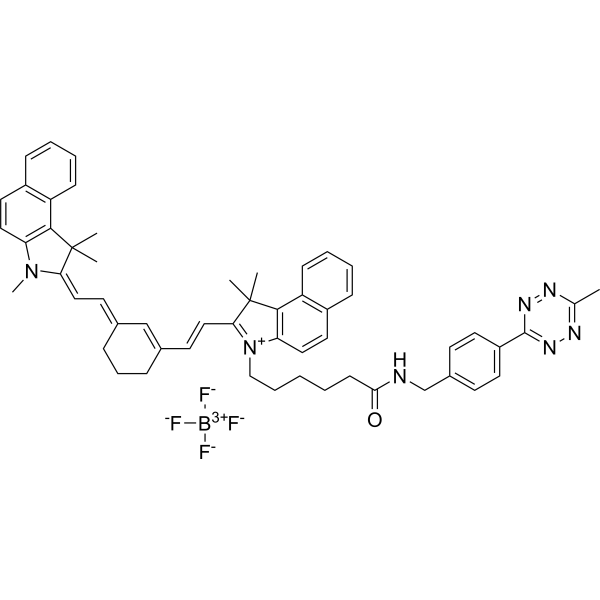 0 ImagesCat. No.: HY-D1847Cy7.5 tetrazine tetrafluoroborate is a dye derivative of Cyanine 7.5 (Cy7.5) (HY-D0926) bearing a tetrazine group. Cy7.5 is a near-infrared fluorescent dye commonly used for biolabeling and cell imaging. Cy7.5 tetrazine tetrafluoroborate can perform efficient click reactions with molecules containing alkyne functional groups (such as alkyne) to form covalent bonds. It can be combined with biological molecules such as proteins and antibodies to track their location and dynamic changes in biological samples.
-
Cy5-PEG1000-DSPE
 0 ImagesCat. No.: HY-D2541Cy5-PEG1000-DSPE is a PEG phospholipid with Cy5 (HY-D0821) dye used in protein/nucelic acid labeling and fluorescence microscopy. Cy5-PEG1000-DSPE can self-assemble in aqueous solution to form micelles/lipid bilayer and used to prepare liposomes or nanoparticles for nutrients delivery such as mRNA or DNA vaccine.




