



Fluorescent Dye
Fluorescence is a phenomenon of photoluminescence in luminescence. When an atom is irradiated by light, some electrons around the nucleus jump from their original orbitals to higher energy orbitals under the influence of light energy, i.e., from the ground state to the first or second excited single-line state, etc. Due to the instability of the first or second excited singlet state, the electron returns from the excited singlet state to the ground state accompanied by released energy, resulting in fluorescence.
Fluorescent dyes can be covalently bound or physically adsorbed in the structure of the substance. The fluorescence properties allow for the characterization, localization and quantitative analysis of the labeled object. Fluorescent dyes have shown great potential for the detection of proteins, nucleic acids, cells, and immunoassays, attributed to the advantages in non-radioactive contamination, simple experimental operation and easy observation.
Fluorescent dyes have penetrated many fields such as pharmacology, physiology, environmental science, and information science, as well as functional studies of proteins and drug screening.
All Product Categories
-
Fluorescent Dye Related Products (4914)
Related Products (4914)

-
Antibodies (4)
-
TOR-G4
 0 ImagesCat. No.: HY-D3415CAS No.: 3030070-69-7TOR-G4 is a Fluorescent probe that binds to G-quadruplex (G4) nucleic acid structures. TOR-G4 exhibits a unique fluorescence lifetime when bound to G4 compared to other structures, enabling sensitive discrimination between G4-bound and non-G4-bound states. TOR-G4 mainly colocalizes with RNA in the cytoplasm and nucleolus. TOR-G4 can be used to investigate the roles of RNA G4 in cells. TOR-G4 shows cytotoxicity against osteosarcoma cells.
-
TP-α
 0 ImagesCat. No.: HY-D3173CAS No.: 1708978-54-4Synonyms: TPG-456TP-α (TPG-456) is a glucagon-selective two-photon fluorescent probe with a Kd of 65 μM. TP-α directly interacts with glucagon to produce significant fluorescence enhancement. TP-α selectively stains viable glucagon-secreting α cells in pancreatic islets, enabling visualization of their localization, distribution and availability. TP-α is applicable to diabetes research (Ex/Em = 370nm/510 nm).
-
RB-PEG10000-OH
 0 ImagesCat. No.: HY-D2882HSynonyms: Rhodamine B-PEG10000-OHRB-PEG10000-OH (Rhodamine B-PEG10000-OH) is a fluorescent dye composed of Rhodamine B (HY-Y0016), PEG and a Hydroxyl group. RB-PEG10000-OH can be used for fluorescent labeling and imaging (Ex/Em=546/610 nm).

-
MC-PSE
 0 ImagesCat. No.: HY-D3136MC-PSE is a fluorescent probe that can be used for glutathione (GSH) detection, NIR-II fluorescence imaging and ratiometric photoacoustic imaging. MC-PSE spontaneously forms J-aggregates in aqueous solution through π-π stacking, and its phenylselenyl group acts as a fluorescence quencher and GSH recognition receptor, thereby eliminating intrinsic fluorescence and generating a maximum absorption peak at 1000 nm. The excitation/emission wavelengths of MC-PSE are Ex = 808 nm and Em = 940 nm. MC-PSE can be applied in tumor-related research.
-
APC Streptavidin
 0 ImagesCat. No.: HY-D3559APC Streptavidin is a streptavidin labeled with Allophycocyanin (APC) (HY-D1815) at a concentration of 0.5 mg/mL. Allophycocyanin (APC Dye) is a light-harvesting protein containing a strongly coupled dimer. Streptavidin specifically binds to biotin, forming a reversible non-covalent interaction. R-PE Streptavidin is commonly used in immunofluorescence (IF), enzyme-linked immunosorbent assay (ELISA), flow cytometry, and other experiments (Ex/Em=652/662 nm).
-
Cyanine3.5 carboxylic acid chloride
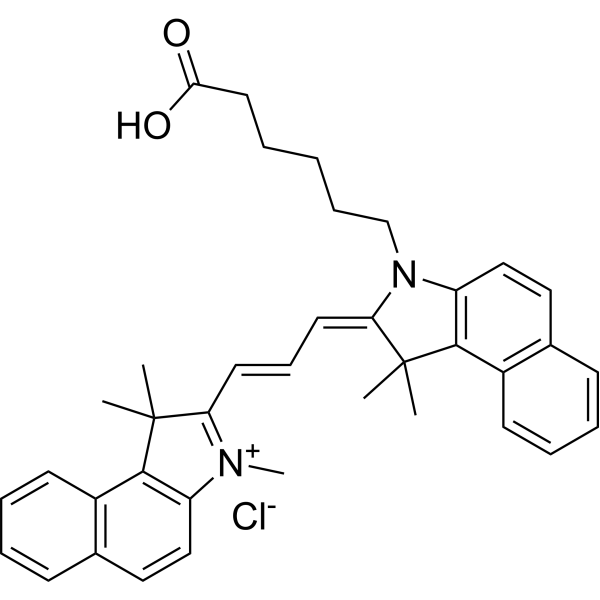 0 ImagesCat. No.: HY-D1338CAS No.: 1802928-88-6Synonyms: Cy 3.5 carboxylic acid chlorideCyanine3.5 carboxylic acid chloride is an anthocyanin dye. Cyanine3.5 carboxylic acid chloride is Cyanine3.5 free unactivated monofunctional carboxylic acid and can be used as a reference or control for non-reactive dye. Cyanine3.5 also is an analog of Cy3.5 fluorophore.
-
DNTPH
 0 ImagesCat. No.: HY-D3069CAS No.: 2892545-08-1DNTPH is a near-infrared (NIR) aggregation-induced emission (AIE) fluorescent probe used for imaging β-amyloid (Aβ) aggregates. Designed by balancing hydrophobic and hydrophilic groups, DNTPH achieves selective binding to Aβ42 fibrils and generates a near-infrared fluorescent signal with high signal-to-noise ratio. Upon binding to Aβ42 fibrils, DNTPH exhibits enhanced fluorescence, while also inhibiting Aβ42 fibril formation, promoting fibril depolymerization, attenuating Aβ-induced neurotoxicity, and improving cognitive function in Alzheimer's disease (AD) mice. DNTPH can be used in Alzheimer's disease research.
-
Th-TMR-S-Halo
 0 ImagesCat. No.: HY-D3366Th-TMR-S-Halo is a fluorescent probe for HaloTag labeling and live-cell imaging, including super-resolution imaging and real-time visualization of endoplasmic reticulum (ER) vortex formation under ER stress conditions. Th-TMR-S-Halo shows weak fluorescence in the free state, and upon covalent binding to HaloTag, fluorescence activation is achieved by restricting the rotation of the thiophene ring. Th-TMR-S-Halo can be used in studies related to intracellular protein localization, cytoskeleton structure, and ER vortex formation. Live-cell NSPARC super-resolution detection is performed using Ex/Em = 561/570-616 nm.
-
Cy3 labled Daplusiran sodium
 0 ImagesCat. No.: HY-177625DCy3 labled Daplusiran sodium is a Cy3 labled Daplusiran sodium.
-
Ctrl-BODIPYS1
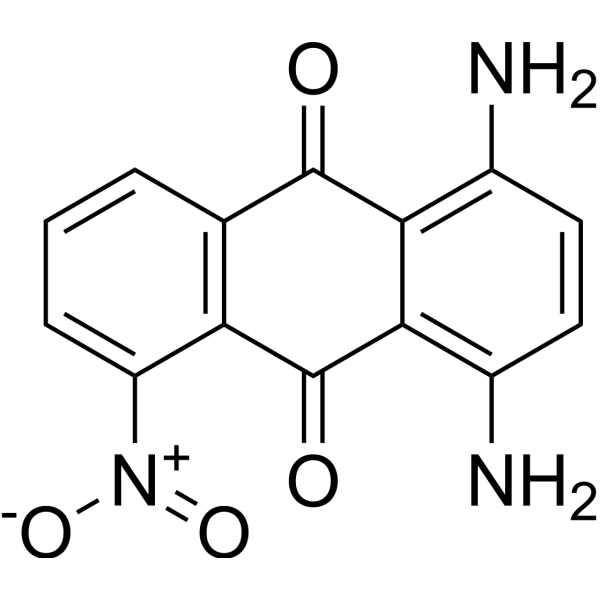
 0 ImagesCat. No.: HY-D3233Ctrl-BODIPYS1 is a BODIPY-based control probe that shows no response to copper ions (exhibiting two emission peaks at 575 nm and 708 nm; the maximum excitation wavelength is at 627 nm). Ctrl-BODIPYS1 has no fluorescent response to Cu+.
-
610CP TFA
 0 ImagesCat. No.: HY-D1346A610CP TFA is a new type of actin labeling dye. It dissolves in organic solvents. In DMSO the 610CP TFA excitation/emission wavelength is between 609 and 634 nm. 610CP TFA is a fluorescent dye that penetrates living cells. Upon cell entry, 610CP TFA binds to Bromo-des-methyl-Jasplakinolide Therefore, 610CP TFA dye can be used to stain actin fluorescence images with low background and high resolution.
-
Cyclo(Val-Val-Ile-d-Ala-Trp(Bodipy)-Gly)
 0 ImagesCat. No.: HY-P11912Cyclo (Val-Val-Ile-d-Ala-Trp (Bodipy)-Gly) is a cyclic peptide-BODIPY conjugate. Cyclo (Val-Val-Ile-d-Ala-Trp (Bodipy)-Gly) detects prefibrillar Aβ1-42 aggregates in neuronal cells, generating perinuclear punctate fluorescent spots. Cyclo (Val-Val-Ile-d-Ala-Trp (Bodipy)-Gly) is applicable to Alzheimer's disease-related research.
-
Golgi-P
 0 ImagesCat. No.: HY-D2970Golgi-P is a near-infrared Golgi-targeted fluorescent probe specifically used for the detection of Golgi polarity in living cells and living tissues. Golgi-P exhibits a significant polarity-dependent spectral behavior, with its emission wavelength shifting redward with polarity (Ex/Em: 700 nm/780-825 nm). Golgi-P achieves near-infrared fluorescence imaging directly in the brain tissue of depressed mice. Golgi-P combines polarity sensing with Golgi-targeting functionality, providing a new tool for the molecular diagnosis of depression.
-
Datura Stramonium Lectin-AF488
 0 ImagesCat. No.: HY-NP065CSynonyms: DSL-AF488Datura Stramonium Lectin-AF488 (DSL-AF488) is a datura lectin (DSL) labeled with the AF488 fluorescent dye. Datura Stramonium Lectin is a dimeric glycoprotein that specifically recognizes and binds to glycan structures containing N-acetylglucosamine (GlcNAc) oligomers. Datura Stramonium Lectin-AF488 can be used for glycosyl studies on cell surfaces (Ex/Em = 470/520 nm).
-
Phaseolus Vulgaris Leucoagglutinin (Fluorescein)
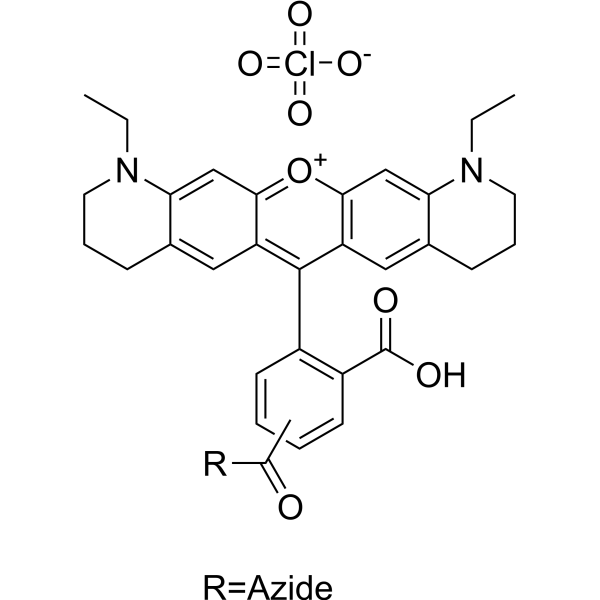
 0 ImagesCat. No.: HY-NP0140Synonyms: PHA-L (Fluorescein)Phaseolus Vulgaris Leucoagglutinin (PHA-L) Fluorescein is a plant lectin that can be used as a probe to specifically bind biomolecules (such as polysaccharides, peptides, etc.).Phaseolus Vulgaris Leucoagglutinin (PHA-L) Fluorescein is a biological material or organic compound that can be used in life science research.
-
Jun14157
 0 ImagesCat. No.: HY-D2898Jun14157 is a fluorescence polarization probe that can specifically bind to the conserved allosteric site of enterovirus 2C proteins (Ex: 485/20; Em: 528/20). Jun14157 has Kd values of 2.3 μM, 1.4 μM, and 1.1 μM for EV-D68 2C, EV-A71 2C, and CVB3 2C, respectively. Jun14157 can be used in research related to enteroviruses.
-
DPH propionic acid
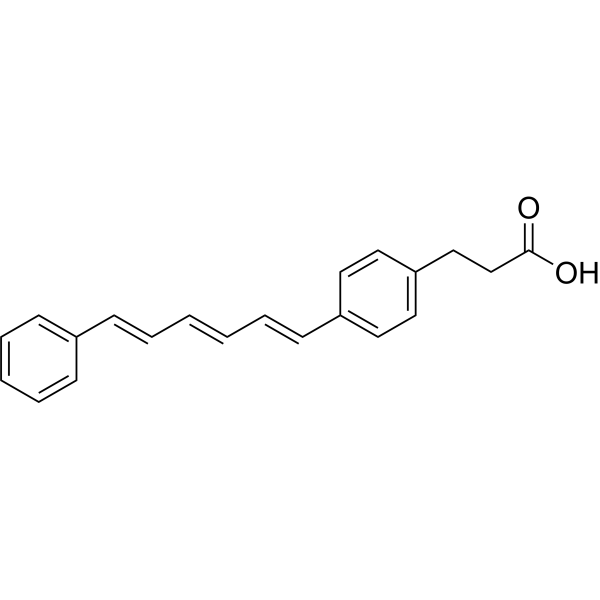 0 ImagesCat. No.: HY-D1743CAS No.: 84294-98-4DPH propionic acid is a fluorescent dye.




