



Fluorescent Dye
Fluorescence is a phenomenon of photoluminescence in luminescence. When an atom is irradiated by light, some electrons around the nucleus jump from their original orbitals to higher energy orbitals under the influence of light energy, i.e., from the ground state to the first or second excited single-line state, etc. Due to the instability of the first or second excited singlet state, the electron returns from the excited singlet state to the ground state accompanied by released energy, resulting in fluorescence.
Fluorescent dyes can be covalently bound or physically adsorbed in the structure of the substance. The fluorescence properties allow for the characterization, localization and quantitative analysis of the labeled object. Fluorescent dyes have shown great potential for the detection of proteins, nucleic acids, cells, and immunoassays, attributed to the advantages in non-radioactive contamination, simple experimental operation and easy observation.
Fluorescent dyes have penetrated many fields such as pharmacology, physiology, environmental science, and information science, as well as functional studies of proteins and drug screening.
All Product Categories
-
Fluorescent Dye Related Products (4914)
Related Products (4914)

-
Antibodies (4)

-
Sulfo-Cy3-PEG3-biotin potassium
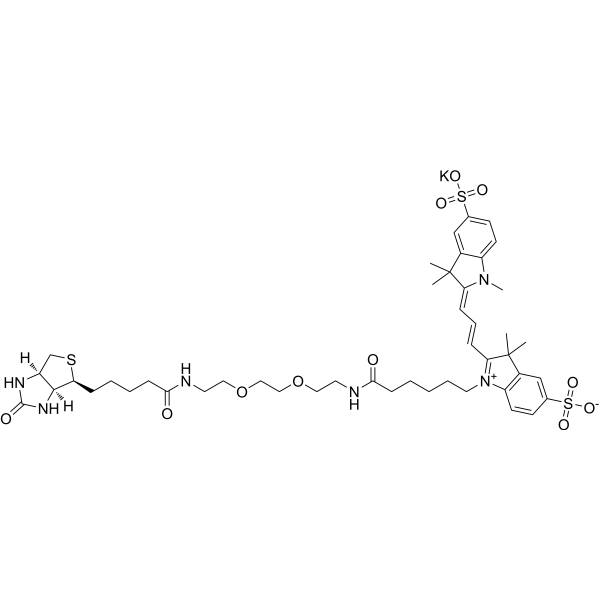 0 ImagesCat. No.: HY-D1870Sulfo-Cy3-PEG3-biotin potassium is a biotin-modified derivative of Cy3 (Cyanine3) (HY-D0822) dye containing a TCO group. The TCO group of Sulfo-Cy3-PEG3-biotin potassium reacts with the tetrazine functional group in highly specific click chemistry to form a covalent bond. Thus, Sulfo-Cy3-PEG3-biotin potassium can be covalently bound to some biomolecules (especially antibodies, proteins, etc.) to track their location and dynamic changes in biological samples. And because it is labeled with biotin, it is often used in affinity chromatography experiments, such as immunoprecipitation.
-
FAM labled LSP-GR3 sodium
 0 ImagesCat. No.: HY-148828DFAM labled LSP-GR3 sodiumis a FAM labled LSP-GR3 sodium.
-
Chlorophenol red
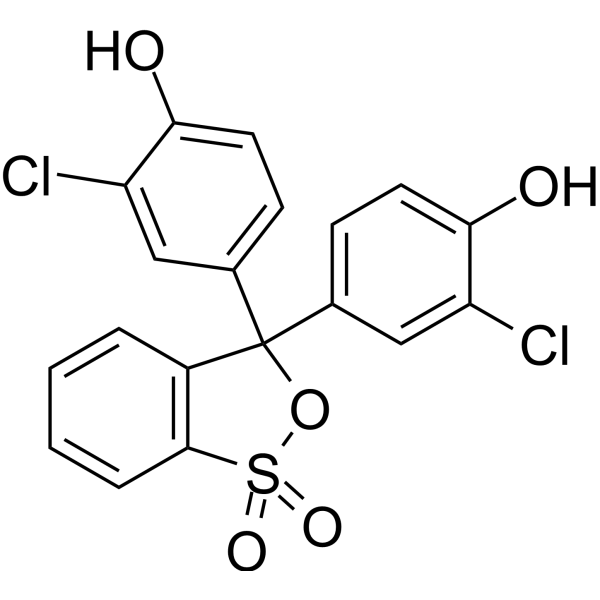 0 ImagesChlorophenol Red is a sulfonephthalein pH indicator dye and chromogenic beta-galactosidase substrate. Chlorophenol Red enables the detection of coliform bacteria through β-galactosidase activity. Chlorophenol Red can be used in research on drinking water quality monitoring.

-
Ctrl-CF4-S2
 0 ImagesCat. No.: HY-150087CAS No.: 2365532-65-4Ctrl-CF4-S2 is a chemically modified control probe of the copper probe Copper Fluor-4 (CF4, HY-150086), in which two of the four thioether ligands in CF4 (HY-150086) are replaced with methylene groups. CF4 (HY-150086) is a fluorescent probe used for detecting the presence and distribution of copper ions, whereas Ctrl-CF4-S2 does not respond to copper ions. This allows it to eliminate background signals from copper, thereby helping to determine whether the signals from CF4 (HY-150086) accurately reflect the dynamic changes of copper ions in biological systems
-
Umbelliferone-13C6
 0 ImagesCat. No.: HY-W777393CAS No.: 1189992-05-9Synonyms: 7-Hydroxycoumarin-13C6; Hydrangin-13C6; NSC 19790-13C6Umbelliferone-13C6 (7-Hydroxycoumarin-13C6) is the 13C-labeled Umbelliferone (HY-N0573). Umbelliferone (7-Hydroxycoumarin), a natural orally active product of the coumarin family, is a fluorescing compound which can be used as a sunscreen agent. Umbelliferone induces cell cycle arrest, apoptosis and DNA fragmentation in HepG2 cells. Umbelliferone exhibits significant anticancer effects. Umbelliferone attenuates the alteration characteristics of allergic airway inflammation. Umbelliferone displays the neuroprotective effects and cross the blood-brain barrier. Umbelliferone exhibits anti-inflammatory and antioxidant effects in chronic alcohol-fed rats.
-
HS-CyBz
 0 ImagesCat. No.: HY-D3133CAS No.: 2410296-16-9HS-CyBz is a Fluorescent probe for H₂S detection, enabling ratiometric optical/photoacoustic dual-modality in/ex vivo imaging. Its detection mechanism relies on nucleophilic substitution of its benzoic ester group by HS⁻, which releases an enolic meso-hydroxyltricarboheptamethine cyanine that then undergoes keto-enol tautomerization to form Cy-ketone; this tautomerization causes distinct shifts in absorption and emission spectra, producing a ratiometric response that reduces interferences from tissue scattering, autofluorescence, and probe concentration. In its initial state, HS-CyBz has an excitation wavelength of 595 nm, with emission bands centered at 805 nm (main) and 630 nm (minor); upon reaction with H₂S, the 805 nm emission band decreases while the 630 nm band drastically increases, and its absorption spectrum shows a sharp band at 775 nm and a shoulder band at 708 nm, which decrease upon H₂S reaction with a minor increase at 850 nm and an isosbestic point at 825 nm. For in vivo optical imaging, excitation at 560 nm is used with emission channels at 620 nm and 790 nm, while in vivo photoacoustic imaging uses excitation at 775 nm and 825 nm. The detection limit of HS-CyBz for H₂S is 0.5 μM, and it shows high selectivity, with only H₂S inducing a distinct enhancement of the emission ratio F₆₃₀/F₈₀₅ and PA ratio PA₈₂₅/PA₇₇₅, while other biochemical species including cations, anions, reactive oxygen species, biothiols, and carboxylesterase trigger only minor changes and do not interfere with H₂S sensing. Tail intravenous injection of HS-CyBz leads to accumulation in the liver of mice, and it can be used to verify endogenous H₂S upregulation triggered by S-adenosyl-L-methionine via ratiometric optical/photoacoustic imaging.
-
Chromotrope 2R
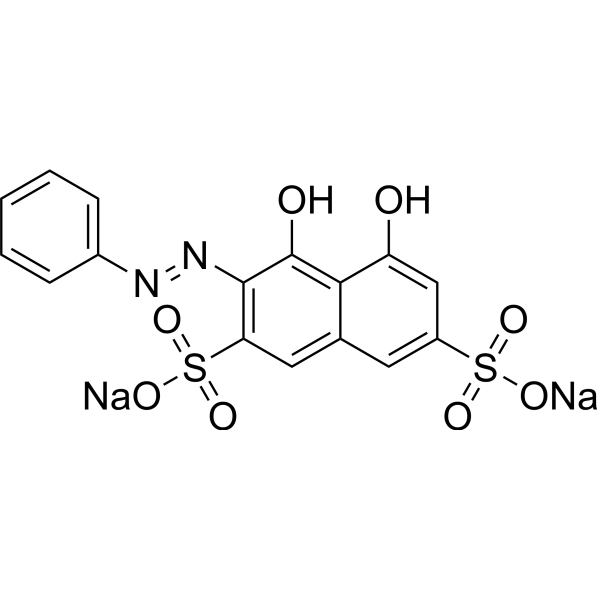 0 ImagesCat. No.: HY-W133997CAS No.: 4197-07-3Chromotrope 2R can be used as a chromogenic analytical probe for the quantification of proteins. Basic proteins stained red and the peak wavelength red shifts from 501.6 nm to 567 nm.

-
Amaranth free acid
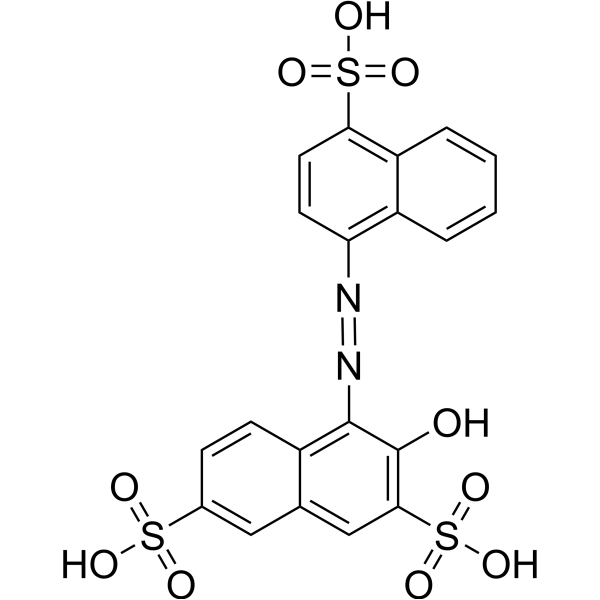 0 ImagesSynonyms: Acid Red 27 free acid; Azorubin S free acid; FD & C Red Dye No. 2 free acidAmaranth free acid (Acid Red 27 free acid; Azorubin S free acid; FD & C Red Dye No. 2 free acid) is a multifunctional dye. Dyes are important tools in biological experiments. They can help researchers observe and analyze cell structures, track biomolecules, evaluate cell functions, distinguish cell types, detect biomolecules, study tissue pathology and monitor microorganisms. Their applications range from basic scientific research to clinical A wide range of diagnostics. Dyes are also widely used in traditional fields such as textile dyeing, as well as in emerging fields such as functional textile processing, food pigments and dye-sensitized solar cells.
-
AF647-NHS ester trisodium
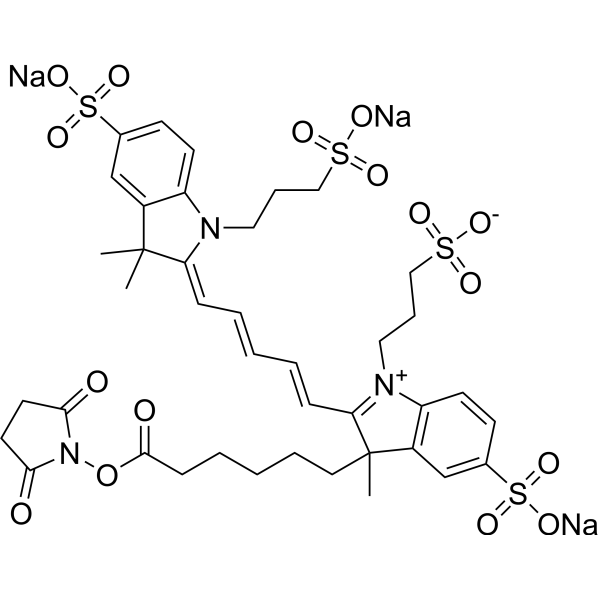 0 ImagesCat. No.: HY-D1119BAF647-NHS ester (trisodium) is an analogue of Alexa Fluor 647 (AF647) (HY-D1119). NHS ester can covalently bind to molecules with amino groups (such as proteins, antibodies, etc.). AF647 is a bright, far-red fluorescent dye with an excitation wavelength (λex) of 635 nm (conventional fluorescence detection)/620 nm (instantaneous detection). Storage: protect from light.
-
ATTO 514 NHS ester
 0 ImagesCat. No.: HY-D2026ATTO 514 NHS ester is a new fluorescent marker based on the Rhodamine structure. It has strong absorption, high fluorescence quantum yield, high thermal stability and photochemical stability, and is suitable for single molecule detection and high-resolution microscopy. ATTO 514 NHS ester is an NHS ester derivative of ATTO 514 that can be used to label proteins or antibodies.
-
12-AS
 0 ImagesCat. No.: HY-D3012CAS No.: 30536-60-812-AS is a 9-anthracenoxy fatty acid probe. 12-AS’s fluorescence decay is not a single index, and its lifetime increases with the red shift of the emission wavelength.
-
Luxol Fast Blue Staining Solution
 0 ImagesCat. No.: HY-DY2025Luxol Fast Blue Staining Solution is a copper phthalocyanine-based histological dye that specifically binds to lipid-rich structures such as myelin sheaths and mitochondria, staining them blue-green. Luxol Fast Blue Staining Solution is suitable for displaying myelin sheaths in neural tissues, staining mitochondria in tissues such as kidney/liver, and staining sections for phase contrast microscopy. It is often used in combination with PAS, Phloxine or Cresyl Violet to enhance structural contrast.
-
FAM labled Rimigorsen sodium
 0 ImagesCat. No.: HY-177659CFAM labled Rimigorsen sodiumis a FAM labled Rimigorsen sodium.
-
N-(4-Anilino-1-naphthyl)maleimide
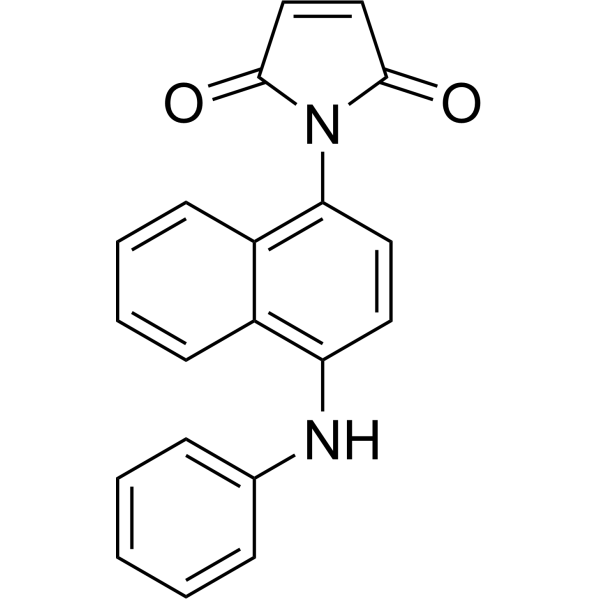 0 ImagesCat. No.: HY-D1526CAS No.: 50539-45-2N-(4-Anilino-1-naphthyl)maleimide is a fluorescent probe that can be used to detect thiol groups in proteins. N-(4-Anilino-1-naphthyl)maleimide reacts with thiol groups and immediately produces a stable fluorescent compound with the λex=355 nm, λem=448 nm.
-
SQM-NBD
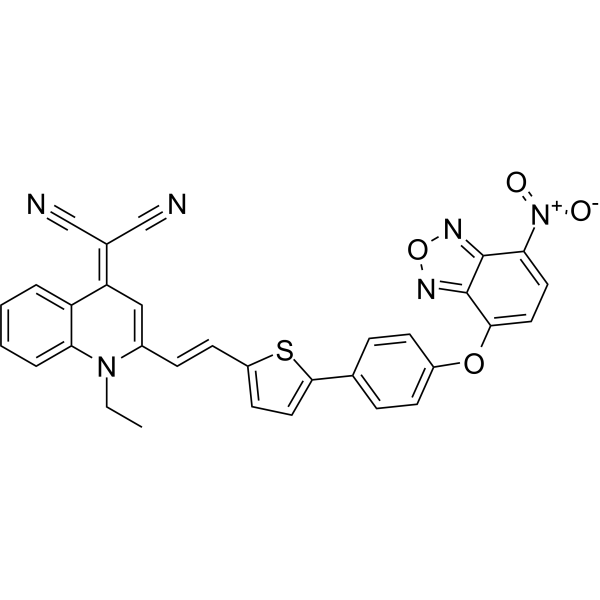 0 ImagesCat. No.: HY-147738CAS No.: 2786704-34-3SQM-NBD is a potent and selectiveAIE fluorescent probe. SQM-NBD exhibits excellent sensitivity to Cys and Hcy with the LOD of 54 nM and 72 nM, respectively.SQM-NBD has good cell permeability and low cytotoxicity. SQM-NBD has the potential for Cys/Hcy identification under physiological and pathological conditions.
-
Flutax-2
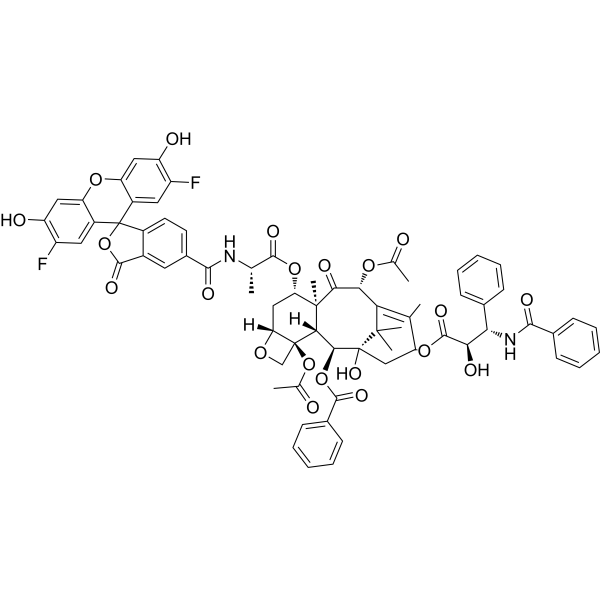 0 ImagesCat. No.: HY-162161CAS No.: 301844-13-3Flutax-2 is an active fluorescent derivative of Paclitaxel (HY-B0015) that binds to polymerized αβ-tubulin dimers. Flutax-2 is applicable for imaging microtubules in live cells, isolated cytoskeletons and parasites (Ex/Em=496/526 nm).
-
RB-PEG1000-DSPE
 0 ImagesCat. No.: HY-D2887BSynonyms: Rhodamine B-PEG1000-DSPERB-PEG1000-DSPE (Rhodamine B-PEG1000-DSPE) is a PEG phospholipid labeled Rhodamine B (HY-Y0016). RB-PEG1000-DSPE can be used to prepare liposomes or nanoparticles for nutrients delivery such as mRNA or DNA vaccine (Ex/Em=546/610 nm).




