



CD1d
CD1d is a nonclassical major histocompatibility complex class I-like molecule that presents endogenous and exogenous lipid antigens to CD1d-restricted T cells, particularly natural killer T (NKT) cells, thereby linking innate and adaptive immunity through rapid cytokine-mediated immune regulation[1][2]. Mechanistically, CD1d-dependent antigen presentation controls the activation of invariant NKT (iNKT) and type II NKT cell subsets, which recognize structurally diverse glycolipids and coordinate downstream responses involving dendritic cells, NK cells, B cells, and conventional T lymphocytes[3][4]. In mucosal tissues and other immune compartments, CD1d-mediated lipid sensing contributes to host defense, inflammatory regulation, and tissue immune homeostasis through specialized lipid antigen presentation pathways[2][5]. In disease models, CD1d-restricted NKT cells participate in antimicrobial immunity, tumor surveillance, autoimmunity, and inflammatory disorders, making the CD1d axis a widely used experimental platform for studying immune modulation and disease pathogenesis[3][6]. Compared with group 1 CD1 isoforms that primarily present lipid antigens to distinct T-cell populations, CD1d is the only group 2 CD1 molecule and exhibits a specialized functional relationship with NKT-cell activation and immune regulation[2]. In mice, the homologous proteins CD1d1 and CD1d2 display distinct biological roles, with evidence indicating differential contributions to NKT-cell development and function despite structural similarity[7]. For experimental applications, the glycolipid agonist α-galactosylceramide (α-GalCer) remains a prototypical CD1d ligand that robustly activates iNKT cells and is extensively used to investigate antitumor immunity and CD1d-dependent immunotherapeutic strategies[3][4].
Références:
- [1]. Van Kaer L, et al. Mechanisms and Consequences of Antigen Presentation by CD1. Trends Immunol. 2016 Nov;37(11):738-754. doi: 10.1016/j.it.2016.08.011. Epub 2016 Sep 9. PMID: 27623113; PMCID: PMC5159200. [Content Brief]
- [2]. Kim S, et al. CD1-mediated immune responses in mucosal tissues: molecular mechanisms underlying lipid antigen presentation system. Exp Mol Med. 2023;55:1858-1871.
- [3]. King LA, et al. CD1d-Invariant Natural Killer T Cell-Based Cancer Immunotherapy: α-Galactosylceramide and Beyond. Front Immunol. 2018 Jul 2;9:1519. [Content Brief]
- [4]. Almeida CF, et al. Distinct CD1d docking strategies exhibited by diverse Type II NKT cell receptors. Nat Commun. 2019 Nov 20;10(1):5242. [Content Brief]
- [5]. De Libero G, et al. CD1 molecules: Beyond antigen presentation. Mol Immunol. 2024;170:1-8.
- [6]. Macho-Fernandez E, et al. The Extended Family of CD1d-Restricted NKT Cells: Sifting through a Mixed Bag of TCRs, Antigens, and Functions. Front Immunol. 2015 Jul 28;6:362. [Content Brief]
- [7]. Sundararaj S, et al. Differing roles of CD1d2 and CD1d1 proteins in type I natural killer T cell development and function. Proc Natl Acad Sci U S A. 2018 Feb 6;115(6):E1204-E1213. [Content Brief]
-
CD1d Produits associés (9)
Produits associés (9)

-
α-Galactosylceramide
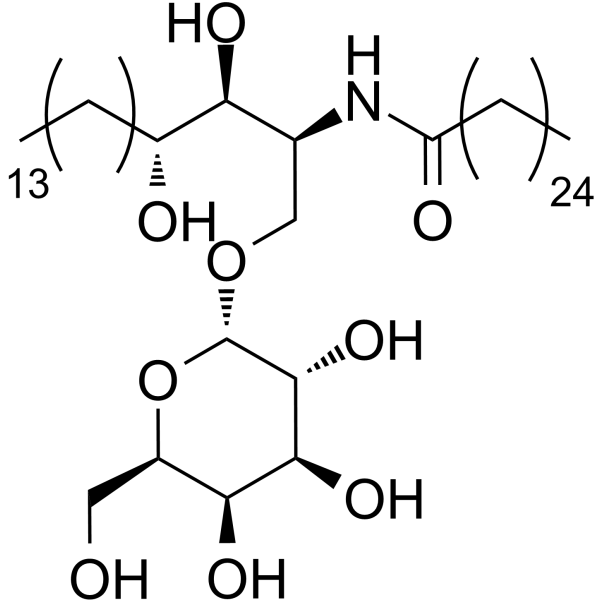 0 ImagesCat. No.: HY-102022CAS No.: 158021-47-7Synonyms: α-GalCer; KRN7000
-
Anti-Mouse CD38 Antibody (NIMR5)
 0 ImagesCat. No.: HY-P990273Anti-Mouse CD38 Antibody (NIMR5) is an anti-mouse CD38 IgG2a monoclonal antibody. Anti-Mouse CD38 Antibody (NIMR5) can activate the ERK signaling pathway and promote cell apoptosis. Anti-Mouse CD38 Antibody (NIMR5) can restore T cell function. Anti-Mouse CD38 Antibody (NIMR5) upregulates the expression of CD1d protein and enhances spleen cell proliferation, dendritic cell (DC) and natural killer T cell (NKT) expansion. Anti-Mouse CD38 Antibody (NIMR5) can be used for researches on cancer and immunology such as melanoma and colon cancer.
-
DPPE-PEG350
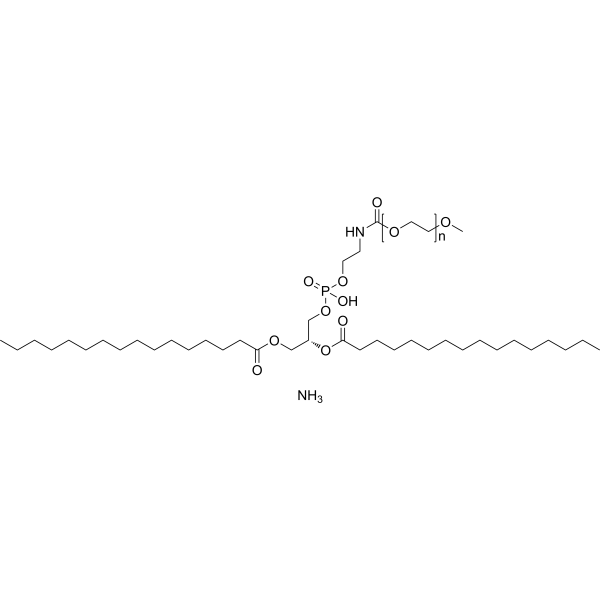 0 ImagesSynonyms: 16:0 PEG350 PE; 1,2-Dipalmitoyl-sn-glycero-3-phosphoethanolamine-N-[methoxy(polyethylene glycol)-350] ammoniumDPPE-PEG350 (16:0 PEG350 PE) is a CD1d lipid antagonist. DPPE-PEG350 blocks alpha-GalCer-dependent ERK tyrosine kinase phosphorylation in cells. DPPE-PEG350 inhibits cellular IL-4 and IFN-gamma production following alpha-GalCer stimulation. DPPE-PEG350 selectively antagonizes iNKT without affecting MHC class II-dependent OVA-specific Th2 responses. DPPE-PEG350 reduces MCP-1 and VCAM-1 protein expression and necrotic core formation in atherosclerotic lesions. DPPE-PEG350 can be used for research on asthma and atherosclerosis.
-
Anti-Mouse CD1d Antibody (1B1)
 0 ImagesCat. No.: HY-P992059Anti-Mouse CD1d Antibody (1B1) is an antibody targeting mouse CD1d (Kd=12.5 nM). By inserting into the lipid-binding groove of CD1d, Anti-Mouse CD1d Antibody (1B1) overlaps with the binding sites of type I and type II NKT cell receptors (TCR), thereby effectively blocking TCR-mediated interactions. Anti-Mouse CD1d Antibody (1B1) activates antigen-presenting cells such as dendritic cells and macrophages, induces them to release IL-12p70, and increases the levels of key cytokines including IL-12, IFN-γ and IFN-α in mouse serum. Anti-Mouse CD1d Antibody (1B1) can be used in studies related to renal cancer, breast cancer and colon adenocarcinoma. When combined with anti-DR5 or anti-CD137 antibodies and chemotherapeutic drugs, Anti-Mouse CD1d Antibody (1B1) exhibits significant tumor inhibitory and even eradication effects in mice.

-
GCS-12–6
 0 ImagesCat. No.: HY-175365GCS-12–6 is a potent Th2-selective NKT cell agonist targeting CD1d protein. GCS-12–6 is promising for research of autoimmune diseases (e.g., inflammatory bowel disease, multiple sclerosis).
-
Glycolipid C34
 0 ImagesCat. No.: HY-186103CAS No.: 1204401-08-0Glycolipid C34, α-GalCer (HY-102022) analog, is a CD1d-binding glycolipid antinfection agent. Glycolipid C34 mediates invariant natural killer T cell activation and increases the secretion of IFN-γ and IL-4. Glycolipid C34 promotes clearance of bacterial infections in murine models and enhances protective immunity against viral infections. Glycolipid C34 can be used for the research of bacterial infection, viral infection.

-
GCC-2
 0 ImagesCat. No.: HY-189459GCC-2 is a glycolipid. GCC-2 binds to CD1d and presents it to cells. GCC-2 induces Th1-biased cellular activation and IFN-γ production. GCC-2 inhibits antitumor activity in colon cancer tumor models and induces antigen-specific humoral immune responses. GCC-2 can be used for research on colon adenocarcinoma.



