



CD28
CD28, a cell surface glycoprotein receptor, predominantly expressed on activated T cells, belongs to the Ig superfamily and provides a critical co-stimulatory signal. Its ligands, CD80 and CD86, are typically found on the surface of antigen-presenting cells and can either bind CD28 or CTLA-4. CD28 interacts with the CD80 dimer with relatively high affinity and the CD86 monomer with lower affinity, mediating T cell co-stimulation in conjunction with T cell receptor (TCR) signals. CD28 drives critical intracellular biochemical events including unique phosphorylation and transcriptional signaling, metabolism, and the production of key cytokines, chemokines, and survival signals that are essential for long-term expansion and differentiation of T cells. Most importantly, treatment of mice with a soluble CD28 antagonist induced antigen-specific tolerance that prevented the progression of autoimmune diseases and organ graft rejection.
All Product Categories
-
CD28 Related Products (50)
Related Products (50)

-
Antibodies (8)
-
UR-1505
 0 ImagesUR-1505 is a nuclear factor of activated T cells (NF-AT) inhibitor. UR-1505 can suppress CD3/CD28 induced T cell proliferation, increase p27KIP levels, and induce G1/S cell cycle arrest. UR-1505 can also inhibit the production of IL-5 and IFN-γ in activated T cells. UR-1505 has immunomodulatory properties and can be used in the study of atopic dermatitis.
-
Renvistobart
 0 ImagesSynonyms: BMS-986207; ONO-4686Renvistobart is an immunoglobulin G1-κ, anti-[Homo sapiens TIGIT (T cell immunoreceptor with Ig domain and ITIM, VSIG9, VSTM3)] Homo sapiens monoclonal antibody.
-
Rozibafusp alfa
 0 ImagesCat. No.: HY-P99893CAS No.: 2143449-47-0Synonyms: AMG-570Rozibafusp alfa (AMG-570) is a humanized IgG2-κ monoclonal antibody targets ICOSL and BAFF. Rozibafusp alfa can be used for the research of systemic lupus erythematosus and other autoimmune diseases.
-
RG-6333
 0 ImagesCat. No.: HY-P991176Purity: 98.05%Synonyms: RO7443904RG-6333 is a bispecific agonist targeting CD19 and CD28. RG-6333 specifically recognizes and binds to the CD19 antigen on the surface of B-cell malignancies to locate tumor cells. RG-6333 activates T cells by binding to CD28, overcoming activation barriers to enhance anti-tumor immunity. RG-6333 can be used in the study of relapsed/refractory non-Hodgkin's lymphoma. The recommended isotype control is human IgG1 kappa, isotype control (HY-P99001).
-
SAR-442257
 0 ImagesCat. No.: HY-P991183Purity: ≥99.0%SAR-442257 is a trispecific T-cell engager and monoclonal antibody that binds to CD38, CD3 and CD28. SAR-442257 can target and bind to CD3 and CD28 on T cells, as well as CD38 expressed on tumor cells. SAR-442257 mediates T-cell activation, enhances T-cell activity, induces T-cell degranulation, and drives cytotoxicity against multiple myeloma cells. SAR-442257 functions via CD38 expression, and its in vitro activity correlates with CD38 expression on the surface of multiple myeloma cells. SAR-442257 can be used in studies related to multiple myeloma and relapsed/refractory multiple myeloma.
-
Reltecimod TFA
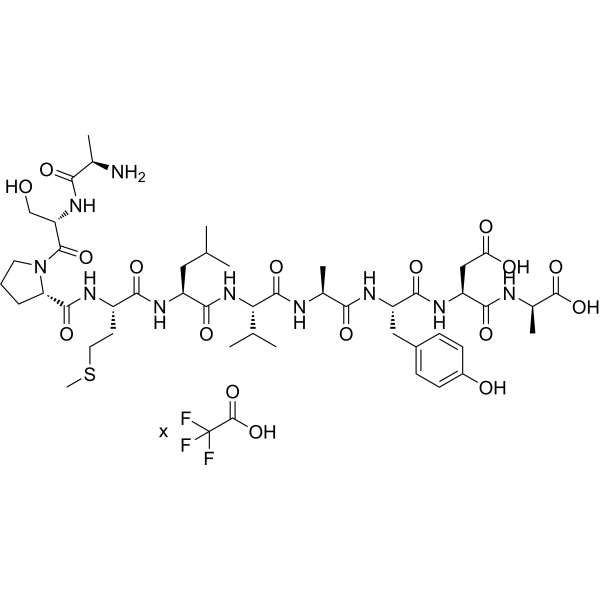 0 ImagesCat. No.: HY-P1698BPurity: 99.78%Synonyms: AB-103 TFAReltecimod (AB-103) TFA is a T-cell-specific surface glycoprotein CD28 (TP44) antagonist. Reltecimod TFA has beneficial effects against different bacterial infections, their exotoxins and endotoxins, and ionizing radiation. Reltecimod TFA modulates the inflammatory response by targeting and attenuating the critical CD28/B7-2 co-stimulatory pathway, without inhibiting it. Reltecimod TFA can be used to research necrotizing soft-tissue infections (NSTIs).

-
Anti-Mouse ICOS Antibody (7E.17G9)
 0 ImagesCat. No.: HY-P990237Purity: 98%Anti-Mouse ICOS Antibody (7E.17G9) is a mouse ICOS agonist IgG2b monoclonal antibody. Anti-Mouse ICOS Antibody (7E.17G9) can upregulate ICOS expression and enhance T cell function. Anti-Mouse ICOS Antibody (7E.17G9) can significantly inhibit the immune regulatory function of dendritic cells (DCs). Anti-Mouse ICOS Antibody (7E.17G9) can eliminate transplant tolerance. Anti-Mouse ICOS Antibody (7E.17G9) can be used for researches on inflammation conditions, cancer and xenotransplantation such as nephritis and pancreatic cancer.
-
CD28-IN-2
 0 ImagesCat. No.: HY-179648CAS No.: 1240857-57-1CD28-IN-2 is a selective CD28-B7 interaction (IC50: 22.4 μM) inhibitor that binds directly to CD28, with a Kd value of 24.1 μM. CD28-IN-2 inhibits CD28-driven immune activation and blocks T cell costimulation. CD28-IN-2 can be used for the study of antitumor immunity and immune-related disorders.
-
Anti-Mouse BTLA/CD272 Antibody (PK18.6)
 0 ImagesCat. No.: HY-P991833Anti-Mouse BTLA/CD272 Antibody (PK18.6) reacts with mouse B- and T-lymphocyte attenuator (BTLA). BTLA is an Ig superfamily member. Recommend Isotype Controls: Rat IgG1 kappa, Isotype Control (HY-P99979).
-
DDS5
 0 ImagesCat. No.: HY-176265CAS No.: 2871481-31-9DDS5 is a CD28 inhibitor with a kd of 175.57 µM. DDS5 significantly inhibits CD28-CD80 interaction (IC50: 332 µM). DDS5 can be used for research of immune-mediated diseases, including inflammatory bowel disease and rheumatoid arthritis.
-
Calcium influx inducer compound 634
 0 ImagesCat. No.: HY-169819CAS No.: 882291-37-4Calcium influx inducer compound 634 is a calcium influx inducer. Calcium influx inducer compound 634 (10 µM) enhances the release of extracellular vesicles (EVs) from mouse bone marrow-derived dendritic cells (mBMDCs). Calcium influx inducer compound 634 (10 µM) also increases the levels of CD86 and CD80 on the surface of mBMDCs, an effect that can be blocked by the calcium release-activated calcium channel inhibitor YM-58483 (HY-100831).
-
ICOS-IN-1
 0 ImagesCat. No.: HY-162810CAS No.: 1006002-58-9ICOS-IN-1 (compound 9) is an inhibitor of the interaction between ICOS and ICOS-L (IC50=29.38 μM) and has activity in recognizing immune checkpoints.
-
Maydispenoid B
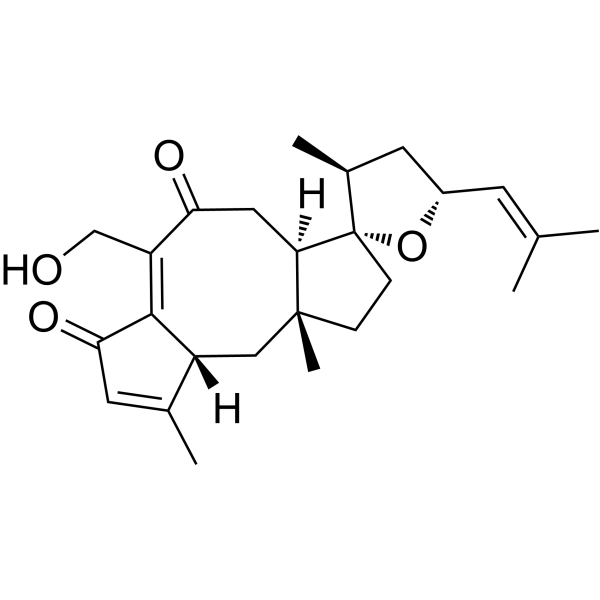 0 ImagesCat. No.: HY-N10446CAS No.: 3024647-69-3Maydispenoid B is a potent immunosuppressor. Maydispenoid B can inhibit anti-CD3/anti-CD28 mAbs activated and lipopolysaccharide activated murine splenocyte proliferation.
-
CD28-IN-1
 0 ImagesCat. No.: HY-175780CAS No.: 1465291-19-3CD28-IN-1 (Compound 19MS-5) is a CD28 inhibitor with a KD of 12.48 μM. CD28-IN-1 has a superior binding capacity to CD28 and potently inhibits CD28-B7 interactions. CD28-IN-1 inhibits CD28-driven immune activation and suppresses cytokine (IFN-γ, IL-2 and TNF-α) production in primary human T cells co-cultured with tumor spheroids and human epithelial tissues. CD28-IN-1 can be used for tumor immunity research.
-
Anti-Mouse BTLA/CD272 Antibody (PJ196)
 0 ImagesCat. No.: HY-P991835Anti-Mouse BTLA/CD272 Antibody (PJ196) reacts with mouse B- and T-lymphocyte attenuator (BTLA). BTLA is an Ig superfamily member. Recommend Isotype Controls: Rat IgG2a kappa, Isotype Control (HY-P990679).
-
ANB032
 0 ImagesCat. No.: HY-P992182ANB032 is a human IgG4 kappa BTLA agonist monoclonal antibody. ANB032 inhibits activated T cell proliferation and reduces secretion of inflammatory cytokines. ANB032 can be used for the research of atopic dermatitis[1].
-
CD28-IN-4
 0 ImagesCat. No.: HY-184441CAS No.: 3116073-35-6CD28-IN-4 is a selective CD28 inhibitor with a human IC50 of 231 nM and a human Kd of 344 nM. CD28-IN-4 binds to CD28, disrupts its interaction with CD80, blocks CD28-mediated co-stimulatory signal transduction, and reduces cytokine secretion in a human primary tumor-PBMC and epithelial tissue co-culture model. CD28-IN-4 can be used for cancer-related research.
-
CD28-IN-3
 0 ImagesCat. No.: HY-181507CAS No.: 850550-70-8CD28-IN-3 is a CD28 inhibitor with an IC50 of 7.80 μM and a Kd of 52.45 μM. CD28-IN-3 selectively blocks the CD28-B7 interaction, thereby inhibiting CD28-mediated costimulation. CD28-IN-3 suppresses the production of proinflammatory cytokines IFN-γ, IL-2 and TNF-α. CD28-IN-3 can be used in the research of checkpoint-resistant cancers.




