



Fluorescent Dye
Fluorescence is a phenomenon of photoluminescence in luminescence. When an atom is irradiated by light, some electrons around the nucleus jump from their original orbitals to higher energy orbitals under the influence of light energy, i.e., from the ground state to the first or second excited single-line state, etc. Due to the instability of the first or second excited singlet state, the electron returns from the excited singlet state to the ground state accompanied by released energy, resulting in fluorescence.
Fluorescent dyes can be covalently bound or physically adsorbed in the structure of the substance. The fluorescence properties allow for the characterization, localization and quantitative analysis of the labeled object. Fluorescent dyes have shown great potential for the detection of proteins, nucleic acids, cells, and immunoassays, attributed to the advantages in non-radioactive contamination, simple experimental operation and easy observation.
Fluorescent dyes have penetrated many fields such as pharmacology, physiology, environmental science, and information science, as well as functional studies of proteins and drug screening.
All Product Categories
-
Fluorescent Dye Related Products (4914)
Related Products (4914)

-
Antibodies (4)
-
BODIPY 650/665 NHS ester
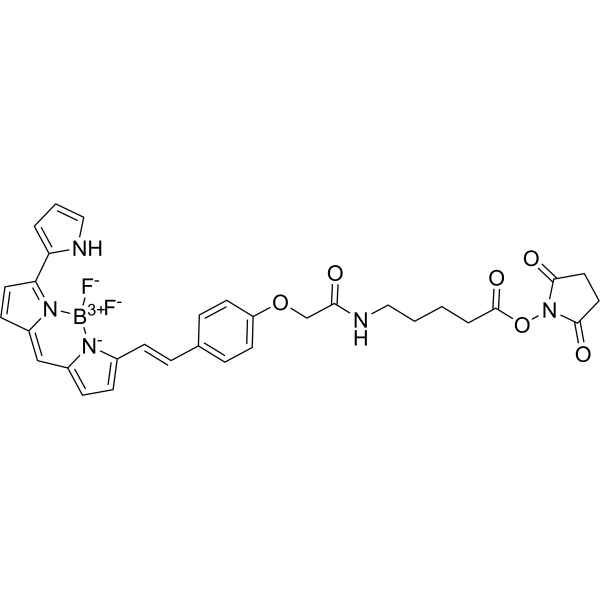 0 ImagesCat. No.: HY-D1692CAS No.: 1818267-45-6BODIPY 650/665 NHS ester is a bright far-red fluorescent dye. Its excitation/emission wavelengths are Ex/Em = 646/660 nm.
-
QPy-TPA
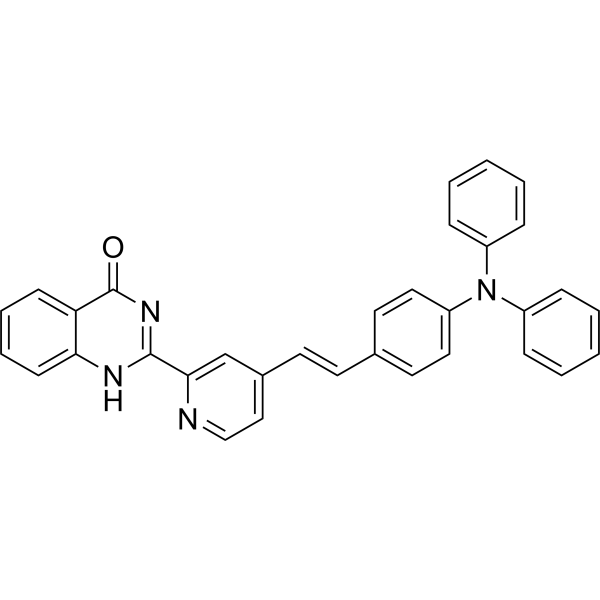 0 ImagesCat. No.: HY-163287CAS No.: 2738332-94-8QPy-TPA is a lipopjilc probes, which induces non-ferroptotic cell death and lipid dynamic regularion in B16 and HepG2 cells upon light irradiation. QPy-TPA reveals a maximum absorption wavelength of 400 nm and a maximum emission wavelength of 590 nm.

-
CDg4
 0 ImagesCat. No.: HY-D3193CAS No.: 1361203-33-9CDg4 is a green fluorescent probe and member of the fluorescent diamino-chalcone library.CDg4 binds to glycogen on mouse embryonic stem cell colony surfaces.
-
α-CN-TO
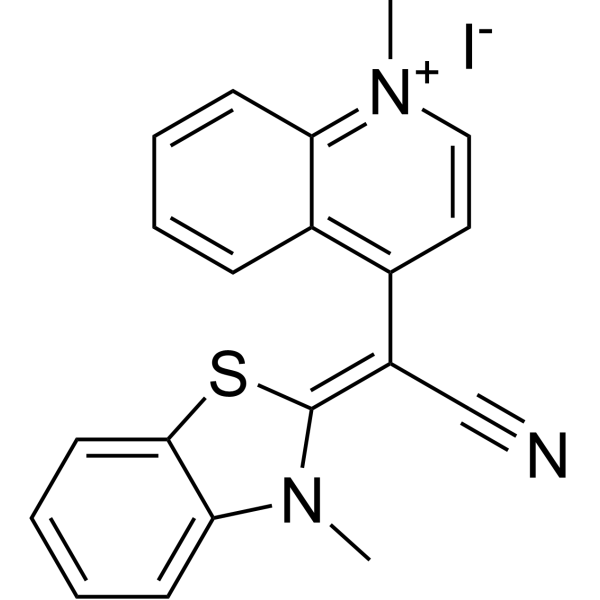 0 ImagesCat. No.: HY-D0712CAS No.: 1416045-49-2α-CN-TO is a multifunctional dye. Dyes are important tools in biological experiments. They can help researchers observe and analyze cell structures, track biomolecules, evaluate cell functions, distinguish cell types, detect biomolecules, study tissue pathology and monitor microorganisms. Their applications range from basic scientific research to clinical A wide range of diagnostics. Dyes are also widely used in traditional fields such as textile dyeing, as well as in emerging fields such as functional textile processing, food pigments and dye-sensitized solar cells.

-
Texas Red (solution)
 0 ImagesCat. No.: HY-DY1056CAS No.: 60311-02-6Texas Red (Sulforhodamine 101) (solution) is an amphoteric rhodamine red fluorescent dye (excitation/emission: 586/605 nm). Texas Red is used extensively for investigating neuronal morphology and acts as acell type-selective fluorescent marker of astrocytes bothin vivoand in slice preparations.
Solvent and concentration: DMSO: 10 mM
The 1 mL volume is defined as the base specification. All larger sizes correspond to incremental volumes of this base.
-
4-Methylumbelliferyl Decanoate
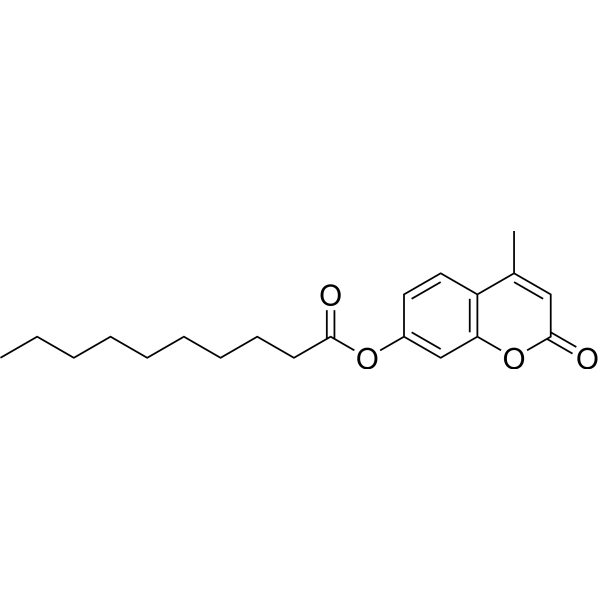 0 ImagesCat. No.: HY-W354821CAS No.: 66185-70-4Synonyms: 4-MUD4-Methyl-2-oxo-2H-1-benzopyran-7-yl decanoate is a fluorogenic substrate used to follow the hydrolytic activity of carboxylesterases.

-
BODIPY FL EDA free base
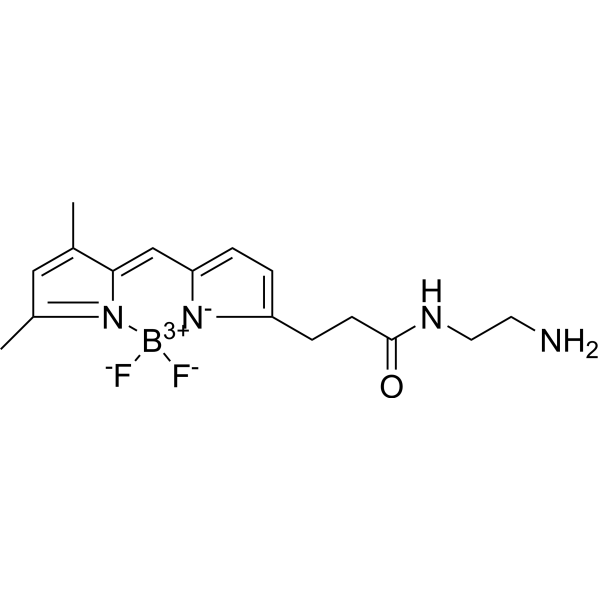 0 ImagesCat. No.: HY-114346ACAS No.: 220524-70-9ODIPY FL EDA free base is an amine-based, green fluorescent probe. The R-NH2 of ODIPY FL EDA free base can be coupled with aldehydes or ketones to form reversible Schiff base products. Convert to stable amine derivatives using reducing agents such as sodium borohydride or sodium cyanoborohydride. ODIPY FL EDA free base can be used to detect modified or normal deoxynucleotides and demonstrate DNA damage and genomic DNA methylation.


-
Human Serum Albumin-Rhodamine
 0 ImagesCat. No.: HY-D3027Synonyms: HSA-RhodamineHuman Serum Albumin-Rhodamine (HSA-Rhodamine) is a Rhodamine B (HY-Y0016) labeled serum albumin. Human Serum Albumin-Rhodamine plays an important role in fluorescent labeling, drug delivery research, and other fields (Ex/Em = 546/610 nm).
-
Concanavalin A-AF555
 0 ImagesCat. No.: HY-NP164JSynonyms: Con A-AF555Concanavalin A-AF555 (Con A-AF555) is an AF555-labled Concanavalin A (HY-P2149). Concanavalin A is a Ca2+/Mn2+-dependent and mannose/glucose-binding plant lectin. Concanavalin A binds the N- and O-glycosylated proteins of head and neck carcinoma cells glycoproteins.

-
Concanavalin A-TRITC
 0 ImagesCat. No.: HY-D3031Concanavalin A-TRITC is a TRITC (HY-D0791)-labled Concanavalin A (HY-P2149). Concanavalin A is a Ca2+/Mn2+-dependent and mannose/glucose-binding plant lectin. Concanavalin A binds the N- and O-glycosylated proteins of head and neck carcinoma cells glycoproteins (Ex/Em = 544/570 nm).
-
4-(9H-Carbazol-3-ylamino)phenol
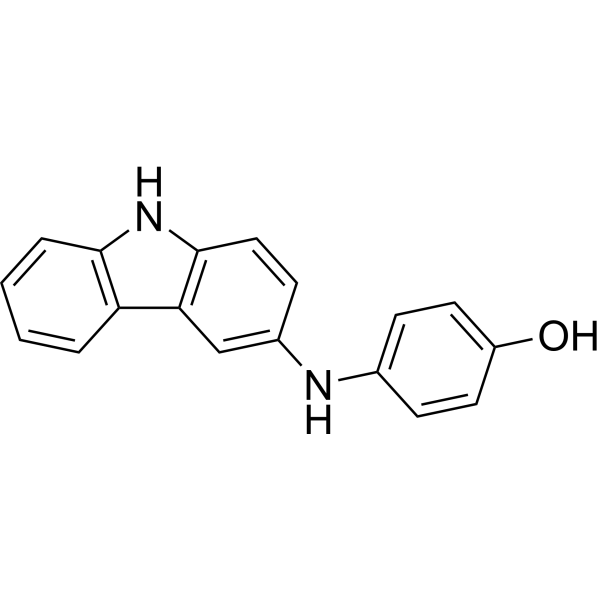 0 Images4-(9H-Carbazol-3-ylamino)phenol is a multifunctional dye. Dyes are important tools in biological experiments. They can help researchers observe and analyze cell structures, track biomolecules, evaluate cell functions, distinguish cell types, detect biomolecules, study tissue pathology and monitor microorganisms. Their applications range from basic scientific research to clinical A wide range of diagnostics. Dyes are also widely used in traditional fields such as textile dyeing, as well as in emerging fields such as functional textile processing, food pigments and dye-sensitized solar cells.

-
BODIPY 576/589 NHS ester
 0 ImagesCat. No.: HY-D3496Synonyms: BODIPY 576/589 Succinimidyl esterBODIPY 576/589 NHS ester (BODIPY 576/589 Succinimidyl ester) is an active fluorophore containing the BODIPY 576/589 fluorophore and an NHS ester. BODIPY 576/589 NHS ester can covalently couple red fluorescence to biomolecules containing primary amines (-NH2), such as proteins, antibodies, peptides, and oligonucleotides. BODIPY 576/589 NHS ester can also be used to prepare BODIPY 576/589-Met-tRNAfMet to achieve N-terminal co-translational labeling of nascent proteins (Ex/Em = 576/589 nm).




