



Fluorescent Dye
Fluorescence is a phenomenon of photoluminescence in luminescence. When an atom is irradiated by light, some electrons around the nucleus jump from their original orbitals to higher energy orbitals under the influence of light energy, i.e., from the ground state to the first or second excited single-line state, etc. Due to the instability of the first or second excited singlet state, the electron returns from the excited singlet state to the ground state accompanied by released energy, resulting in fluorescence.
Fluorescent dyes can be covalently bound or physically adsorbed in the structure of the substance. The fluorescence properties allow for the characterization, localization and quantitative analysis of the labeled object. Fluorescent dyes have shown great potential for the detection of proteins, nucleic acids, cells, and immunoassays, attributed to the advantages in non-radioactive contamination, simple experimental operation and easy observation.
Fluorescent dyes have penetrated many fields such as pharmacology, physiology, environmental science, and information science, as well as functional studies of proteins and drug screening.
All Product Categories
-
Fluorescent Dye Related Products (4914)
Related Products (4914)

-
Antibodies (4)

-
Medical fluorophore 33
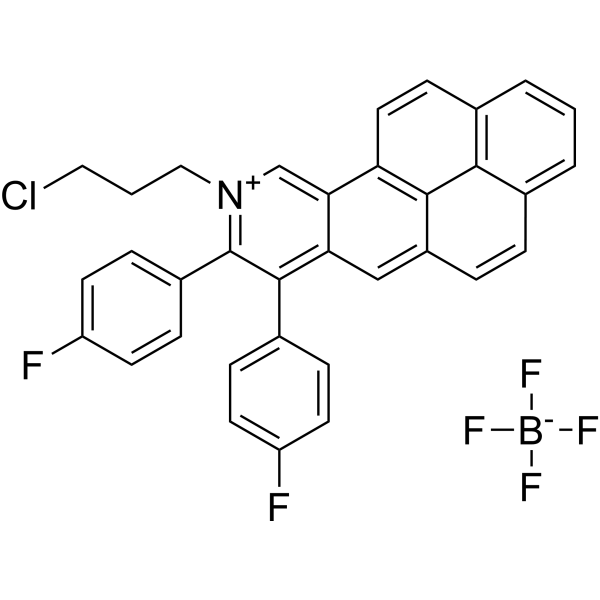 0 ImagesCat. No.: HY-D2095Medical fluorophore 33 is a novel quinoline-isoquinoline salt. Medical fluorophore 33 exhibits a strong fluorescent signal, good microsomal stability and high biocompatibility in vivo. Medical fluorophore 33 has antitumor activity in colorectal cancer mice.
-
BIN-3
 0 ImagesCat. No.: HY-D2988CAS No.: 3086791-47-8
-
Rhodamine B-Chitosan (MW 40000)
 0 ImagesCat. No.: HY-D3048DRhodamine B-Chitosan (MW 40000) is a Rhodamine B (HY-Y0016)-labeled chitosan with a molecular weight of 40,000. Rhodamine B-Chitosan (MW 40000) combines the polysaccharide properties of chitosan with the fluorescence properties of Rhodamine B, playing an important role in fields such as fluorescent labeling, cell imaging, and drug delivery research (Ex/Em = 546/610 nm).
-
IETDC
 0 ImagesCat. No.: HY-D3169CAS No.: 1476735-95-1IETDC is a caspase 8-responsive fluorescent probe. IETDC is cleaved by activated caspase 8 to release D-cysteine, which then reacts with 6-hydroxy-2-cyanobenzothiazole (HCBT) to form firefly luciferin in situ. IETDC must be used in conjunction with PCL-2 (HY-D3168) to detect the co-existence of hydrogen peroxide and caspase 8. IETDC is applicable to studies related to acute inflammation.
-
18:1-6:0 DNP-C11 BODIPY 505/515 TG
 0 ImagesCat. No.: HY-N15876CAS No.: 2260795-52-418:1-6:0 DNP-C11 BODIPY 505/515 TG is a fluorescently-labeled triglyceride that can be used to study the effects of phosphoinositides (Ex/Em = 495/503 nm).
-
Bacterial Sortase Substrate III, Abz/DNP
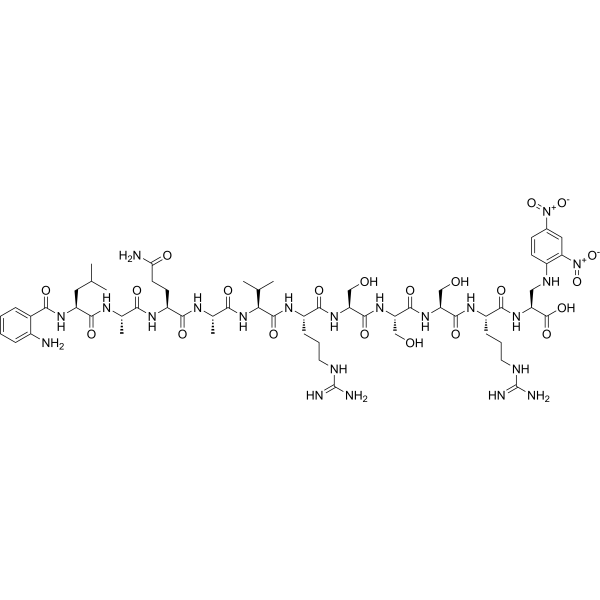
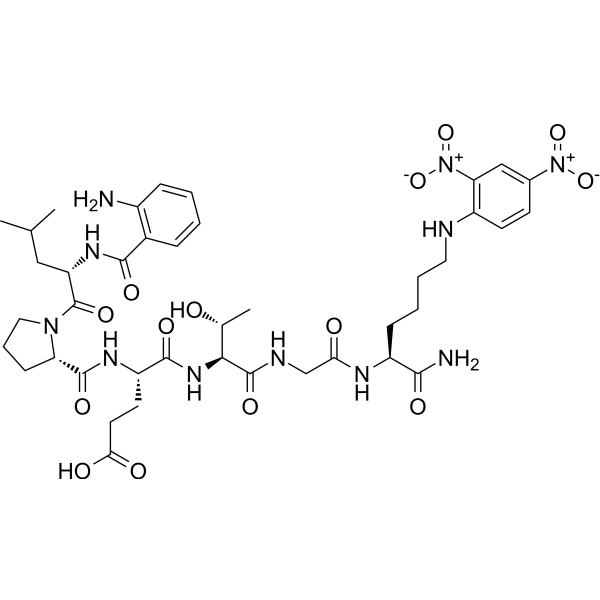 0 ImagesCat. No.: HY-P1883CAS No.: 2857862-12-3Bacterial Sortase Substrate III, Abz/DNP is a fluorescent peptide substrate. Bacterial Sortase Substrate III, Abz/DNP undergoes cleavage catalyzed by Staphylococcus aureus sortase A (SrtAΔN24) and Streptococcus pyogenes sortase A (SrtAΔN81), and catalyzes the formation of an amide bond between the carboxyl group of threonine and the amino group of the cell wall cross-bridge. Cleavage of this substrate can be detected at Ex/Em=320 nm/420 nm.
-
Ethyl benzo[6,7]-4-oxo-4H-quinolizine-3-carboxlate
![Ethyl benzo[6,7]-4-oxo-4H-quinolizine-3-carboxlate](https://file.medchemexpress.com/product_pic/hy-d1488.gif "Click to View Ethyl benzo[6,7]-4-oxo-4H-quinolizine-3-carboxlate Product Detail") 0 ImagesCat. No.: HY-D1488CAS No.: 101192-30-7Ethyl benzo[6,7]-4-oxo-4H-quinolizine-3-carboxlate (Compound 3) is a Mg2+ selective fluorescent indicator.
0 ImagesCat. No.: HY-D1488CAS No.: 101192-30-7Ethyl benzo[6,7]-4-oxo-4H-quinolizine-3-carboxlate (Compound 3) is a Mg2+ selective fluorescent indicator.
-
BMV109
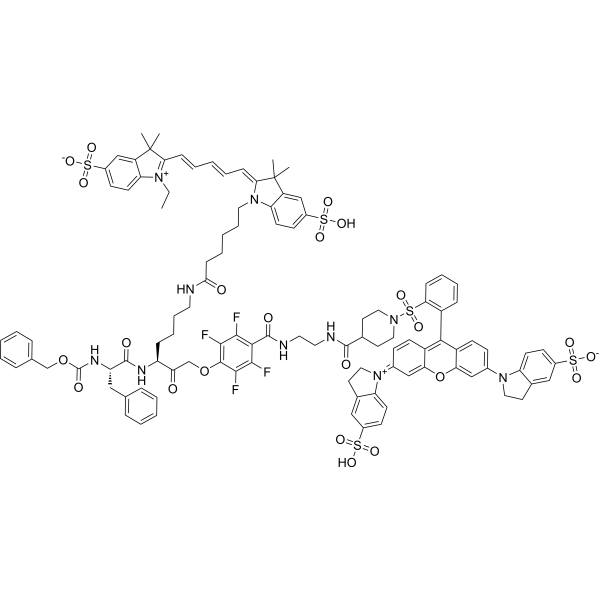 0 ImagesCat. No.: HY-149931CAS No.: 1458731-58-2BMV109 is a quenched probe that becomes fluorescent when cleaved and covalently bound by active cathepsin proteases. BMV109 can be exploited for tumor imaging.
-
Sulfo-Cy7 carboxylic acid
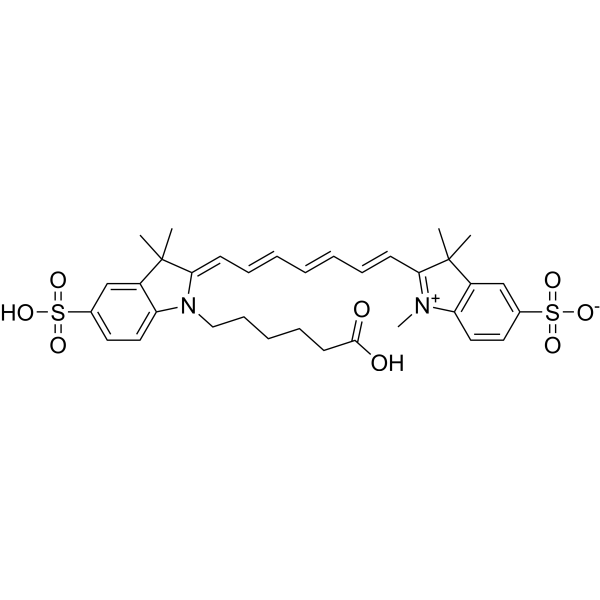 0 ImagesCat. No.: HY-D1881CAS No.: 1251915-04-4Sulfo-Cy7 carboxylic acid (compound 6m) is a cyanine dye.
-
FAM labled Obeversen sodium
 0 ImagesCat. No.: HY-145624CFAM labled Obeversen sodiumis a FAM labled Obeversen sodium.
-
Peanut Agglutinin (CY5)
 0 ImagesCat. No.: HY-NP146Peanut Agglutinin CY5 is a plant lectin that can be used as a probe to specifically bind biomolecules (such as polysaccharides, peptides, etc.). Peanut Agglutinin CY5 is a biological material or organic compound that can be used in life science research.
-
DiO (solution)
 0 ImagesCat. No.: HY-DY1010CAS No.: 34215-57-1DiO (solution) is a long-chain carbocyanine dye. Carbocyanine dyes are widely used as Di to label cells, organelles, liposomes, viruses and lipoproteins.
Solvent and concentration: DMSO: 5 mM
-
Dusquench3 azide
 0 ImagesCat. No.: HY-D3406Dusquench3 azide is a non-fluorescent dark quencher that absorbs emission from a nearby fluorophore without generating a fluorescent signal of its own. It contains an azide group, making it suitable for click chemistry reactions (CuAAC). Dusquench3 azide is primarily used in FRET-based nucleic acid probes, molecular beacons, and multiplex qPCR assays.

-
Pinkment-OAc
 0 ImagesCat. No.: HY-D3139CAS No.: 2245162-94-9Pinkment-OAc is an AND logic gate-based dual-analyte-dependent fluorescence inducer (Ex/Em = 545 nm/590 nm) that can be used for the simultaneous detection of hydrogen peroxide (H2O2) and esterases (e.g., porcine liver esterase PLE). Pinkment-OAc triggers a fluorescent response only when both esterase and hydrogen peroxide are present.
-
RU 45196
 0 ImagesCat. No.: HY-120948CAS No.: 121548-81-0RU 45196 is an 11 beta-substituted 19-norsteroid of the estra-4,9-diene series. RU 45196 displays fluorescence properties (excitation at 480 nm, emission at 525 nm) as well as high binding affinities for the glucocorticoid and progesterone receptors.
-
1,4-Diacetoxy-2,3-dicyanobenzene
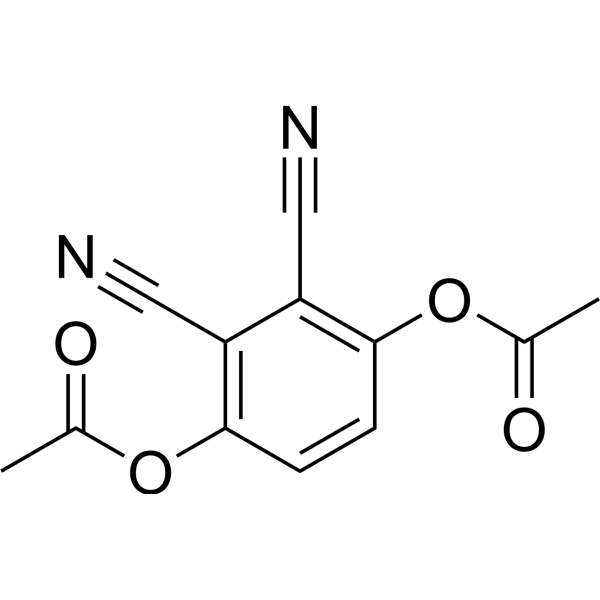 0 ImagesCat. No.: HY-W411215CAS No.: 83619-73-21,4-Diacetoxy-2,3-dicyanobenzene is a cell-permeable fluorescent probe. 1,4-Diacetoxy-2,3-dicyanobenzene crosses the cell membrane and is cleaved by cytosolic esterases to the fluorescent pH indicator 2,3-dicyano-hydroquinone (DCH). 1,4-Diacetoxy-2,3-dicyanobenzene can be used to monitor intracellular pH.
-
FAM labled Xalnesiran sodium
 0 ImagesCat. No.: HY-145638DSynonyms: FAM labled RO7445482 sodiumFAM labled Xalnesiran sodiumis a FAM labled Xalnesiran sodium.




