



Fluorescent Dye
Fluorescence is a phenomenon of photoluminescence in luminescence. When an atom is irradiated by light, some electrons around the nucleus jump from their original orbitals to higher energy orbitals under the influence of light energy, i.e., from the ground state to the first or second excited single-line state, etc. Due to the instability of the first or second excited singlet state, the electron returns from the excited singlet state to the ground state accompanied by released energy, resulting in fluorescence.
Fluorescent dyes can be covalently bound or physically adsorbed in the structure of the substance. The fluorescence properties allow for the characterization, localization and quantitative analysis of the labeled object. Fluorescent dyes have shown great potential for the detection of proteins, nucleic acids, cells, and immunoassays, attributed to the advantages in non-radioactive contamination, simple experimental operation and easy observation.
Fluorescent dyes have penetrated many fields such as pharmacology, physiology, environmental science, and information science, as well as functional studies of proteins and drug screening.
All Product Categories
-
Fluorescent Dye Related Products (4914)
Related Products (4914)

-
Antibodies (4)
-
FAM hydrazide,5-isomer
 0 ImagesCat. No.: HY-132263CAS No.: 2183440-64-2FAM hydrazide, 5-isomer is a Fluorescein dye linker containing a hydrazide group. Fluorescein is a universal dye. Hydrazide moieties react with aldehydes to form semi-permanent hydrazone bonds.
-
CAL Fluor Red 635 Phosphoramidite
 0 ImagesCat. No.: HY-W1061591CAS No.: 1206197-75-2CAL Fluor Red 635 Phosphoramidite is a Phosphoramidite labeled CAL Fluor Red 635. CAL Fluor Red 635 Phosphoramidite can be used for oligonucleotide synthesis research.
-
Cy3 labled SSOe26 sodium
 0 ImagesCat. No.: HY-158829CCy3 labled SSOe26 sodium is a Cy3 labled SSOe26 sodium.
-
Disperse blue 291G
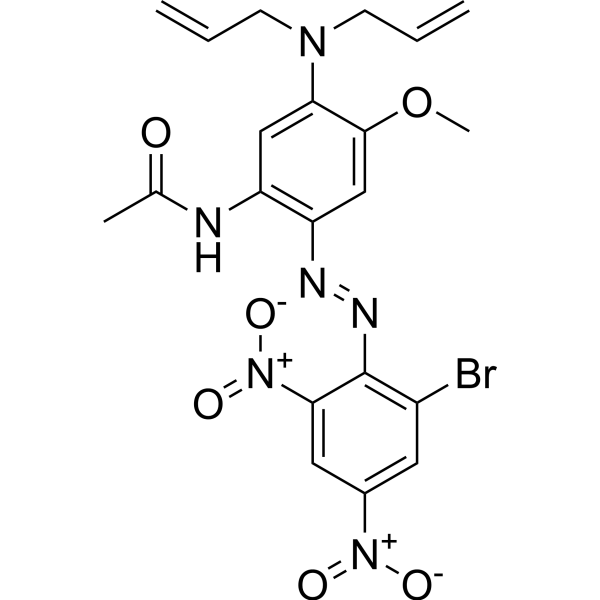 0 ImagesCat. No.: HY-D0565CAS No.: 51868-46-3Disperse blue 291G is a blue dye commonly used for fiber dyeing.
-
Disperse blue 165:1
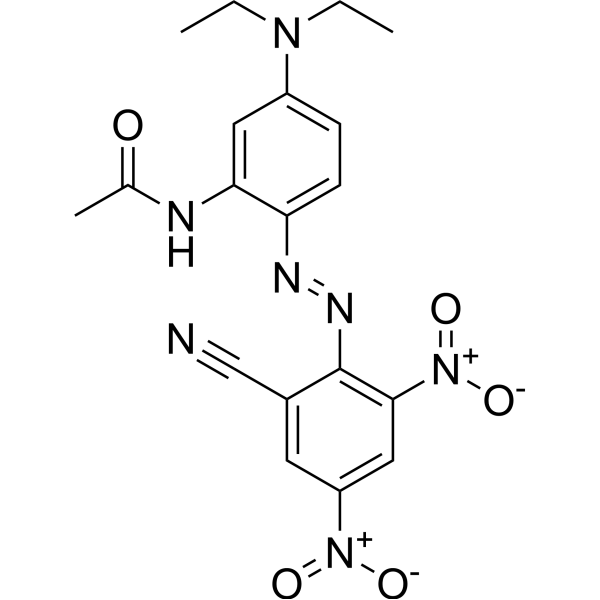 0 ImagesCat. No.: HY-D0533CAS No.: 24170-60-3Disperse blue 165:1 is a blue dye commonly used for fiber dyeing.
-
Pigment yellow 194
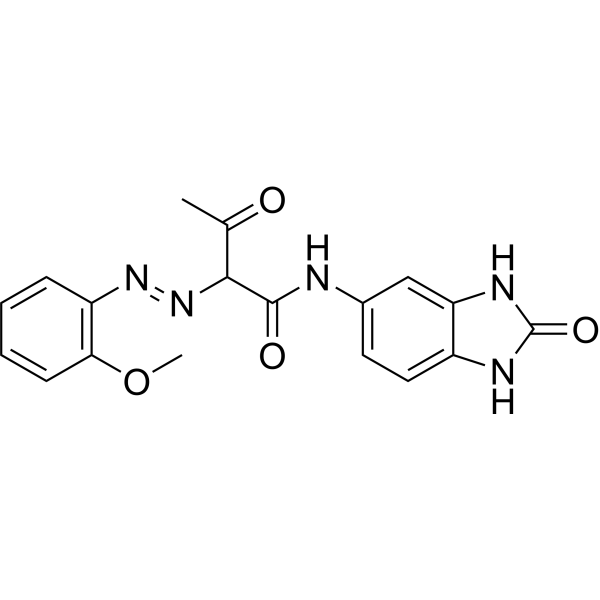 0 ImagesCat. No.: HY-D0734CAS No.: 82199-12-0Pigment yellow 194 is a disazomethine dye with solid-state fluorescence.a biologically active chemical.
-
Asante potassium green-1 AM
 0 ImagesCat. No.: HY-D2482CAS No.: 1369302-18-0Synonyms: APG-1 AMAsante potassium green-1 AM (APG-1 AM) is a cell-permeable K+-sensitive fluorescent indicator and potassium ion indicator that exhibits minimal interference from Na+ and pH at physiologically relevant intracellular levels. Asante potassium green-1 AM enables non-invasive monitoring and quantitative analysis of intracellular potassium ion concentrations (Ex/Em = 522/547 nm).
-
Cy5 HA biotin 3000
 0 ImagesCat. No.: HY-D2653Cy5 HA biotin 3000 is a biotinylated hyaluronic acid labeled with CY5 (HY-D0821). Cy5 HA biotin 3000 is widely used for cell imaging and in vivo imaging of shallow tissues (Ex/Em = 633/670 nm).
-
C.I. Acid red 57
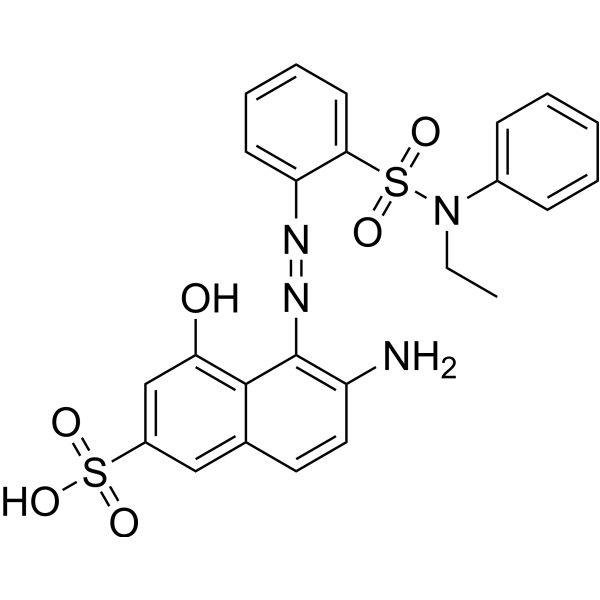 0 ImagesCat. No.: HY-D0477CAS No.: 12217-34-4C.I. Acid red 57 is an acid red dye that can be adsorbed and removed by bentone clay.
-
Cy7 HA MA (MW 100000)
 0 ImagesCat. No.: HY-D2685Cy7 HA MA (MW 100000) is a hyaluronic acid methacrylate labeled with CY7 (HY-D0825). Cy7 HA MA (MW 100000) is widely used in the fields of biolabeling and imaging, drug delivery and tissue engineering and regenerative medicine (Ex/Em = 740/770 nm).
-
(Z)-Thiazole Orange iodide
 0 ImagesCat. No.: HY-D0150ACAS No.: 2394903-71-8(Z)-Thiazole Orange iodide is an asymmetric cyanine dye whose fluorescence highly depends on the local environment.(Z)-Thiazole Orange iodide is essentially dark in solution; however, its fluorescence increases a thousandfold when (Z)-Thiazole Orange iodide is introduced into double-stranded DNA and RNA (dsDNA or dsRNA). The maximum absorption of Thiazole Orange in complex with DNA is 509 nm, and the maximum emission is 532 nm. Thiazole Orange solution is widely used for determining the percentage of reticulocytes in human peripheral blood with microscopy and flow cytometry.
-
FAM labled AFP aptamer sodium
 0 ImagesCat. No.: HY-160042BFAM labled AFP aptamer sodiumis a FAM labled AFP aptamer sodium.
-
Cy7 HA MA (MW 3000)
 0 ImagesCat. No.: HY-D2681Cy7 HA MA (MW 3000) is a hyaluronic acid methacrylate labeled with CY7 (HY-D0825). Cy7 HA MA (MW 3000) is widely used in the fields of biolabeling and imaging, drug delivery and tissue engineering and regenerative medicine (Ex/Em = 740/770 nm).
-
BP Light 550 carboxylic acid
 0 ImagesCat. No.: HY-D2754CAS No.: 1638197-36-0BP Light 550 acid is a vibrant orange-to-red fluorochrome with better performance t han other rhodamine derivatives, including BP Fluor 555, TRITC, and Cy3 dye for fluorescent applications. The high water solubility of BP Light Fluors means that a high dye-to-protein ratio can be attained without causing precipitation of the conjugates.
-
WSP2
 0 ImagesCat. No.: HY-D3300CAS No.: 1593024-71-5WSP2 (compound 7) is a turn-on fluoresonance probe that can be used for the detection of sulfane sulfur species.
-
ADOS
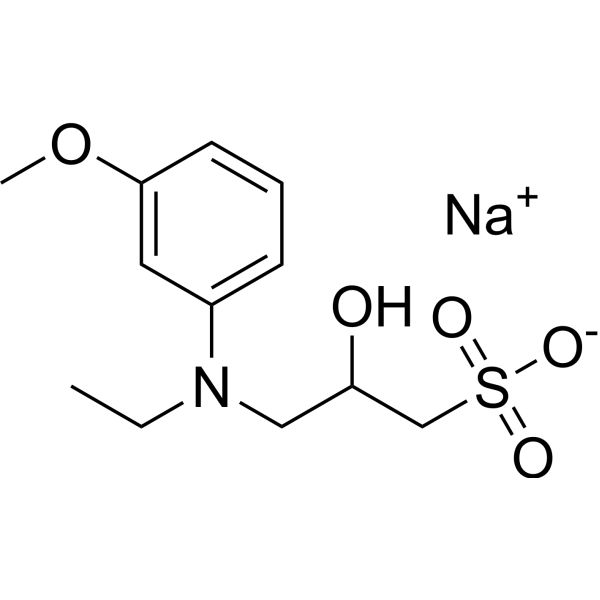 0 ImagesCat. No.: HY-15903CAS No.: 82692-96-4ADOS(82692-96-4) is a biochemical reagent/chromogenic reagent.
-
Acid red 119
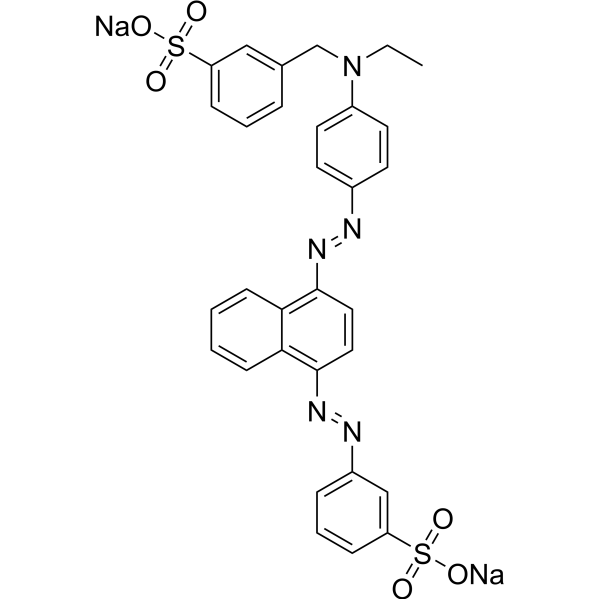 0 ImagesCat. No.: HY-D0651CAS No.: 70210-06-9Acid red 119 is an acid red dye that can be removed from aqueous solutions when polyaluminum chloride (PAC) and polyaluminum chloride sludge (PACS) are used as coagulants.
-
Alizarin complexone (Standard)
 0 ImagesCat. No.: HY-121075RCAS No.: 3952-78-1Alizarin complexone (Standard) is the analytical standard of Alizarin complexone (HY-121075). This product is intended for research and analytical applications. Alizarin complexone is a calcium-binding fluorescent dye. Alizarin complexone stains mineralized areas of bone by binding to calcium crystals. Alizarin complexone inhibits the reverse transcriptase activity of RAV-2, HIV-1, and RSV with IC50 values of 3.8 μg/mL, 45 μg/mL, and 100 μg/mL, respectively. Alizarin complexone exhibits antiviral activity against HIV-1 and RSV. Alizarin complexone delays RSV-induced tumor induction in chickens.
-
BP Fluor 350 NHS ester
 0 ImagesCat. No.: HY-169754CAS No.: 200554-19-4BP Fluor 350 NHS ester is an amine reactive, water soluble, blue emitting dye used to specifically and efficiently modify primary amines at pH 7-9 to form stable covalent amide bonds.




