



mAChR
Muscarinic acetylcholine receptor
mAChRs (muscarinic acetylcholine receptors) are acetylcholine receptors that form G protein-receptor complexes in the cell membranes of certainneurons and other cells. They play several roles, including acting as the main end-receptor stimulated by acetylcholine released from postganglionic fibersin the parasympathetic nervous system. mAChRs are named as such because they are more sensitive to muscarine than to nicotine. Their counterparts are nicotinic acetylcholine receptors (nAChRs), receptor ion channels that are also important in the autonomic nervous system. Many drugs and other substances (for example pilocarpineand scopolamine) manipulate these two distinct receptors by acting as selective agonists or antagonists. Acetylcholine (ACh) is a neurotransmitter found extensively in the brain and the autonomic ganglia.
mAChR Isoform Specific Products
All Product Categories
-
mAChR Inhibitors
(115)
View all products
-
mAChR Agonists
(147)
View all products
-
mAChR Antagonists
(320)
View all products
-
mAChR Activators
(20)
View all products
-
mAChR Modulators
(48)
View all products
-
mAChR Inducer
(1)
View all products
-
mAChR Controls
(9)
View all products
-
mAChR Ligands
(10)
View all products
-
mAChR Related Products (722)
Related Products (722)

-
Antibodies (2)
-
mAChR Isoform Comparison
-
VU0357017
 0 ImagesCat. No.: HY-19752CAS No.: 1135681-23-0Synonyms: CID-25010775 free baseVU0357017 (CID-25010775) is a potent, selective and brain-penetrant allosteric agonist of M1 muscarinic acetylcholine receptor, with an EC50 of 477 nM. VU0357017 is highly selective for M1 and has no activity at M2-M5 up to the highest concentrations tested (30 μM). VU0357017 can be used for the research of Alzheimer’s disease and schizophrenia.
-
Sabcomeline
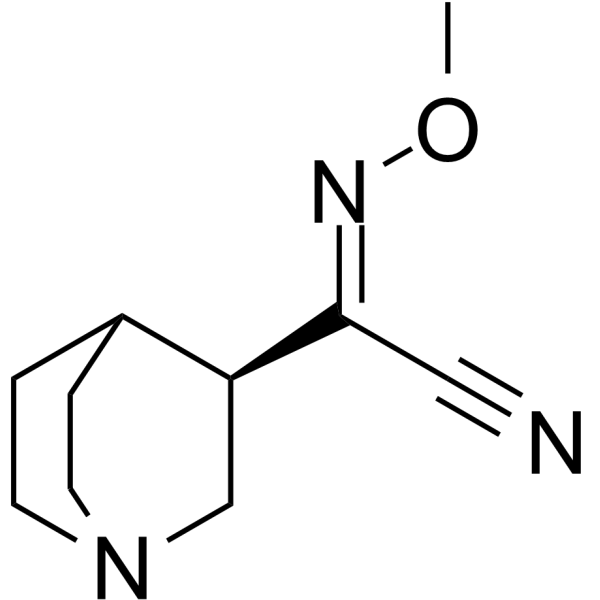 0 ImagesCat. No.: HY-106432CAS No.: 159912-53-5Synonyms: SB-202026; MemricSabcomeline (SB-202026) is a potent and functionally selective muscarinic M1 receptor partial agonist that improve cognition. Sabcomeline can be used for Alzheimer's disease research.
-
trans-Cevimeline hydrochloride
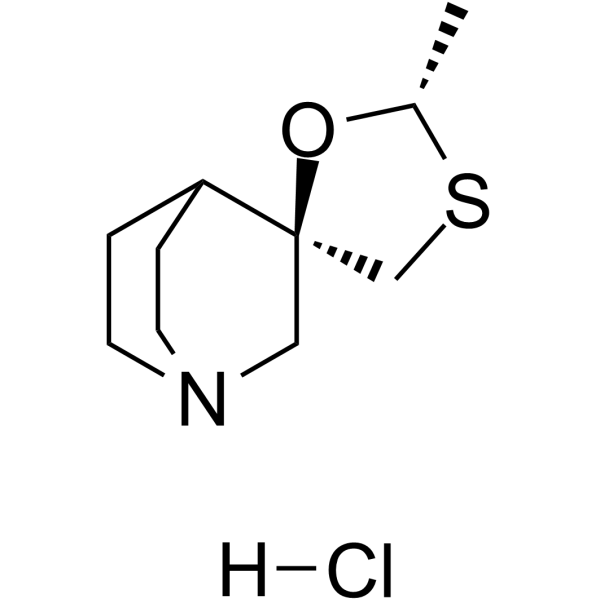 0 ImagesCat. No.: HY-116459CAS No.: 107220-29-1Synonyms: AF102A hydrochlorideTrans-Cevimeline (AF102A) (hydrochloride), as a trans-isomer of AF102B, is a M1 selective cholinergic agonist. Trans-Cevimeline (AF102A) (hydrochloride) can be used for the research of Alzheimer's disease.
-
Methacholine chloride (Standard)
 0 ImagesMethacholine (chloride) (Standard) is the analytical standard of Methacholine (chloride). This product is intended for research and analytical applications. Methacholine (Acetyl-β-methylcholine) choride is a potent muscarinic-3 (M3) agonist. Methacholine choride acts directly on acetylcholine receptors on smooth muscle causing bronchoconstriction and airway narrowing. Methacholine choride shows a high sensitivity to identify bronchial hyperresponsiveness (BHR). Methacholine choride can be used to measure airway hyperresponsiveness (AHR) as a diagnostic aid in the assessment of individuals with asthma-like symptoms and normal resting expiratory flow rates.
-
Pilocarpine nitrate (Standard)
 0 ImagesPilocarpine (nitrate) (Standard) is the analytical standard of Pilocarpine (nitrate). This product is intended for research and analytical applications. Pilocarpine nitrate is a potent M3-type muscarinic acetylcholine receptor (M3 muscarinic receptor) agonist.
-
Cevimeline hydrochloride hemihydrate (Standard)
 0 ImagesCat. No.: HY-76772RCAS No.: 153504-70-2Synonyms: SNI-2011 (Standard); AF102B hydrochloride hemihydrate (Standard)Cevimeline (hydrochloride hemihydrate) (Standard) is the analytical standard of Cevimeline (hydrochloride hemihydrate). This product is intended for research and analytical applications. Cevimeline hydrochloride hemihydrate (SNI-2011) is a quinuclidine derivative of acetylcholine and a selective and orally active muscarinic M1 and M3 receptor agonist. Cevimeline hydrochloride hemihydrate stimulates secretion by the salivary glands and can be used as a sialogogue for xerostomia. Cevimeline hydrochloride hemihydrate can cross the blood-brain barrier (BBB).
-
CDD0102 hydrochloride
 0 ImagesCat. No.: HY-U00230ACAS No.: 1196130-86-5CDD0102 Hydrochloride is a potent M1 Muscarinic receptor agonist.
-
Baogongteng A
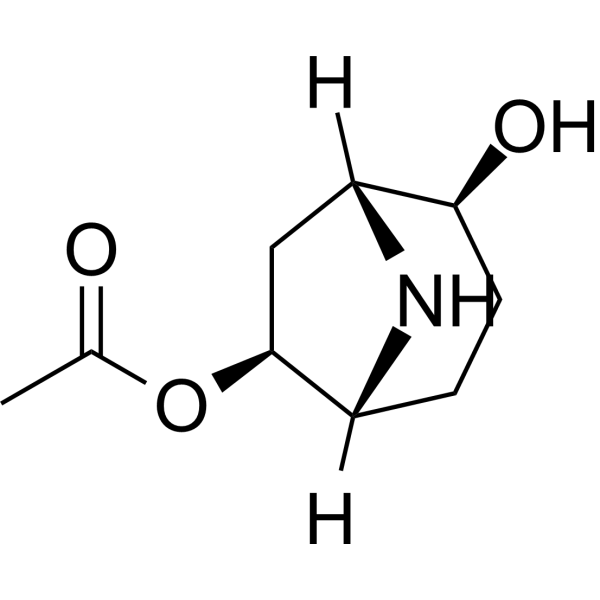 0 ImagesCat. No.: HY-125700CAS No.: 74239-84-2Synonyms: (-)-Bao Gong Teng ABaogongteng A ((-)-Bao Gong Teng A) is an optically active tropane alkaloid with hypotensive and miotic activity, and can be isolated from the Chinese herb Erycibe obtusifolia Benth. Baogongteng A is also a muscarinic agonist. Baogongteng A can be used for cardiovascular and glaucoma research.
-
NNC 11-1607
 0 ImagesCat. No.: HY-119333CAS No.: 250649-13-9NNC 11-1607 is a selective M1/M4 muscarinic acetylcholine receptor (mAChR) agonist. NNC 11-1607 inhibits Forskolin (HY-15371)-stimulated cAMP accumulation in Chinese hamster ovary cells expressing the human M2 or M4 mAChR. NNC 11-1607 is promising for research of central nervous system disorders, such as Alzheimer’s disease and schizophrenia.
-
AC260584 (Standard)
 0 ImagesCat. No.: HY-100336RCAS No.: 560083-42-3
-
DREADD agonist 21 dihydrochloride (Standard)
 0 ImagesCat. No.: HY-100234ARCAS No.: 2250025-92-2DREADD agonist 21 (dihydrochloride) (Standard) is the analytical standard of DREADD agonist 21 (dihydrochloride) (HY-100234A). This product is intended for research and analytical applications. DREADD agonist 21 dihydrochloride is a potent human muscarinic acetylcholine M3 receptors (hM3Dq) agonist (EC50=1.7 nM).
-
Xanomeline tartrate (Standard)
 0 ImagesSynonyms: LY 246708 tartrate (Standard)Xanomeline (tartrate) (Standard) is the analytical standard of Xanomeline (tartrate). This product is intended for research and analytical applications. Xanomeline (LY 246708) is the potent agonist of muscarinic M1/M4 receptor with antipsychotic-like activity. Xanomeline (LY 246708) increases neuronal excitability. Xanomeline (LY 246708) can be used for the research of schizophrenia.
-
GSK1034702 (Standard)
 0 ImagesCat. No.: HY-107111RCAS No.: 932373-87-0GSK1034702 (Standard) is the analytical standard of GSK1034702 (HY-107111). This product is intended for research and analytical applications. GSK1034702 is an orally active and allosteric agonist of M1 mAChR (pEC50=8.1) that can cross the blood-brain barrier. GSK1034702 activates the Gq/11 protein-mediated signaling pathway, enhancing neuronal firing and long-term potentiation (LTP) in the CA1 region of the hippocampus. GSK1034702 can modulate hippocampal function, improve memory encoding in the nicotine withdrawal cognitive dysfunction model, and show pro-cognitive effects in rodents. GSK1034702 can be used for the study of the mechanisms of cognitive impairment diseases such as Alzheimer's disease, and has certain peripheral M receptor activation-related side effects (such as gastrointestinal reactions).
-
Xanomeline oxalate (Standard)
 0 ImagesSynonyms: LY246708 oxalate (Standard)Xanomeline (oxalate) (Standard) is the analytical standard of Xanomeline (oxalate). This product is intended for research and analytical applications. Xanomeline oxalate (LY246708 oxalate) is a potent and selective muscarinic receptor agonist (SMRA) and stimulates phosphoinositide hydrolysis in vivo. Xanomeline oxalate can be used for the research of Alzheimer’s disease.
-
Anethole trithione (Standard)
 0 ImagesAnethole trithione (Standard) is the analytical standard of Anethole trithione. This product is intended for research and analytical applications. Anethole trithione, a sulfur heterocyclic choleretic, is a bile secretion-stimulating agent. Anethole trithione enhances salivary secretion and increases mAChRs, and can be used for dry mouth research.
-
Cevimeline hydrochloride (Standard)
 0 ImagesCat. No.: HY-70020BRCAS No.: 107220-28-0Synonyms: AF102B hydrochloride (Standard)Cevimeline (hydrochloride) (Standard) is the analytical standard of Cevimeline (hydrochloride). This product is intended for research and analytical applications. Cevimeline hydrochloride (AF102B hydrochloride) is a quinuclidine derivative of acetylcholine and a selective and orally active muscarinic M1 and M3 receptor agonist. Cevimeline hydrochloride stimulates secretion by the salivary glands and can be used as a sialogogue for xerostomia. Cevimeline hydrochloride can cross the blood-brain barrier (BBB).
-
Sabcomeline hydrochloride (Standard)
 0 ImagesCat. No.: HY-106432ARCAS No.: 159912-58-0Synonyms: SB-202026 hydrochloride (Standard); Memric hydrochloride (Standard)Sabcomeline hydrochloride (Standard) is the analytical standard of Sabcomeline hydrochloride (HY-106432A). This product is intended for research and analytical applications. Sabcomeline (SB-202026) hydrochloride is a potent and functionally selective muscarinic M1 receptor partial agonist that improve cognition. Sabcomeline hydrochloride can be used for Alzheimer's disease research.
-
Arecaidine-propargyl ester
 0 ImagesCat. No.: HY-183853CAS No.: 35516-99-5Arecaidine-propargyl ester is a selective M2 muscarinic receptor agonist with blood-brain barrier permeability, with a pKi of 5.91 for hm1, 7.06 for hm2, 6.07 for hm3, 6.01 for hm4, and 6.03 for hm5. Arecaidine-propargyl ester stimulates central and peripheral muscarinic receptors. Arecaidine-propargyl ester increases intracellular ROS, induces DNA damage and Apoptosis, and upregulates the expression of MnSOD and SIRT1. Arecaidine-propargyl ester reduces sympathetic nerve outflow, induces dose-dependent hypotension, and triggers negative chronotropic effects at high peripheral doses. Arecaidine-propargyl ester can be used in research related to Alzheimer's disease and glioblastoma.
-
Oxotremorine M iodide (Standard)
 0 ImagesOxotremorine M (iodide) (Standard) is the analytical standard of Oxotremorine M (iodide) (HY-101372A). This product is intended for research and analytical applications. Oxotremorine M iodide is a potent and non-selective muscarinic acetylcholine receptor (mAChR) agonist. Oxotremorine M iodide potentiates NMDA receptors by muscarinic receptor dependent and independent mechanisms.
-
ENS-163 phosphate
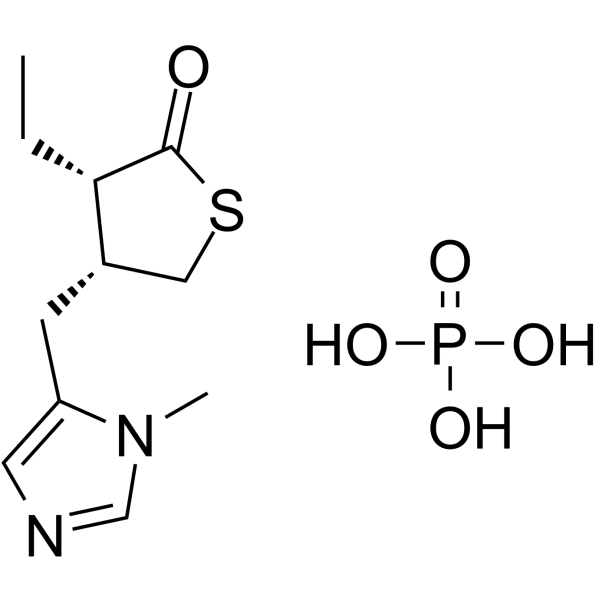 0 ImagesCat. No.: HY-U00038CAS No.: 117707-51-4Synonyms: ENS 213-163; Sandoz ENS 163 phosphate; Thiopilocarpine phosphateENS-163 phosphate is a selective muscarinic M1 receptor agonist.




