



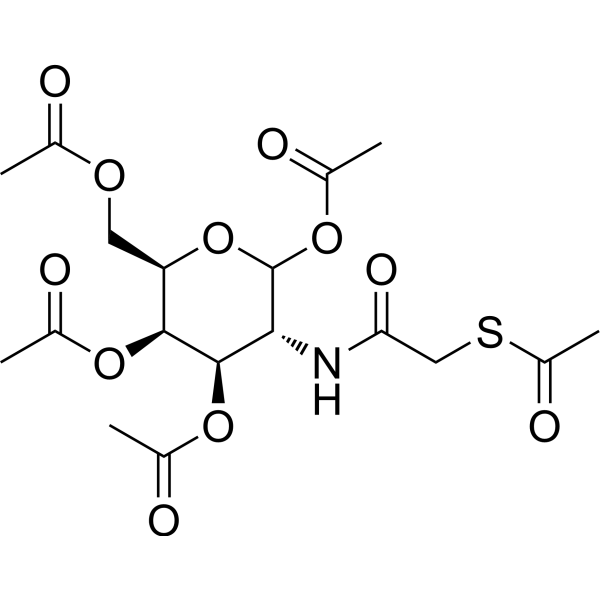
Ac5GalNTGc epimer

Based on 1 Customer Validation
Ac5GalNTGc epimer is an analogue of hexosamine and the racemate of Ac5GalNTGc (HY-160109). Ac5GalNTGc is a potent, peracetylated C-2 thioglycolyl-substituted GalNAc analog that efficiently inhibits mucin-type O-glycan biosynthesis. Ac5GalNTGc reduces leukocyte sialyl-Lewis-X expression and inhibits L-/P-selectin mediated rolling under flow, as well as P-selectin dependent leukocyte-platelet adhesion. Ac5GalNTGc exhibits anti-inflammatory activity in a thioglycollate-induced acute peritonitis model. Ac5GalNTGc can be used for studies of O-glycan/mucin biology, inflammation, and related translational research.
For research use only. We do not sell to patients.
- Purity : 98.39%
- CAS No.: 1334320-77-2
- Formula: C18H25NO11S
- Molecular Weight:463.46
-
Storage:Powder -20°C, 3 years , 4°C, 2 years ; In solvent -80°C, 6 months , -20°C, 1 month

To place orders, for customer services and technical support, please contact: MedChemExpress USA
Tel: 609-228-6898 E-mail: [email protected] [email protected]


-
 Biological Activity
-
Chemical Information
-
Solvent & Solubility
- Protocols
- Purity & Documentation
- References
-
 Help & FAQs




Biological Activity
Description


Chemical Information
-
CAS No. 1334320-77-2
-
Appearance Solid
-
Molecular Weight 463.46
-
Formula C18H25NO11S
-
Color White to off-white
-
SMILES
CC(O[C@@H]1[C@H](C(O[C@@H]([C@@H]1OC(C)=O)COC(C)=O)OC(C)=O)NC(CSC(C)=O)=O)=O
-
Shipping
Room temperature in continental US; may vary elsewhere.
-
Storage
Powder -20°C 3 years 4°C 2 years In solvent -80°C 6 months -20°C 1 month


Solvent & Solubility
In Vitro:
DMSO : ≥ 50 mg/mL (107.88 mM; Hygroscopic DMSO has a significant impact on the solubility of product, please use newly opened DMSO)
* "≥" means soluble, but saturation unknown.
Please refer to the solubility information to select the appropriate solvent. Once prepared, please aliquot and store the solution to prevent product inactivation from repeated freeze-thaw cycles.
Storage method and period of stock solution: -80°C, 6 months; -20°C, 1 month. When stored at -80°C, please use it within 6 months. When stored at -20°C, please use it within 1 month.
Please refer to the solubility information to select the appropriate solvent. Once prepared, please aliquot and store the solution to prevent product inactivation from repeated freeze-thaw cycles.
Storage method and period of stock solution: -80°C, 6 months; -20°C, 1 month. When stored at -80°C, please use it within 6 months. When stored at -20°C, please use it within 1 month.
Concentration (start) × Volume (start) = Concentration (final) × Volume (final)


Purity & Documentation
-
Data Sheet (276 KB)
-
SDS (251 KB)
- English - EN (251 KB)
- Français - FR (251 KB)
- Deutsch - DE (251 KB)
- Norwegian - NO (251 KB)
- Español - ES (251 KB)
- Swedish - SV (251 KB)
- Italian - IT (251 KB)
- Korean - KR (251 KB)
- Portuguese - PT (251 KB)
-
Handling Instructions (2659 KB)
References
[1]. Agarwal K, et al. Inhibition of mucin-type O-glycosylation through metabolic processing and incorporation of N-thioglycolyl-D-galactosamine peracetate (Ac5GalNTGc). J Am Chem Soc. 2013 Sep 25;135(38):14189-97. [Content Brief]
[2]. Wang SS, et al. Efficient inhibition of O-glycan biosynthesis using the hexosamine analog Ac5GalNTGc. Cell Chem Biol. 2021 May 20;28(5):699-710.e5. [Content Brief]


Complete Stock Solution Preparation Table
Please refer to the solubility information to select the appropriate solvent. Once prepared, please aliquot and store the solution to prevent product inactivation from repeated freeze-thaw cycles.
Storage method and period of stock solution: -80°C, 6 months; -20°C, 1 month. When stored at -80°C, please use it within 6 months. When stored at -20°C, please use it within 1 month.
| Optional Solvent | Concentration Solvent Mass | 1 mg | 5 mg | 10 mg | 25 mg |
|---|---|---|---|---|---|
| DMSO | 1 mM | 2.1577 mL | 10.7884 mL | 21.5768 mL | 53.9421 mL |
| 5 mM | 0.4315 mL | 2.1577 mL | 4.3154 mL | 10.7884 mL | |
| 10 mM | 0.2158 mL | 1.0788 mL | 2.1577 mL | 5.3942 mL | |
| 15 mM | 0.1438 mL | 0.7192 mL | 1.4385 mL | 3.5961 mL | |
| 20 mM | 0.1079 mL | 0.5394 mL | 1.0788 mL | 2.6971 mL | |
| 25 mM | 0.0863 mL | 0.4315 mL | 0.8631 mL | 2.1577 mL | |
| 30 mM | 0.0719 mL | 0.3596 mL | 0.7192 mL | 1.7981 mL | |
| 40 mM | 0.0539 mL | 0.2697 mL | 0.5394 mL | 1.3486 mL | |
| 50 mM | 0.0432 mL | 0.2158 mL | 0.4315 mL | 1.0788 mL | |
| 60 mM | 0.0360 mL | 0.1798 mL | 0.3596 mL | 0.8990 mL | |
| 80 mM | 0.0270 mL | 0.1349 mL | 0.2697 mL | 0.6743 mL | |
| 100 mM | 0.0216 mL | 0.1079 mL | 0.2158 mL | 0.5394 mL |


Ac5GalNTGc epimer Related Classifications
HY-160109A Related Classifications
 Powered by Bioz