



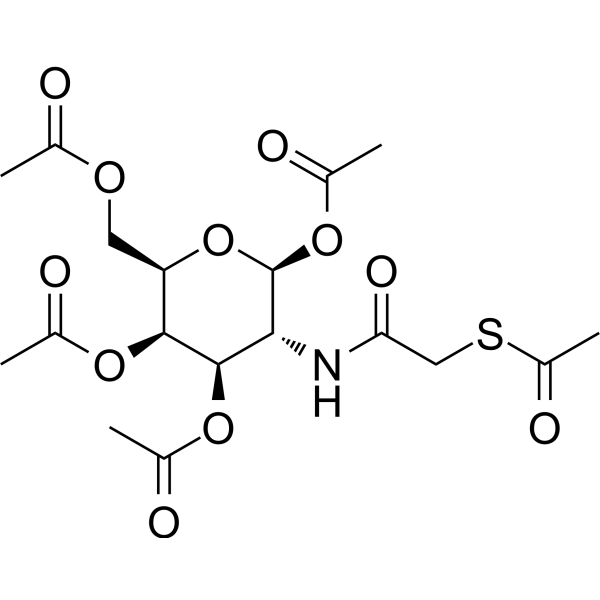
Ac5GalNTGc
Based on 2 publication(s) in Google Scholar
Ac5GalNTGc is a potent, peracetylated C-2 thioglycolyl-substituted GalNAc analog that efficiently inhibits mucin-type O-glycan biosynthesis. Ac5GalNTGc reduces leukocyte sialyl-Lewis-X expression and inhibits L-/P-selectin mediated rolling under flow, as well as P-selectin dependent leukocyte-platelet adhesion. Ac5GalNTGc exhibits anti-inflammatory activity in a thioglycollate-induced acute peritonitis model. Ac5GalNTGc can be used for studies of O-glycan/mucin biology, inflammation, and related translational research.
For research use only. We do not sell to patients.
- Purity : 98.54%
- Formula: C18H25NO11S
- Molecular Weight:463.46
-
Storage:Powder -20°C, 3 years , 4°C, 2 years ; In solvent -80°C, 6 months , -20°C, 1 month

To place orders, for customer services and technical support, please contact: MedChemExpress USA
Tel: 609-228-6898 E-mail: [email protected] [email protected]


-
 Biological Activity
-
Chemical Information
-
Solvent & Solubility
- Protocols
- Purity & Documentation
- References
-
 Help & FAQs


Publications Citing Use of MedChemExpress (MCE) Ac5GalNTGc
More

Biological Activity
Description
In Vitro
Ac5GalNTGc (0-50 μM, 48 h) drastically reduces CD43-L60, CD43-1G10, CD45-UCHL-1 and CD43-L10 epitopes in Jurkat cells[1].
Ac5GalNTGc (50-80 μM, 40 h) effectively inhibits O-glycan biosynthesis in various cells (HL-60 promyelocytes, breast cancer cells, prostate cancer cells)[2].
Ac5GalNTGc (50 μM, 40 h) significantly reduces the expression of sialyl Lewis-X on the surface of HL-60 cells[2].
Ac5GalNTGc (80 μM, 40 h) reduces rolling of HL-60 cells on L-selectin substrates and on P-selectin-bearing CHO-P cells, without affecting E-selectin-dependent rolling, and also decreases P-selectin-dependent leukocyte-platelet adhesion[2].
Ac5GalNTGc (80 μM, 40 h) reduces the apparent molecular mass of the major L-/P-selectin ligand PSGL-1 in HL-60 cells and also decreases the molecular mass of CD43[2].
Ac5GalNTGc (50-80 μM, 40 h) increases VVA binding in mouse bone marrow cells (mBMCs) and neutrophils (mPMNs), reduces P-selectin-IgG binding and L-selectin binding without affecting PSGL-1 expression[2].
MedChemExpress (MCE) has not independently confirmed the accuracy of these methods. They are for reference only.
In Vivo
MedChemExpress (MCE) has not independently confirmed the accuracy of these methods. They are for reference only.
-
Animal Model:Thioglycollate (4%) was intraperitoneally injected into 8-12 week-old C57BL/6 wild-type mice of either sex to induce acute peritonitis[2]
-
Dosage:100 mg/kg
-
Administration:i.p. once daily for 4 days
-
Result:Reduced neutrophil migration into the peritoneum in a thioglycollate-induced acute peritonitis model when Ac₅GalNTGc-treated mouse bone marrow cells were injected intravenously.
Decreased neutrophil extravasation into the peritoneal lavage in mice.
Increased VVA binding to neutrophils in the peritoneal lavage by two-fold.
Caused no significant changes in peripheral blood counts and leukocyte differentials after 4 days of administration.


Chemical Information
-
Appearance Solid
-
Molecular Weight 463.46
-
Formula C18H25NO11S
-
Color White to off-white
-
SMILES
CC(O[C@@H]1[C@H]([C@@H](O[C@@H]([C@@H]1OC(C)=O)COC(C)=O)OC(C)=O)NC(CSC(C)=O)=O)=O
-
Shipping
Room temperature in continental US; may vary elsewhere.
-
Storage
Powder -20°C 3 years 4°C 2 years In solvent -80°C 6 months -20°C 1 month


Publications (2)
-
Journal Impact Factor
-
Most Recent
-
Nat Commun
The O-glycosyltransferase C1GALT1 promotes EWSR1::FLI1 expression and is a therapeutic target for Ewing sarcoma. [Abstract]2025 Feb 2;16(1):1267. PMID: 39894896 -


Solvent & Solubility
In Vitro:
DMSO : 100 mg/mL (215.77 mM; Need ultrasonic; Hygroscopic DMSO has a significant impact on the solubility of product, please use newly opened DMSO)
Please refer to the solubility information to select the appropriate solvent. Once prepared, please aliquot and store the solution to prevent product inactivation from repeated freeze-thaw cycles.
Storage method and period of stock solution: -80°C, 6 months; -20°C, 1 month. When stored at -80°C, please use it within 6 months. When stored at -20°C, please use it within 1 month.
Please refer to the solubility information to select the appropriate solvent. Once prepared, please aliquot and store the solution to prevent product inactivation from repeated freeze-thaw cycles.
Storage method and period of stock solution: -80°C, 6 months; -20°C, 1 month. When stored at -80°C, please use it within 6 months. When stored at -20°C, please use it within 1 month.
Concentration (start) × Volume (start) = Concentration (final) × Volume (final)
In Vivo:
Select the appropriate dissolution method based on your experimental animal and administration route.
- For the following dissolution methods, please ensure to first prepare a clear stock solution using an In Vitro approach and then sequentially add co-solvents:
- To ensure reliable experimental results, the clarified stock solution can be appropriately stored based on storage conditions. As for the working solution for In Vivo experiments, it is recommended to prepare freshly and use it on the same day.
- The percentages shown for the solvents indicate their volumetric ratio in the final prepared solution. If precipitation or phase separation occurs during preparation, heat and/or sonication can be used to aid dissolution.
Add each solvent one by one: 10% DMSO 40% PEG300 5% Tween-80 45% Saline
Solubility: ≥ 2.5 mg/mL (5.39 mM); Clear solution
This protocol yields a clear solution of ≥ 2.5 mg/mL (saturation unknown).
Taking 1 mL working solution as an example, add 100 μL DMSO stock solution (25.0 mg/mL) to 400 μL PEG300, and mix evenly; then add 50 μL Tween-80 and mix evenly; then add 450 μL Saline to adjust the volume to 1 mL.
Preparation of Saline: Dissolve 0.9 g sodium chloride in ddH₂O and dilute to 100 mL to obtain a clear Saline solution.
Add each solvent one by one: 10% DMSO 90% (20% SBE-β-CD in Saline)
Solubility: ≥ 2.5 mg/mL (5.39 mM); Clear solution
This protocol yields a clear solution of ≥ 2.5 mg/mL (saturation unknown).
Taking 1 mL working solution as an example, add 100 μL DMSO stock solution (25.0 mg/mL) to 900 μL 20% SBE-β-CD in Saline, and mix evenly.
Preparation of 20% SBE-β-CD in Saline (4°C, storage for one week): 2 g SBE-β-CD powder is dissolved in 10 mL Saline, completely dissolve until clear.
In Vivo Dissolution Calculator
Please enter the basic information of animal experiments:
-
-
-
-
Recommended: Prepare an additional quantity of animals to account for potential losses during experiments.
Please enter your animal formula composition:
-
%DMSO +
Recommended: Keep the proportion of DMSO in working solution below 2% if your animal is weak.
-
%+
-
+%Tween-80 + +
-
%Saline +
The co-solvents required include: DMSO, . All of co-solvents are available by MedChemExpress (MCE). , Tween 80. All of co-solvents are available by MedChemExpress (MCE).
Working solution concentration: 0.22 mg/mL
Method for preparing stock solution: mg drug dissolved in μL DMSO. Stock solution concentration: mg/mL.
1. Take μL DMSO stock solution;
2. Add μL .
μL , mix evenly;
3. Then add μL Tween 80, mix evenly;
4. Then add μL
Please ensure that the stock solution in the first step is dissolved to a clear state, and add co-solvents in sequence. You can use ultrasonic heating (ultrasonic cleaner, recommended frequency 20-40 kHz), vortexing, etc. to assist dissolution.


Purity & Documentation
-
Data Sheet (280 KB)
-
SDS (251 KB)
- English - EN (251 KB)
- Français - FR (251 KB)
- Deutsch - DE (251 KB)
- Norwegian - NO (251 KB)
- Español - ES (251 KB)
- Swedish - SV (251 KB)
- Italian - IT (251 KB)
- Korean - KR (251 KB)
- Portuguese - PT (251 KB)
-
Handling Instructions (2659 KB)
References
[1]. Agarwal K, et al. Inhibition of mucin-type O-glycosylation through metabolic processing and incorporation of N-thioglycolyl-D-galactosamine peracetate (Ac5GalNTGc). J Am Chem Soc. 2013 Sep 25;135(38):14189-97. [Content Brief]
[2]. Wang SS, et al. Efficient inhibition of O-glycan biosynthesis using the hexosamine analog Ac5GalNTGc. Cell Chem Biol. 2021 May 20;28(5):699-710.e5. [Content Brief]


Complete Stock Solution Preparation Table
Please refer to the solubility information to select the appropriate solvent. Once prepared, please aliquot and store the solution to prevent product inactivation from repeated freeze-thaw cycles.
Storage method and period of stock solution: -80°C, 6 months; -20°C, 1 month. When stored at -80°C, please use it within 6 months. When stored at -20°C, please use it within 1 month.
| Optional Solvent | Concentration Solvent Mass | 1 mg | 5 mg | 10 mg | 25 mg |
|---|---|---|---|---|---|
| DMSO | 1 mM | 2.1577 mL | 10.7884 mL | 21.5768 mL | 53.9421 mL |
| 5 mM | 0.4315 mL | 2.1577 mL | 4.3154 mL | 10.7884 mL | |
| 10 mM | 0.2158 mL | 1.0788 mL | 2.1577 mL | 5.3942 mL | |
| 15 mM | 0.1438 mL | 0.7192 mL | 1.4385 mL | 3.5961 mL | |
| 20 mM | 0.1079 mL | 0.5394 mL | 1.0788 mL | 2.6971 mL | |
| 25 mM | 0.0863 mL | 0.4315 mL | 0.8631 mL | 2.1577 mL | |
| 30 mM | 0.0719 mL | 0.3596 mL | 0.7192 mL | 1.7981 mL | |
| 40 mM | 0.0539 mL | 0.2697 mL | 0.5394 mL | 1.3486 mL | |
| 50 mM | 0.0432 mL | 0.2158 mL | 0.4315 mL | 1.0788 mL | |
| 60 mM | 0.0360 mL | 0.1798 mL | 0.3596 mL | 0.8990 mL | |
| 80 mM | 0.0270 mL | 0.1349 mL | 0.2697 mL | 0.6743 mL | |
| 100 mM | 0.0216 mL | 0.1079 mL | 0.2158 mL | 0.5394 mL |


Ac5GalNTGc Related Classifications
HY-160109 Related Classifications
 Powered by Bioz