



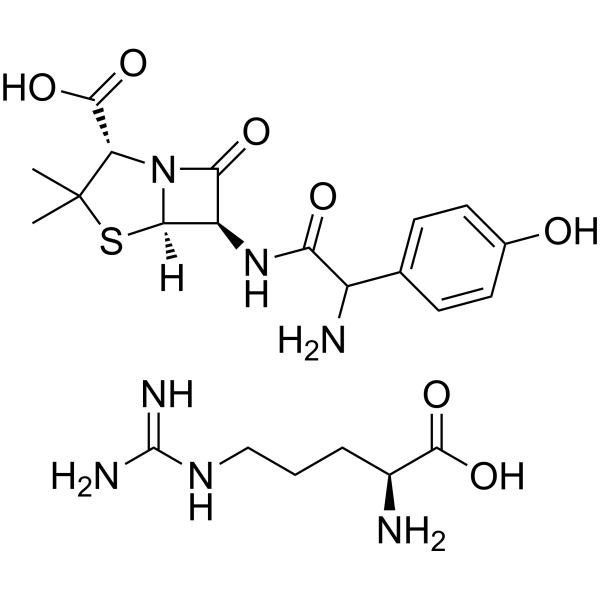
Amoxicillin arginine
Based on 25 publication(s) in Google Scholar
Amoxicillin (Amoxycillin) arginine is an antibiotic with good oral absorption and broad spectrum antimicrobial activity. Amoxicillin arginine inhibits the biosynthesis of polypeptides in the cell wall, thereby inhibiting cell growth.
For research use only. We do not sell to patients.
- CAS No.: 59261-05-1
- Formula: C16H19N3O5S.C6H14N4O2
-
Storage:
Please store the product under the recommended conditions in the Certificate of Analysis.

To place orders, for customer services and technical support, please contact: MedChemExpress USA
Tel: 609-228-6898 E-mail: [email protected] [email protected]


-
 Biological Activity
-
Chemical Information
- Protocols
- Purity & Documentation
- References
-
 Help & FAQs


Publications Citing Use of MedChemExpress (MCE) Amoxicillin arginine
More- Nat Commun. 2022 Mar 2;13(1):1116. [Abstract]
- J Exp Med. 2026 Mar 2;223(3):e20241287. [Abstract]
- Emerg Contam. 2026 Feb 23.
- Talanta. 2025 Jan 1:282:126966. [Abstract]
- Results Chem. 2024 Oct.
- iScience. 2025 Sep 25;28(11):113648. [Abstract]
- ACS ES T Water. 2025 Jan 24.
- FASEB J. 2026 Jan 31;40(2):e71438. [Abstract]
- Antimicrob Agents Chemother. 2021 Feb 17;65(3):e01921-20. [Abstract]
- Genomics. 2022 Nov;114(6):110527. [Abstract]
- Arch Microbiol. 2025 Jun 17;207(8):177. [Abstract]
- J Fluoresc. 2019 Jan;29(1):221-229. [Abstract]
- Tissue Cell. 2026 Apr 22:102:103551. [Abstract]
- Biomed Res Int. 2018 Jul 2:2018:3579832. [Abstract]
- Vet Microbiol. 2024 May:292:110046. [Abstract]
- Solvent Extr Lon Exc. 2024 Jul 25.
- Boston University. 2026.
- Authorea. 2026 May 12.
- bioRxiv. 2024 May 10.
- Chemosphere. 2023 Dec:344:140353. [Abstract]
- SSRN. 2023 May 30.
- Drug Metab Pers Ther. 2020 Mar 5;35(1):/j/dmdi.2020.35.issue-1/dmpt-2019-0032/dmpt-2019-0032.xml. [Abstract]
- Nanyang Technological University. 2020 Mar.
- Chemosphere. 2019 Jun:225:378-387. [Abstract]
- Federal University of Rio Grande do Sul. 2017 Nov.
All Antibiotic Isoforms
More

Biological Activity
Description
In Vitro
Amoxicillin (Amoxycillin) arginine (1-100 µM; 24 hours; L. acidophilus) decreases living cells and increases degree of cell wall rupture in a dose-dependent manner[1].
MedChemExpress (MCE) has not independently confirmed the accuracy of these methods. They are for reference only.
In Vivo
Amoxicillin (Amoxycillin) arginine (1.6-9.5 mg/kg; p.o.; daily, for 7 or 14 days; swiss albino mice) has against infection with chlamydia trachomatis in mice[3].
MedChemExpress (MCE) has not independently confirmed the accuracy of these methods. They are for reference only.
-
Animal Model:Female ICR/Swiss mice[2]
-
Dosage:7 mg/kg
-
Administration:Subcutaneous injection; every 8 h, for 24 hours
-
Result:Inhibited bacterial numbers in a dose-dependent manner.
-
Animal Model:Female ICR/Swiss mice[2]
-
Dosage:7 mg/kg
-
Administration:Subcutaneous injection; every 8 h, for 4 days
-
Result:Survived all animals that were infected with organisms for which MICs were 1 mg/L or less, and with the two strains for which MICs were 2 mg/L, 20 to 40% mortality.
-
Animal Model:Swiss albino mice[3]
-
Dosage:1.6 and 9.5 mg/kg
-
Administration:Oral administration; daily, for 7 or 14 days
-
Result:Improved the activity of Chlamydia trachomatis infection in mice.


Chemical Information
-
CAS No. 59261-05-1
-
Formula C16H19N3O5S.C6H14N4O2
-
SMILES
O=C(O)[C@H](N1C2=O)C(C)(S[C@@]1([C@@H]2NC(C(C3=CC=C(C=C3)O)N)=O)[H])C.N[C@H](C(O)=O)CCCNC(N)=N
-
Synonyms
Amoxycillin arginine
-
Shipping
Room temperature in continental US; may vary elsewhere.
-
Storage
Please store the product under the recommended conditions in the Certificate of Analysis.


Publications (25)
-
Journal Impact Factor
-
Most Recent
-
Nat Commun
Antimicrobial resistance and population genomics of multidrug-resistant Escherichia coli in pig farms in mainland China. [Abstract]2022 Mar 2;13(1):1116. PMID: 35236849 -
J Exp Med
2026 Mar 2;223(3):e20241287. PMID: 41400657 -
-
Talanta
Environmentally friendly molecularly imprinted polymers as an insert for SPE type columns in the gentamicin monitoring process. [Abstract]2025 Jan 1:282:126966. PMID: 39342674 -
-
iScience
Stability and biocompatibility of hBD3 with different chiral configurations and their therapeutic efficacy in periodontitis. [Abstract]2025 Sep 25;28(11):113648. PMID: 41142128 -
-
FASEB J
Enhancing the Susceptibility of Methicillin-Resistant Staphylococcus aureus to β-Lactam Antibiotics Through the Use of 4-Methoxysalicyl Aldehyde. [Abstract]2026 Jan 31;40(2):e71438. PMID: 41524623 -
Antimicrob Agents Chemother
Dihydrotanshinone I Is Effective against Drug-Resistant Helicobacter pylori In Vitro and In Vivo. [Abstract]2021 Feb 17;65(3):e01921-20. PMID: 33318002 -
Genomics
LRRK2 deficiency mitigates colitis progression by favoring resolution of inflammation and restoring homeostasis of gut microbiota. [Abstract]2022 Nov;114(6):110527. PMID: 36455749 -
Arch Microbiol
Jatrorrhizine attenuates inflammatory response in Helicobacter pylori-induced gastritis by suppressing NLRP3 inflammasomes and NF-κB signaling pathway. [Abstract]2025 Jun 17;207(8):177. PMID: 40526168 -
J Fluoresc
Nitrogen-Doped Durian Shell Derived Carbon Dots for Inner Filter Effect Mediated Sensing of Tetracycline and Fluorescent Ink. [Abstract]2019 Jan;29(1):221-229. PMID: 30565002 -
Tissue Cell
Vitamin D3 in synergy with triple therapy to eradicate Helicobacter pylori infection in mice via the c-Raf/MEK/ERK pathway. [Abstract]2026 Apr 22:102:103551. PMID: 42033901 -
Biomed Res Int
In Vitro Activity of β-Lactams in Combination with β-Lactamase Inhibitors against Mycobacterium tuberculosis Clinical Isolates. [Abstract]2018 Jul 2:2018:3579832. PMID: 30065936 -
Vet Microbiol
Discovery of the tigecycline resistance gene cluster tmexCD3-toprJ1 in Pasteurella multocida strains isolated from pigs in China. [Abstract]2024 May:292:110046. PMID: 38471428 -
-
-
-
-
Chemosphere
Sustainable production of Fe-doped MnO2 nanoparticles for accelerated tetracycline antibiotic detoxification. [Abstract]2023 Dec:344:140353. PMID: 37797898 -
-
Drug Metab Pers Ther
Saccharomyces boulardii CNCM I-745 probiotic does not alter the pharmacokinetics of amoxicillin. [Abstract]2020 Mar 5;35(1):/j/dmdi.2020.35.issue-1/dmpt-2019-0032/dmpt-2019-0032.xml. PMID: 32134728 -
-
Chemosphere
Mass-balance-model-based evaluation of sewage treatment plant contribution to residual pharmaceuticals in environmental waters. [Abstract]2019 Jun:225:378-387. PMID: 30884299 -


Purity & Documentation
References
[1]. Guo Y, et, al. Metabolic response of Lactobacillus acidophilus exposed to amoxicillin. J Antibiot (Tokyo). 2022 May;75(5):268-281. [Content Brief]
[2]. Andes D, et, al. In vivo activities of amoxicillin and amoxicillin-clavulanate against Streptococcus pneumoniae: application to breakpoint determinations. Antimicrob Agents Chemother. 1998 Sep;42(9):2375-9. [Content Brief]
[3]. Kramer MJ, et, al. Activity of oral amoxicillin, ampicillin, and oxytetracycline against infection with chlamydia trachomatis in mice. J Infect Dis. 1979 Jun;139(6):717-9. [Content Brief]

Calculators
Concentration (start) × Volume (start) = Concentration (final) × Volume (final)


Amoxicillin arginine Related Classifications
HY-B0467C Related Classifications
 Powered by Bioz