



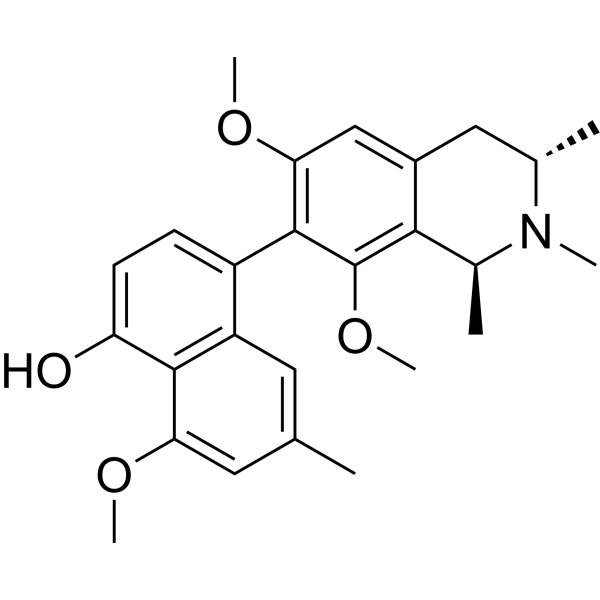
Ancistrotecine B
Ancistrotecine B (Compound 2) is a Nav1.7 channel inhibitor (IC50: 0.73 μM). Ancistrotecine B relieves inflammatory pain in mice.
For research use only. We do not sell to patients.
- Formula: C26H31NO4
- Molecular Weight:421.53
-
Storage:
Please store the product under the recommended conditions in the Certificate of Analysis.

To place orders, for customer services and technical support, please contact: MedChemExpress USA
Tel: 609-228-6898 E-mail: [email protected] [email protected]


-
 Biological Activity
-
Chemical Information
- Protocols
- Purity & Documentation
- References
-
 Help & FAQs




Biological Activity
Description
IC50 & Target
0.73 μM (Nav1.7)[1]


Chemical Information
-
Molecular Weight 421.53
-
Formula C26H31NO4
-
SMILES
C[C@@H]1N(C)[C@@H](C)C2=C(OC)C(C3=CC=C(O)C4=C3C=C(C)C=C4OC)=C(OC)C=C2C1
-
Structure Classification
-
Shipping
Room temperature in continental US; may vary elsewhere.
-
Storage
Please store the product under the recommended conditions in the Certificate of Analysis.

Protocols
-
Cell Cytotoxicity Assay
Cytotoxicity assays are usually based on the assessment of cell membrane damage, which can also be indirectly detected by measuring cell viability. Detection methods include MTT assay, CKK-8 assay, LDH assay and ATP assay, etc.
-
Formalin-Induced Paw Inflammation/Nociceptive Inflammation
The formalin-induced paw inflammation/nociceptive test is a chemical persistent pain model in rodents in which subcutaneous injection of formalin into the hind paw produces spontaneous nocifensive behaviors such as flinching and licking. The response is classically biphasic, consisting of an early acute phase (Phase I) reflecting direct activation of peripheral nociceptors (particularly C-fiber afferents), followed by a later prolonged phase (Phase II) associated with central sensitization in the spinal dorsal horn driven by sustained afferent input and inflammatory signaling. This model is widely used to evaluate analgesic and anti-inflammatory interventions because it captures both peripheral nociception and central sensitization processes within a single assay system.


Purity & Documentation
References

Calculators
Concentration (start) × Volume (start) = Concentration (final) × Volume (final)


Ancistrotecine B Related Classifications
HY-155236 Related Classifications
 Powered by Bioz