



ASK1 Antibody
(Synonyms: MAP3K5; ASK1; MAPKKK5; MEKK5; Mitogen-activated protein kinase kinase kinase 5; Apoptosis signal-regulating kinase 1; ASK-1; MAPK/ERK kinase kinase 5; MEK kinase 5; MEKK 5)Based on 1 publication(s) in Google Scholar
ASK1 Antibody is a Rabbit-derived and non-conjugated IgG polyclonal antibody, targeting to ASK1.
-
Host:
Rabbit
-
Isotype:
IgG
-
Application:
WB, IHC-P, ICC/IF, FC
-
Reactivity :
Human, Mouse
-
Formulation:
Supplied in 50mM Tris-Glycine(pH 7.4), 0.15M NaCl, 40%Glycerol, 0.01% sodium azide and 0.05% BSA.
-
Conjugation:
Non-conjugated


To place orders, for customer services and technical support, please contact: MedChemExpress USA
Tel: 609-228-6898 E-mail: [email protected] [email protected]



Publications Citing Use of MedChemExpress (MCE) ASK1 Antibody
More

Applications
| Application |
WB

WB: Western Blot
|
IHC-P
IHC-P: Immunohistochemistry-Paraffin
|
ICC/IF
ICC/IF: Immunocytochemistry/
Immunofluorescence |
FC
FC: Flow Cytometry
|
|---|---|---|---|---|
| Dilution Ratio | 1:500-1:1000 | 1:50-1:100 | 1:50-1:200 | 1:50-1:100 |


Product Details
ASK1 Antibody is a Rabbit-derived and non-conjugated IgG polyclonal antibody, targeting to ASK1.
-
Host Rabbit

-
Clonality Polyclonal

-
Species ReactivityHuman, Mouse
-
Observed Molecular WeightObserved band size: 155 kDa
Note: Due to possible protein modifications or aggregation, the molecular weight should be confirmed by actual measurement, and the predicted value is for reference only.

-
Calculated Molecular Weight Predicted band size: 155 kDa

Synthetic peptide corresponding to Human ASK1.The exact sequence is proprietary to MCE.
Endogenous
affinity purified
Non-conjugated
Unmodified
IgG


Product Properties
-
Appearance
Solution
-
Formulation
Supplied in 50mM Tris-Glycine(pH 7.4), 0.15M NaCl, 40%Glycerol, 0.01% sodium azide and 0.05% BSA.
-
Concentration
Batch-dependent, Please check the COA for the concentration of each lot. Check Lot Concentration
-
Storage & Stability
Stored at -20°C for 1 year. Avoid repeated freeze / thaw cycles.
-
선적
Shipping with blue ice.


Publications (1)
-
Journal Impact Factor
-
Most Recent
-
Eur J Pharmacol
Sophoridine alleviates spleen injury in sepsis by inhibiting ASK1-mediated inflammation, oxidative stress, and apoptosis. [Abstract]2026 Feb 28:1016:178593. PMID: 41621573


Verification Images
-
 Western blot analysis of extracts from Hela(lane 2(20ug) and Hela(lane 3(40ug) using ASK1 Antibody (HY-P80549) Rabbit mAb. Proteins were transferred to a PVDF membrane and blocked with 5% non-fat milk in TBST for 2 hour at room temperature. The primary antibody (1/1000) and Loading control antibody (Beta Actin, HY-P83730, 1/10000) was used in 5% non-fat milk in TBST at 4°C overnight. Goat Anti-Mouse/Rabbit IgG-HRP Secondary Antibody (1/10000) was used for 1 hour at room temperature.
 -
 Flow cytometric analysis of 1X10⁶ HeLa cells labeling ASK1 Antibody (HY-P80549, red). Cells were fixed with 4% paraformaldehyde and permeabilised with 90% methanol. Then stained with the primary antibody at 1/100 dilution for an hour at 4℃. AF488-conjugated Goat Anti-Rabbit IgG H&L (HY-P8002) was used as the secondary antibody at 1/1,000 dilution for 30 minutes at 4℃. Rabbit IgG Isotype Control (HY-P80879, blue) was used as the isotype control, cells without incubation with primary antibody were used as the unlabeled control (black).
 -
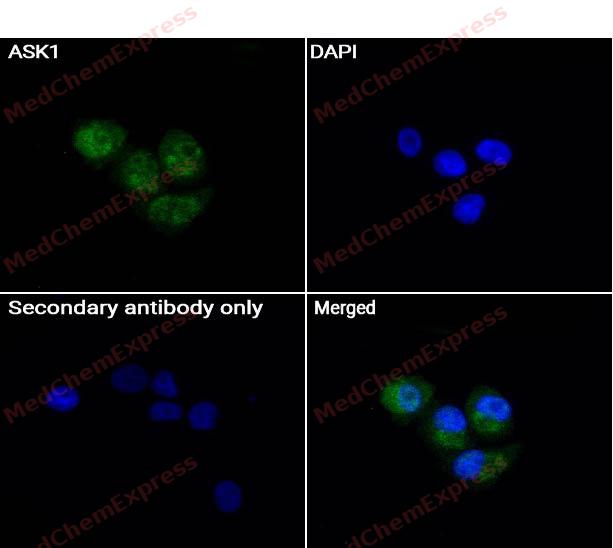 Immunocytochemistry analysis of PANC-1 cells labeling ASK1 Antibody (HY-P80549) at 1/50 dilution. Cells were fixed in 4% paraformaldehyde for 15 minutes at room temperature, permeabilized with 0.1% Triton X-100 for 10 minutes at room temperature, then blocked with QuickBlock™ Blocking Buffer for Immunol Staining for 10 min at room temperature. Cells were then incubated with NTH1 Antibody (HY-P81690) at 1/50 dilution in QuickBlock™ Blocking Buffer for Immunol Staining at 4 ℃. Alexa Fluor® 488-conjugated AffiniPure Goat Anti-Rabbit IgG H&L(HY-P8002, Green) was used as the secondary antibody at 1/1,000 dilution. PBS instead of the primary antibody was used as the secondary antibody only control. The Nuclear counterstain was DAPI (Blue).
 -
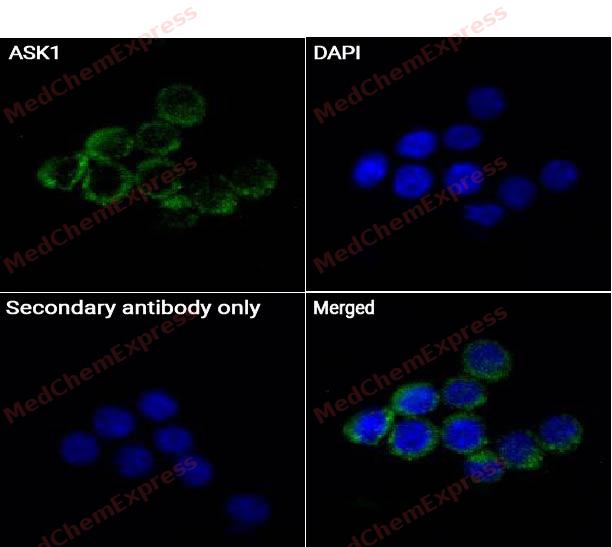 Immunocytochemistry analysis of RAW 264.7 cells labeling ASK1 Antibody (HY-P80549) at 1/50 dilution. Cells were fixed in 4% paraformaldehyde for 15 minutes at room temperature, permeabilized with 0.1% Triton X-100 for 10 minutes at room temperature, then blocked with QuickBlock™ Blocking Buffer for Immunol Staining for 10 min at room temperature. Cells were then incubated with ASK1 Antibody (HY-P80549) at 1/50 dilution in QuickBlock™ Blocking Buffer for Immunol Staining at 4 ℃. Alexa Fluor® 488-conjugated AffiniPure Goat Anti-Rabbit IgG H&L(HY-P8002, Green) was used as the secondary antibody at 1/1,000 dilution. PBS instead of the primary antibody was used as the secondary antibody only control. The Nuclear counterstain was DAPI (Blue).


Background
-
Function
Apoptosis signal-regulating kinase 1 (ASK1) is a member of the mitogen-activated protein kinase (MAP3K) family which acts as an upstream regulator for the activation of p38 MAPK and c-Jun N-terminal kinase (JNK) . Under normal physiological conditions, ASK1 is maintained in an inactive state through binding to the reduced form of thioredoxin. However, during pathological conditions which induce intracellular production of reactive oxygen species (e.g., mitochondrial or endoplasmic reticulum stress), thioredoxin is oxidized and dissociates from ASK1 facilitating activation of ASK1 and downstream p38 MAPK and JNK signaling that can cause tissue injury .
-
Subcellular Localization
Cytoplasm; Endoplasmic reticulum
-
Expression
Tissue_specificity:It is expressed in large quantities in the heart and pancreas.
Induction:By TNF. Inhibited by HIV-1 Nef -
Isoforms & Post-Translational Modification
Q99683 has 2 isomers: Q99683-1: 154537 Da (predicted); Q99683-2: 69839 Da (predicted).
Phosphorylated at Thr-838 through autophosphorylation and by MAP3K6/ASK2 which leads to activation. Thr-838 is dephosphorylated by PPP5C. Ser-83 and Ser-1033 are inactivating phosphorylation sites, the former of which is phosphorylated by AKT1. Phosphorylated at Ser-966 which induces association of MAP3K5/ASK1 with the 14-3-3 family proteins and suppresses MAP3K5/ASK1 activity. Calcineurin (CN) dephosphorylates this site. Also dephosphorylated and activated by PGAM5. Phosphorylation at Ser-966 in response to oxidative stress is negatively regulated by PPIA/CYPA (PubMed:26095851);Ubiquitinated (PubMed:16038411, PubMed:17220297, PubMed:29186683). Tumor necrosis factor (TNF) induces TNFR2-dependent ubiquitination, leading to proteasomal degradation (PubMed:17220297). Ubiquitinated by RC3H2 in a TRIM48-dependent manner (PubMed:29186683);Methylation at Arg-78 and Arg-80 by PRMT1 promotes association of MAP3K5 with thioredoxin and negatively regulates MAP3K5 association with TRAF2, inhibiting MAP3K5 activation (PubMed:22095282). Methylation is blocked by ubiquitination of PRMT1 by TRIM48 (PubMed:29186683) -
Subunit
Homodimer when inactive. Binds both upstream activators and downstream substrates in multimolecular complexes. Part of a cytoplasmic complex made of HIPK1, DAB2IP and MAP3K5 in response to TNF (PubMed:15310755, PubMed:15701637, PubMed:17210579, PubMed:17389591). This complex formation promotes MAP3K5-JNK activation and subsequent apoptosis. Interacts with SOCS1 which recognizes phosphorylation of Tyr-718 and induces MAP3K5/ASK1 degradation in endothelial cells. Interacts with the 14-3-3 family proteins such as YWHAB, YWHAE, YWHAQ, YWHAH, YWHAZ and SFN (PubMed:10411906, PubMed:15023544, PubMed:15094778). Interacts with ARRB2, BIRC2, DAB2IP, IGF1R, MAP3K6/ASK2, PGAM5, PIM1, PPP5C, SOCS1, STUB1, TRAF2, TRAF6 and TXN (PubMed:10688666, PubMed:11090355, PubMed:11689443, PubMed:12556535, PubMed:12813029, PubMed:15310755, PubMed:16038411, PubMed:16129676, PubMed:16407264, PubMed:17220297, PubMed:17724081, PubMed:18408005, PubMed:19590015, PubMed:19749799, PubMed:9564042, PubMed:9774977). Interacts with ERN1 in a TRAF2-dependent manner (PubMed:14749717). Interacts with calcineurin subunit PPP3R1 (By similarity). Interacts with PPM1L (PubMed:17456047). Interacts (via N-terminus) with RAF1 and this interaction inhibits the proapoptotic function of MAP3K5 (PubMed:11427728). Interacts with DAB2IP (via N-terminus C2 domain); the interaction occurs in a TNF-alpha-dependent manner (PubMed:15310755). Interacts with DUSP13A; may positively regulate apoptosis (PubMed:20358250). Interacts with DAXX (PubMed:9743501). Interacts with RC3H2 (PubMed:24448648). Interacts with PPIA/CYPA (PubMed:26095851). Interacts with PRMT1; the interaction results in MAP3K5 methylation by PRMT1 which inhibits MAP3K5 activation (PubMed:22095282). Interacts with TRAF2; the interaction is inhibited by PRMT1 (PubMed:22095282). Interacts with TRIM48 (PubMed:29186683)
-
SwissProt ID
-
Synonyms
MAP3K5; ASK1; MAPKKK5; MEKK5; Mitogen-activated protein kinase kinase kinase 5; Apoptosis signal-regulating kinase 1; ASK-1; MAPK/ERK kinase kinase 5; MEK kinase 5; MEKK 5
-
Research Field
Cell Biology
각종 서류
-
Data Sheet (235 KB)
-
SDS (252 KB)
- English - EN (252 KB)
- Français - FR (252 KB)
- Deutsch - DE (252 KB)
- Norwegian - NO (252 KB)
- Español - ES (252 KB)
- Swedish - SV (252 KB)
- Italian - IT (252 KB)
- Korean - KR (252 KB)
- Portuguese - PT (252 KB)
-
User Guide for Antibodies (1077 KB)

 Powered by Bioz
