



CD133 Antibody (YA808)
Based on 3 publication(s) in Google Scholar
CD133 Antibody (YA808) is a Mouse-derived and non-conjugated IgG1 monoclonal antibody, targeting to CD133.
-
Host:
Mouse
-
Isotype:
IgG1
-
Application:
WB, IHC-P, FC
-
Reactivity :
Human
-
Formulation:
Supplied in 1*PBS (pH7.4), 0.1% BSA, 40% Glycerol. Preservative: 0.05% Sodium Azide.
-
Conjugation:
Non-conjugated


To place orders, for customer services and technical support, please contact: MedChemExpress USA
Tel: 609-228-6898 E-mail: [email protected] [email protected]



Publications Citing Use of MedChemExpress (MCE) CD133 Antibody (YA808)
More

Applications
| Application |
WB

WB: Western Blot
|
IHC-P
IHC-P: Immunohistochemistry-Paraffin
|
FC
FC: Flow Cytometry
|
|---|---|---|---|
| Dilution Ratio | 1:500 | 1:600 | 1:500-1:1000 |


Product Details
CD133 Antibody (YA808) is a Mouse-derived and non-conjugated IgG1 monoclonal antibody, targeting to CD133.
-
Host Mouse

-
Clonality Monoclonal

-
Species ReactivityHuman
-
Observed Molecular WeightObserved band size: 120 kDa
Note: Due to possible protein modifications or aggregation, the molecular weight should be confirmed by actual measurement, and the predicted value is for reference only.

-
Calculated Molecular Weight Predicted band size: 97 kDa

Synthetic peptide corresponding to Human CD133.AA range:151-400.
Endogenous
Protein G affinity purified.
Non-conjugated
Unmodified
IgG1


Product Properties
-
Appearance
Liquid
-
Formulation
Supplied in 1*PBS (pH7.4), 0.1% BSA, 40% Glycerol. Preservative: 0.05% Sodium Azide.
-
Concentration
Batch-dependent, Please check the COA for the concentration of each lot. Check Lot Concentration
-
Storage & Stability
Stored at -20°C for 1 year. Avoid repeated freeze / thaw cycles.
-
Shipping
Shipping with blue ice.


Publications (3)
-
Journal Impact Factor
-
Most Recent
-
Mater Today Bio
Biomimetic selenium nanomedicine with homologous targeting enhances hepatocellular carcinoma therapy. [Abstract]2025 Oct 21:35:102441. PMID: 41209698 -
Biol Direct
L-741626 inhibits hepatocellular carcinoma progression by targeting Ref-1 to suppress MAPK/ERK signalling pathway activity. [Abstract]2025 Apr 16;20(1):54. PMID: 40241114 -
Biochem Biophys Res Commun
CENPA-driven transcriptional activation of ECT2 enhances EGFR inhibitor resistance in lung adenocarcinoma. [Abstract]2025 Sep 1:777:152287. PMID: 40618443


Verification Images
-
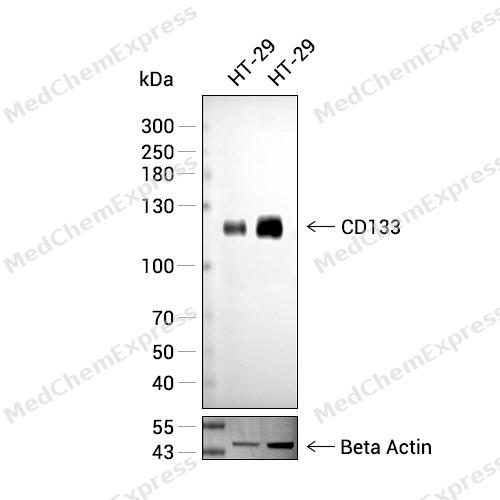 Western blot analysis of extracts from HT-29 (lane 2(20μg) and HT-29 (lane 3(40μg)using CD133 (HY-P80054) Rabbit mAb. Proteins were transferred to a PVDF membrane and blocked with 5% defatted milk powder in TBST for 2 hour at room temperature. The primary antibody (HY-P80054, 1/1000) and Loading control antibody (Beta Actin, HY-P80438, 1/3000) was used in 5% defatted milk powder in TBST at 4°C overnight. Goat Anti-Mouse/Rabbit IgG-HRP Secondary Antibody (HY-P8004/HY-P8001, 1/10,000) was used for 1 hour at room temperature.


Background
-
Function
CD133 may play a role in cell differentiation, proliferation and apoptosis. Binds cholesterol in cholesterol-containing plasma membrane microdomains and may play a role in the organization of the apical plasma membrane in epithelial cells. During early retinal development acts as a key regulator of disk morphogenesis. Involved in regulation of MAPK and Akt signaling pathways. In neuroblastoma cells suppresses cell differentiation such as neurite outgrowth in a RET-dependent manner[1][2].
-
Subcellular Localization
Apical cell membrane; Multi-pass membrane protein; Cell projection, microvillus membrane; Multi-pass membrane protein; Cell projection, cilium, photoreceptor outer segment; Endoplasmic reticulum; Endoplasmic reticulum-Golgi intermediate compartment
-
Expression
Tissue_specificity:Isomer 1 is selectively expressed on CD34+ hematopoietic stem cells and progenitor cells in human bone marrow, fetal liver, umbilical cord blood, and human peripheral blood. Isomer 1 is not detected in other blood cells. Isomer 1 is also expressed in a variety of non-lymphoid tissues, including the retina, pancreas, placenta, kidney, liver, lung, brain, and heart. In saliva, isomer 1 exists as small membrane granules. Isomer 2 is primarily expressed in fetal liver, skeletal muscle, kidney, and heart, as well as in human pancreas, kidney, liver, lung, and placenta. Isomer 2 is highly expressed in fetal liver, lowly expressed in bone marrow, and almost undetectable in peripheral blood. Isomer 2 is expressed on hematopoietic stem cells and epidermal basal cells (protein level) . In the human retina, isomer 2 is expressed by rod cells and cone cells (protein level) . -
Isoforms & Post-Translational Modification
O43490 has 7 isomers: O43490-1: 97202 Da (predicted); O43490-2: 96251 Da (predicted); O43490-3: 93270 Da (predicted); O43490-4: 93654 Da (predicted); O43490-5: 92741 Da (predicted); O43490-6: 93692 Da (predicted); O43490-7: 94605 Da (predicted).
Isoform 1 and isoform 2 are glycosylated;Acetylation at Lys-225, Lys-257 and Lys-264 by NAT8 and NAT8B may control PROM1 protein expression and its function in cell apoptosis -
Subunit
Interacts with CDHR1 and with actin filaments. Interacts with NAT8 and NAT8B
-
SwissProt ID
-
Research Field
Neuroscience
Documentation
-
Data Sheet (258 KB)
-
SDS (251 KB)
- English - EN (251 KB)
- Français - FR (251 KB)
- Deutsch - DE (251 KB)
- Norwegian - NO (251 KB)
- Español - ES (251 KB)
- Swedish - SV (251 KB)
- Italian - IT (251 KB)
- Korean - KR (251 KB)
- Portuguese - PT (251 KB)
-
User Guide for Antibodies (1077 KB)

 Powered by Bioz
