



Cdk7 Antibody (YA3495)
(Synonyms: CDK7_HUMAN; Cyclin-dependent kinase 7; EC:2.7.11.22; EC:2.7.11.23; CDK7; CAK; CAK1; CDKN7; MO15; STK1; 39 kDa protein kinase (p39 Mo15); CDK-activating kinase 1; Cell division protein kinase 7; Serine/threonine-protein kinase 1; TFIIH basal transcription factor complex kinase subunit; )Based on 1 Customer Validation
Cdk7 Antibody (YA3495) is a Rabbit-derived and non-conjugated IgG monoclonal antibody, targeting to Cdk7.
-
Host:
Rabbit
-
Isotype:
IgG
-
Application:
WB
-
Reactivity :
Human
-
Formulation:
Supplied in 50mM Tris-Glycine(pH 7.4), 0.15M NaCl, 40%Glycerol, 0.01% sodium azide and 0.05% BSA.
-
Conjugation:
Non-conjugated


To place orders, for customer services and technical support, please contact: MedChemExpress USA
Tel: 609-228-6898 E-mail: [email protected] [email protected]





Applications
| Application |
WB

WB: Western Blot
|
|---|---|
| Dilution Ratio | 1:500-1000 |


Product Details
Cdk7 Antibody (YA3495) is a Rabbit-derived and non-conjugated IgG monoclonal antibody, targeting to Cdk7.
-
Host Rabbit

-
Clonality Monoclonal,Recombinant

-
Species ReactivityHuman
-
Observed Molecular WeightObserved band size: 39 kDa
Note: Due to possible protein modifications or aggregation, the molecular weight should be confirmed by actual measurement, and the predicted value is for reference only.

-
Calculated Molecular Weight Predicted band size: 39 kDa

A synthesized peptide derived from human CDK7 aa190-346.
Endogenous
Protein A affinity purified.
Non-conjugated
Unmodified
IgG


Product Properties
-
Appearance
Solution
-
Formulation
Supplied in 50mM Tris-Glycine(pH 7.4), 0.15M NaCl, 40%Glycerol, 0.01% sodium azide and 0.05% BSA.
-
Concentration
Batch-dependent, Please check the COA for the concentration of each lot. Check Lot Concentration
-
Storage & Stability
Stored at -20°C for 1 year. Avoid repeated freeze / thaw cycles.
-
선적
Shipping with blue ice.


Verification Images
-
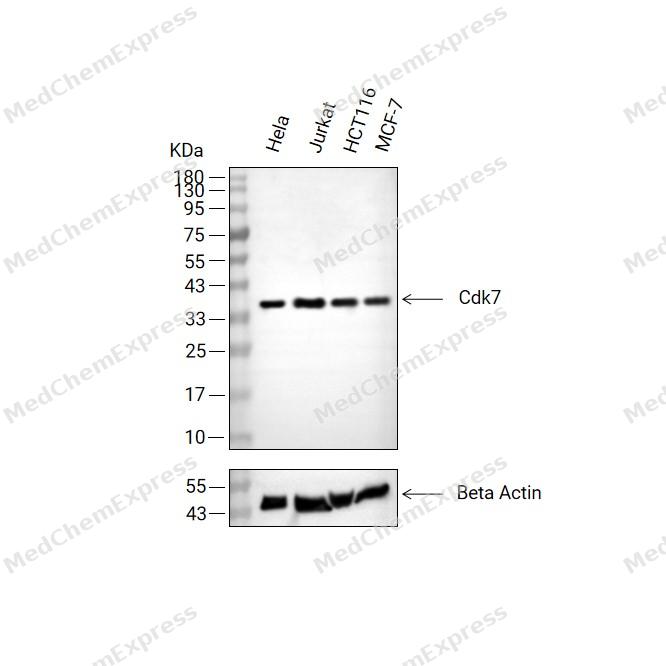 Western blot analysis of extracts from Hela (lane2(20μg), Jurkat (lane3(20μg), HCT116 (lane4(20μg) and MCF-7 (lane5(20μg) using Cdk7 Antibody (HY-P80389). Proteins were transferred to a PVDF membrane and blocked with 5% non-fat milk in TBST at 4°C overnight. The primary antibody (1/1000) and Loading control antibody (Beta Actin, HY-P80993, 1/10,000) was used in 5% non-fat milk in TBST for 2 hour at room temperature. Goat Anti-Rabbit IgG-HRP Secondary Antibody (HY-P8001, 1/10,000) was used for 1 hour at room temperature.


Background
-
Function
CDK7 (cyclin-dependent kinase 7) functions as a dual-regulatory kinase that coordinates cell-cycle progression and RNA polymerase II-dependent transcription through its activity within the CDK-activating kinase (CAK) complex and the general transcription factor TFIIH complex[1][2][3]. CDK7 phosphorylates and activates multiple cell-cycle CDKs, including CDK1, CDK2, CDK4, and CDK6, thereby linking transcriptional control to cell-cycle regulation[1][4]. Mechanistically, TFIIH-associated CDK7 phosphorylates the C-terminal domain (CTD) of RNA polymerase II and promotes transcription initiation, promoter clearance, and productive promoter escape[2][5][6]. CDK7 further regulates transcriptional programs through phosphorylation-dependent control of transcription-associated kinases and RNA processing factors, supporting coordinated gene expression in proliferating cells[2]. In disease models, aberrant CDK7 activity is associated with tumor cell proliferation and transcriptional dependency, making CDK7 a relevant target for cancer research and therapeutic intervention[1][7]. Compared with related CDK family members that primarily regulate discrete cell-cycle transitions, CDK7 uniquely combines CAK activity with direct transcriptional regulation through TFIIH, establishing a distinct functional position within the CDK network[4][6]. For experimental applications, selective CDK7 inhibitors have enabled mechanistic dissection of transcription initiation, RNA polymerase II dynamics, and transcriptional kinase signaling, supporting their broad use in functional genomics and oncology research[2][5].
-
Subcellular Localization
Nucleus; Cytoplasm; Cytoplasm, perinuclear region
-
Expression
Tissue_specificity:Ubiquitous
Induction:Repressed by DNA-bound peptides -
Subunit
Associates primarily with cyclin-H (CCNH) and MAT1 to form the CAK complex. CAK can further associate with the core-TFIIH to form the TFIIH basal transcription factor; this complex is sensitive to UV light. The CAK complex binds to p53/TP53 in response to DNA damage. Interacts with CDK2, SF1/NR5A1, PUF60 and PRKCI. Interacts with HINT1 (PubMed:10958787)
-
SwissProt ID
-
Synonyms
CDK7_HUMAN; Cyclin-dependent kinase 7; EC:2.7.11.22; EC:2.7.11.23; CDK7; CAK; CAK1; CDKN7; MO15; STK1; 39 kDa protein kinase (p39 Mo15); CDK-activating kinase 1; Cell division protein kinase 7; Serine/threonine-protein kinase 1; TFIIH basal transcription factor complex kinase subunit;
-
Research Field
Cell Biology


각종 서류
-
Data Sheet (262 KB)
-
SDS (252 KB)
- English - EN (252 KB)
- Français - FR (252 KB)
- Deutsch - DE (252 KB)
- Norwegian - NO (252 KB)
- Español - ES (252 KB)
- Swedish - SV (252 KB)
- Italian - IT (252 KB)
- Korean - KR (252 KB)
- Portuguese - PT (252 KB)
-
User Guide for Antibodies (1077 KB)
References
[2]. Rimel JK, et al. Selective inhibition of CDK7 reveals high-confidence targets and new models for TFIIH function in transcription. Genes Dev. 2020 Nov 1;34(21-22):1452-1473. [Content Brief]
[3]. Lee MJ, et al. Time to HIV rebound after infusion of long-acting broadly neutralising antibodies 3BNC117-LS and 10-1074-LS and analytical treatment interruption (the RIO trial): a double-blind, randomised, placebo-controlled trial. Lancet HIV. 2026 May 27:S2352-3018(26)00059-7. [Content Brief]
[4]. Wood DJ, et al. Structural insights into the functional diversity of the CDK-cyclin family. Open Biol. 2018 Sep;8(9):180112. [Content Brief]
[5]. Žumer K, et al. FACT maintains chromatin architecture and thereby stimulates RNA polymerase II pausing during transcription in vivo. Mol Cell. 2024 Jun 6;84(11):2053-2069.e9. [Content Brief]
[6]. Fisher RP. Cdk7: a kinase at the core of transcription and in the crosshairs of cancer drug discovery. Transcription. 2019 Apr;10(2):47-56. doi: 10.1080/21541264.2018.1553483. Epub 2018 Dec 6. PMID: 30488763; PMCID: PMC6602562. et al. Cdk7: a kinase at the core of transcription and in the crosshairs of cancer drug discovery. Transcription. 2019 Apr;10(2):47-56. [Content Brief]
[7]. Jones T, et al. TFIIH kinase CDK7 drives cell proliferation through a common core transcription factor network. Sci Adv. 2025 Feb 28;11(9):eadr9660. [Content Brief]

 Powered by Bioz
