



LIN28A Antibody (YA710)
(Synonyms: CSDD1, LIN28, ZCCHC1, LIN28A, Protein lin-28 homolog A, Lin-28A, Zinc finger CCHC domain-containing protein 1)
Based on 1 Customer Validation
LIN28A Antibody (YA710) is a Mouse-derived and non-conjugated IgG2b monoclonal antibody, targeting to LIN28A.
-
Host:
Mouse
-
Isotype:
IgG
-
Application:
WB, ICC/IF, IHC-P
-
Reactivity :
Human, Mouse
-
Formulation:
Supplied in 1*PBS (pH7.4), 0.2% BSA and 40% Glycerol. Preservative: 0.05% Sodium Azide.
-
Conjugation:
Non-conjugated



To place orders, for customer services and technical support, please contact: MedChemExpress USA
Tel: 609-228-6898 E-mail: [email protected] [email protected]





Applications
| Application |
WB

WB: Western Blot
|
ICC/IF
ICC/IF: Immunocytochemistry/
Immunofluorescence |
IHC-P
IHC-P: Immunohistochemistry-Paraffin
|
|---|---|---|---|
| Dilution Ratio | 1:10000 | 1:100 | 1:100 |


Product Details
LIN28A Antibody (YA710) is a Mouse-derived and non-conjugated IgG2b monoclonal antibody, targeting to LIN28A.
-
Host Mouse

-
Clonality Monoclonal

-
Species ReactivityHuman, Mouse
-
Observed Molecular WeightObserved band size: 28 kDa
Note: Due to possible protein modifications or aggregation, the molecular weight should be confirmed by actual measurement, and the predicted value is for reference only.

-
Calculated Molecular Weight Predicted band size: 23 kDa;

Entrez Gene: 79727 Human ; 83557 Mouse ; 500562 Rat
SwissProt: Q9H9Z2 Human ; Q8K3Y3 Mouse ;
OMIM: 611043 Human
Recombinant protein within human Lin28A aa 1-209/209.
Endogenous
Protein A affinity purified.
Non-conjugated
Unmodified
IgG


Product Properties
-
Appearance
Solution
-
Formulation
Supplied in 1*PBS (pH7.4), 0.2% BSA and 40% Glycerol. Preservative: 0.05% Sodium Azide.
-
Concentration
Batch-dependent, Please check the COA for the concentration of each lot. Check Lot Concentration
-
Storage & Stability
Stored at -20°C for 1 year. Avoid repeated freeze / thaw cycles.
-
Shipping
Shipping with blue ice.


Verification Images
-
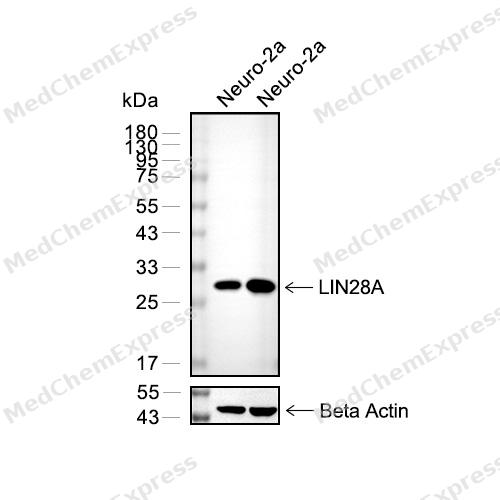 Western blot analysis of extracts from Neuro-2a (lane 2(20μg) , Neuro-2a (lane 3(40μg) , using LIN28A Antibody (HY-P80210). Proteins were transferred to a PVDF membrane and blocked with 5% BSA in TBST for 2 hour at room temperature. The primary antibody and Loading control antibody (Beta Actin, HY-P80438, 1/3000) was used in 5% BSA in TBST at 4°C overnight. Goat Anti-Mouse/Rabbit IgG-HRP Secondary Antibody (HY-P8004/HY-P8001, 1/10,000) was used for 1 hour at room temperature.
 -
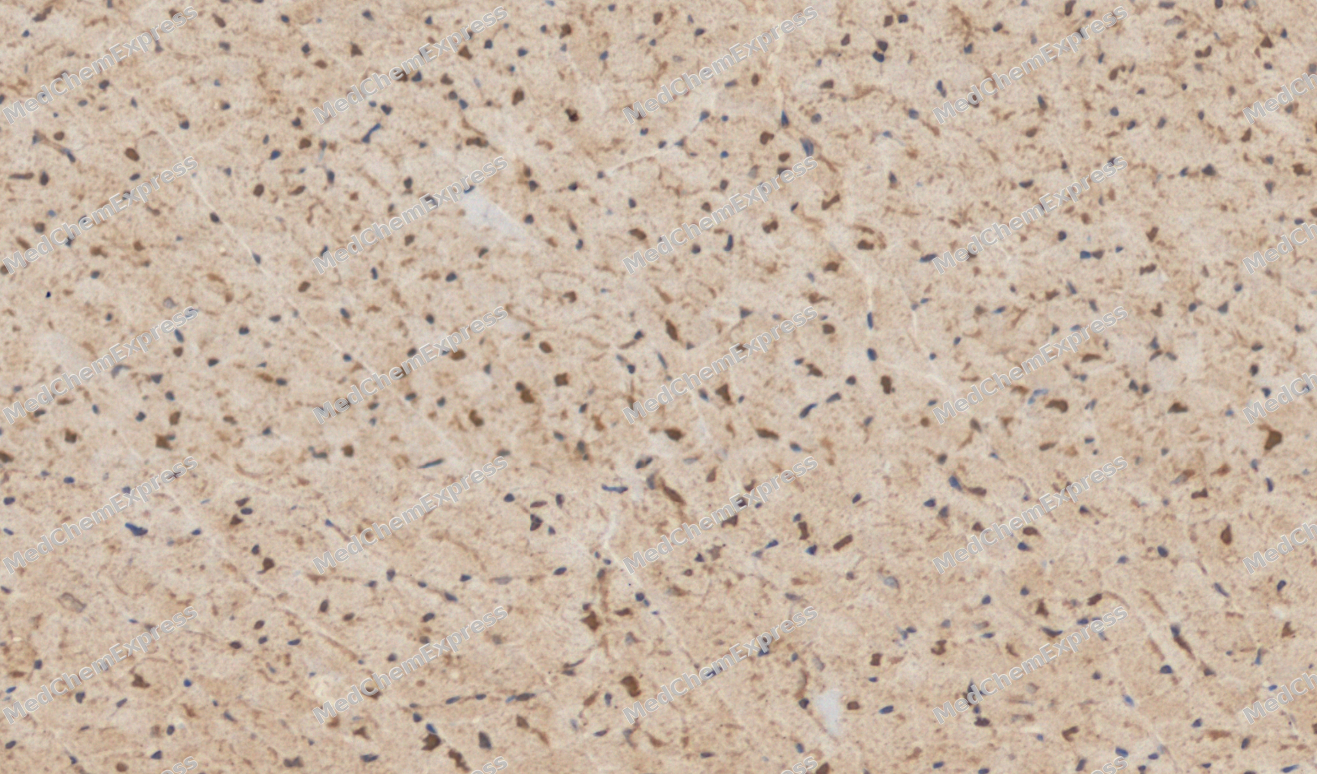
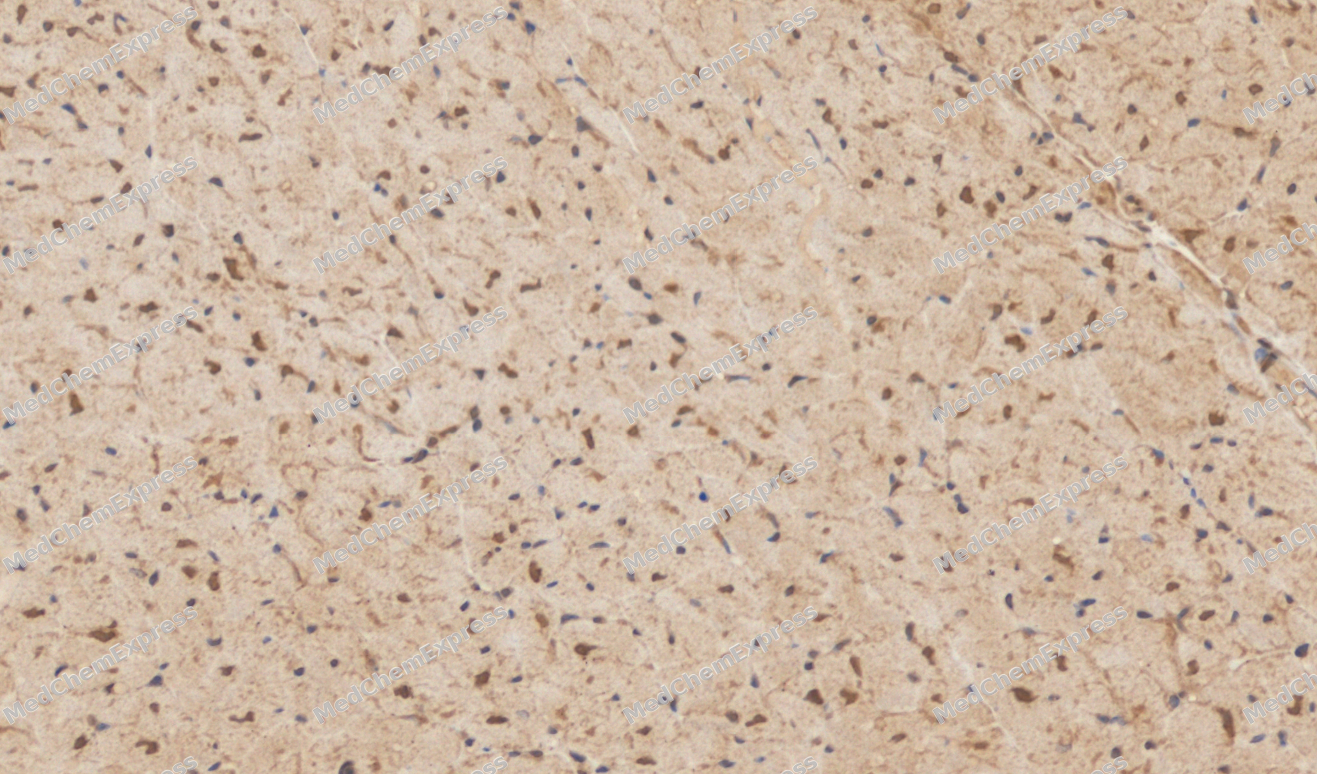
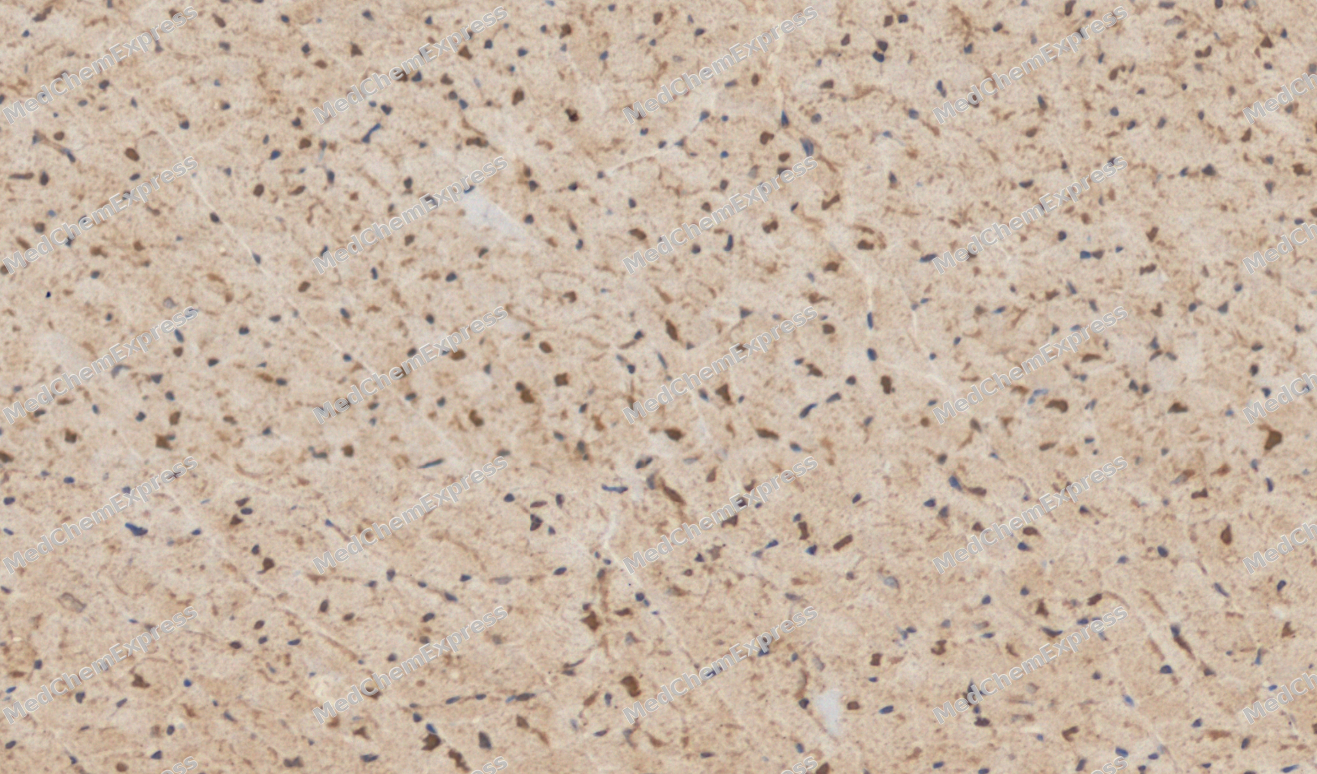 Immunohistochemical analysis of paraffin-embedded Mouse heart tissue using LIN28A Antibody. The section was pre-treated using heat mediated antigen retrieval with Tris-EDTA buffer (pH 9.0) for 8 minutes. The tissues were blocked in QuickBlock for 20 minutes at room temperature, washed with ddH2O and PBS, and then probed with the primary antibody (HY-P80210, 1/200) in 4℃ overnight. The detection was performed using an HRP conjugated compact polymer system. DAB was used as the chromogen. Tissues were counterstained with hematoxylin and mounted with DPX.
 -
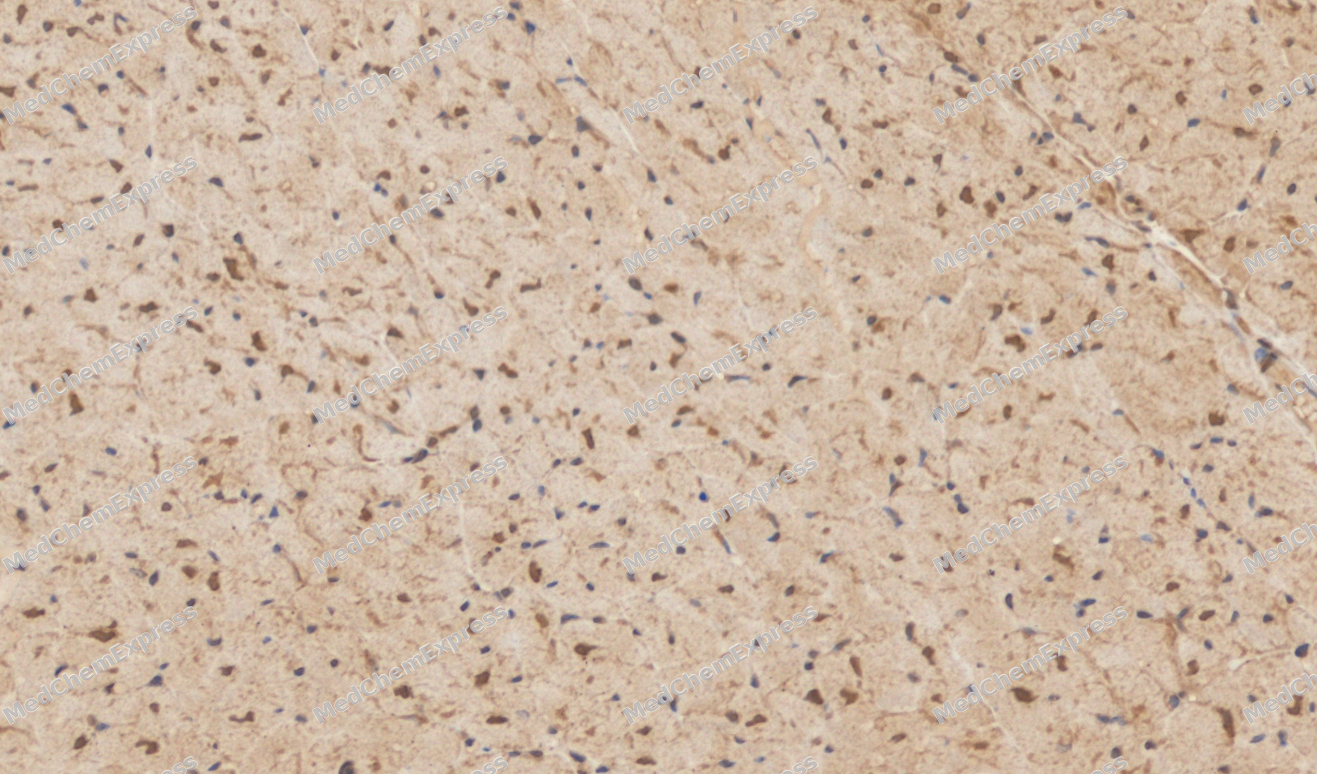 Immunohistochemical analysis of paraffin-embedded Mouse heart tissue using LIN28A Antibody. The section was pre-treated using heat mediated antigen retrieval with Tris-EDTA buffer (pH 9.0) for 8 minutes. The tissues were blocked in QuickBlock for 20 minutes at room temperature, washed with ddH2O and PBS, and then probed with the primary antibody (HY-P80210, 1/200) in 4℃ overnight. The detection was performed using an HRP conjugated compact polymer system. DAB was used as the chromogen. Tissues were counterstained with hematoxylin and mounted with DPX.


Background
-
Function
LIN28A is a RNA-binding protein that inhibits processing of pre-let-7 miRNAs and regulates translation of mRNAs that control developmental timing, pluripotency and metabolism. Seems to recognize a common structural G-quartet (G4) feature in its miRNA and mRNA targets (Probable). 'Translational enhancer' that drives specific mRNAs to polysomes and increases the efficiency of protein synthesis. Its association with the translational machinery and target mRNAs results in an increased number of initiation events per molecule of mRNA and, indirectly, in mRNA stabilization. Binds IGF2 mRNA, MYOD1 mRNA, ARBP/36B4 ribosomal protein mRNA and its own mRNA. Essential for skeletal muscle differentiation program through the translational up-regulation of IGF2 expression. Suppressor of microRNA (miRNA) biogenesis, including that of let-7, miR107, miR-143 and miR-200c. Specifically binds the miRNA precursors (pre-miRNAs), recognizing an 5'-GGAG-3' motif found in pre-miRNA terminal loop, and recruits TUT4 and TUT7 uridylyltransferases. This results in the terminal uridylation of target pre-miRNAs. Uridylated pre-miRNAs fail to be processed by Dicer and undergo degradation. The repression of let-7 expression is required for normal development and contributes to maintain the pluripotent state by preventing let-7-mediated differentiation of embryonic stem cells. Localized to the periendoplasmic reticulum area, binds to a large number of spliced mRNAs and inhibits the translation of mRNAs destined for the ER, reducing the synthesis of transmembrane proteins, ER or Golgi lumen proteins, and secretory proteins. Binds to and enhances the translation of mRNAs for several metabolic enzymes, such as PFKP, PDHA1 or SDHA, increasing glycolysis and oxidative phosphorylation. Which, with the let-7 repression may enhance tissue repair in adult tissue[1][2][3][4][5].
-
Subcellular Localization
Cytoplasm; Rough endoplasmic reticulum; Cytoplasm, P-body; Cytoplasm, Stress granule; Nucleus, nucleolus
-
Expression
Tissue_specificity:Expressed in embryonic stem cells, placenta and testis. Tends to be up-regulated in HER2-overexpressing breast tumors.
Induction:Can be negatively regulated by the interaction of microRNAs miR-125a and miR-125b with at least two miRNA responsive elements (miREs) in the 3'-UTR of this gene. These interactions may reduce both translation efficiency and mRNA abundance. Negatively regulated by retinoic acid -
Subunit
Monomer (By similarity). During skeletal muscle differentiation, associated with translation initiation complexes in the polysomal compartment (PubMed:21247876). Directly interacts with EIF3S2 (By similarity). Interacts with NCL in an RNA-dependent manner (By similarity). Interacts (via C-terminus) with DHX9 (via N- and C-terminus); this interaction occurs in a RNA-independent manner (PubMed:21247876). Interacts with TUT4 in the presence of pre-let-7 RNA (PubMed:19703396, PubMed:22118463)
-
SwissProt ID
-
Synonyms
CSDD1, LIN28, ZCCHC1, LIN28A, Protein lin-28 homolog A, Lin-28A, Zinc finger CCHC domain-containing protein 1
-
Research Field
Epigenetics and Nuclear Signaling


Documentation
-
Data Sheet (261 KB)
-
SDS (313 KB)
- English - EN (313 KB)
- Français - FR (313 KB)
- Deutsch - DE (313 KB)
- Norwegian - NO (313 KB)
- Español - ES (313 KB)
- Swedish - SV (313 KB)
- Italian - IT (313 KB)
- Korean - KR (313 KB)
- Portuguese - PT (313 KB)
-
User Guide for Antibodies (1077 KB)
References
[1]. Jin J, et al. Evidence that Lin28 stimulates translation by recruiting RNA helicase A to polysomes. Nucleic Acids Res. 2011 May;39(9):3724-34. [Content Brief]
[2]. Heo I, et al. Lin28 mediates the terminal uridylation of let-7 precursor MicroRNA. Mol Cell. 2008 Oct 24;32(2):276-84. [Content Brief]
[3]. Heo I, et al. TUT4 in concert with Lin28 suppresses microRNA biogenesis through pre-microRNA uridylation. Cell. 2009 Aug 21;138(4):696-708. [Content Brief]
[4]. Piskounova E, et al. Lin28A and Lin28B inhibit let-7 microRNA biogenesis by distinct mechanisms. Cell. 2011 Nov 23;147(5):1066-79. [Content Brief]
[5]. Thornton JE, et al. Lin28-mediated control of let-7 microRNA expression by alternative TUTases Zcchc11 (TUT4) and Zcchc6 (TUT7). RNA. 2012 Oct;18(10):1875-85. [Content Brief]

 Powered by Bioz
