



Nucleolin Antibody (YA259)
(Synonyms: Nucleolin, Protein C23, NCL)
Based on 1 Customer Validation
Nucleolin Antibody (YA259) is a Rabbit-derived and non-conjugated IgG monoclonal antibody, targeting to Nucleolin.
-
Host:
Rabbit
-
Isotype:
IgG
-
Application:
WB, ICC/IF, IHC-P
-
Reactivity :
Human, Mouse, Rat
-
Formulation:
Supplied in 1*TBS (pH7.4), 0.05% BSA and 40% Glycerol. Preservative: 0.05% Sodium Azide.
-
Conjugation:
Non-conjugated


To place orders, for customer services and technical support, please contact: MedChemExpress USA
Tel: 609-228-6898 E-mail: [email protected] [email protected]





Applications
| Application |
WB

WB: Western Blot
|
ICC/IF
ICC/IF: Immunocytochemistry/
Immunofluorescence |
IHC-P
IHC-P: Immunohistochemistry-Paraffin
|
|---|---|---|---|
| Dilution Ratio | 1:500-1:5000 | 1:200 | 1:200-1:400 |


Product Details
Nucleolin Antibody (YA259) is a Rabbit-derived and non-conjugated IgG monoclonal antibody, targeting to Nucleolin.
-
Host Rabbit

-
Clonality Recombinant,Monoclonal

-
Species ReactivityHuman, Mouse, Rat
-
Observed Molecular WeightObserved band size: 100 kDa
Note: Due to possible protein modifications or aggregation, the molecular weight should be confirmed by actual measurement, and the predicted value is for reference only.

-
Calculated Molecular Weight Predicted band size: 77 kDa;

Entrez Gene: 4691 Human ; 17975 Mouse ; 25135 Rat
SwissProt: P19338 Human ; P09405 Mouse ; P13383 Rat
OMIM: 164035 Human
Synthetic peptide corresponding to Human CSDE1.AA range:661-710.
Endogenous
Protein A affinity purified.
Non-conjugated
Unmodified
IgG


Product Properties
-
Appearance
Solution
-
Formulation
Supplied in 1*TBS (pH7.4), 0.05% BSA and 40% Glycerol. Preservative: 0.05% Sodium Azide.
-
Concentration
Batch-dependent, Please check the COA for the concentration of each lot. Check Lot Concentration
-
Storage & Stability
Stored at -20°C for 1 year. Avoid repeated freeze / thaw cycles.
-
Shipping
Shipping with blue ice.


Verification Images
-
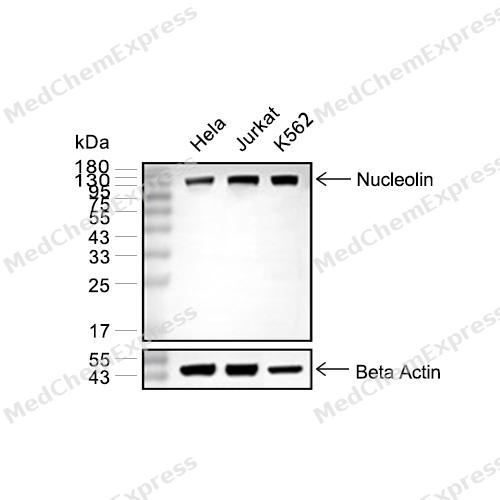 Western blot analysis of extracts from Hela(lane 2(20μg), Jurkat (lane 3(20μg) and K562 (lane 4(20μg) using Nucleolin (HY-P80252) Rabbit mAb. Proteins were transferred to a PVDF membrane and blocked with 5% non-fat milk in TBST for 2 hour at room temperature. The primary antibody (1/1000) and Loading control antibody (Beta Actin, HY-P80438, 1/10000) was used in 5% non-fat milk in TBST at 4°C overnight. Goat Anti-Mouse/Rabbit IgG-HRP Secondary Antibody (1/10000) was used for 1 hour at room temperature.
 -
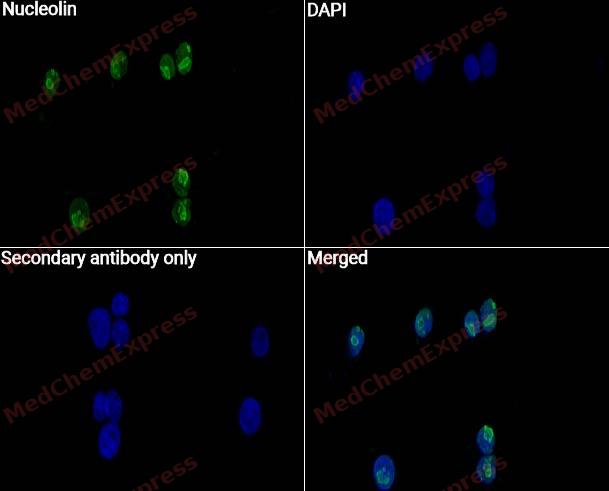 Immunocytochemistry analysis of HT-29 cells labeling Nucleolin with Nucleolin Antibody (HY-P80252) at 1/200 dilution. Cells were fixed in 4% paraformaldehyde for 15 minutes at room temperature, permeabilized with 0.1% Triton X-100 for 10 minutes at room temperature, then blocked with QuickBlock™ Blocking Buffer for Immunol Staining for 10 min at room temperature. Cells were then incubated with Nucleolin Antibody (HY-P80252) at 1/200 dilution in QuickBlock™ Blocking Buffer for Immunol Staining at 4 ℃. Alexa Fluor® 488-conjugated AffiniPure Goat Anti-Rabbit IgG H&L(HY-P8002, Green) was used as the secondary antibody at 1/1,000 dilution. PBS instead of the primary antibody was used as the secondary antibody only control. The Nuclear counterstain was DAPI (Blue).
 -
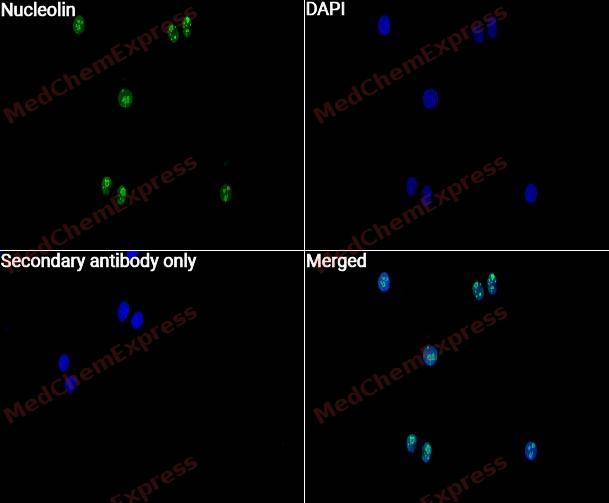 Immunocytochemistry analysis of Hela cells labeling Nucleolin with Nucleolin Antibody (HY-P80252)at 1/200 dilution. Cells were fixed in 4% paraformaldehyde for 15 minutes at room temperature, permeabilized with 0.1% Triton X-100 for 10 minutes at room temperature, then blocked with QuickBlock™ Blocking Buffer for Immunol Staining for 10 min at room temperature. Cells were then incubated with Nucleolin Antibody (HY-P80252) at 1/200 dilution in QuickBlock™ Blocking Buffer for Immunol Staining at 4 ℃. Alexa Fluor® 488-conjugated AffiniPure Goat Anti-Rabbit IgG H&L(HY-P8002, Green) was used as the secondary antibody at 1/1,000 dilution. PBS instead of the primary antibody was used as the secondary antibody only control. The Nuclear counterstain was DAPI (Blue).
 -
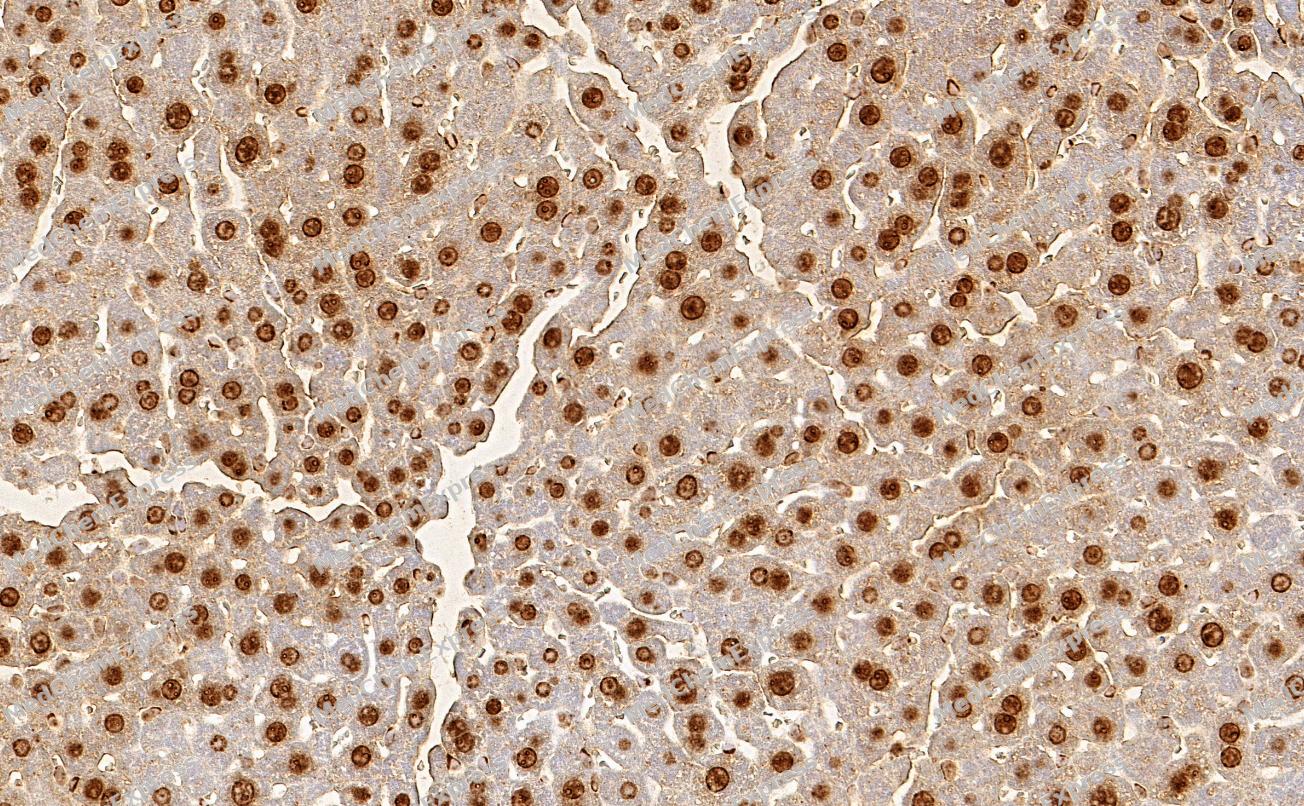 Immunohistochemical analysis of paraffin-embedded Mouse liver tissue using Nucleolin Antibody. The section was pre-treated using heat mediated antigen retrieval with sodium citrate buffer (pH 6.0) for 8 minutes. The tissues were blocked in QuickBlock for 20 minutes at room temperature, washed with ddH2O and PBS, and then probed with the primary antibody (HY-P80252, 1/200) in 4℃ overnight. The detection was performed using an HRP conjugated compact polymer system. DAB was used as the chromogen. Tissues were counterstained with hematoxylin and mounted with DPX.
 -
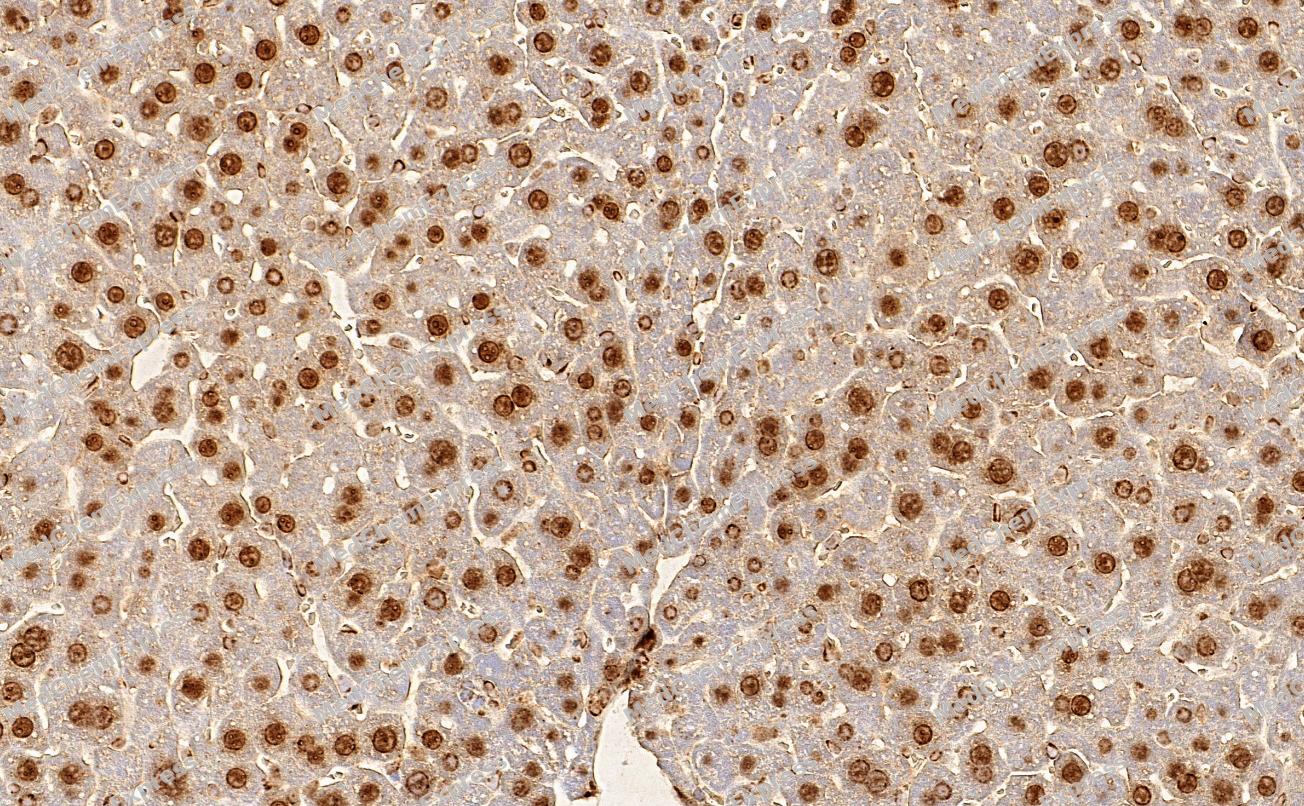 Immunohistochemical analysis of paraffin-embedded Mouse liver tissue using Nucleolin Antibody. The section was pre-treated using heat mediated antigen retrieval with sodium citrate buffer (pH 6.0) for 8 minutes. The tissues were blocked in QuickBlock for 20 minutes at room temperature, washed with ddH2O and PBS, and then probed with the primary antibody (HY-P80252, 1/200) in 4℃ overnight. The detection was performed using an HRP conjugated compact polymer system. DAB was used as the chromogen. Tissues were counterstained with hematoxylin and mounted with DPX.


Background
-
Function
Nucleolin is a Nucleolin is the major nucleolar protein of growing eukaryotic cells. It is found associated with intranucleolar chromatin and pre-ribosomal particles. It induces chromatin decondensation by binding to histone H1. It is thought to play a role in pre-rRNA transcription and ribosome assembly. May play a role in the process of transcriptional elongation. Binds RNA oligonucleotides with 5'-UUAGGG-3' repeats more tightly than the telomeric single-stranded DNA 5'-TTAGGG-3' repeats
-
Subcellular Localization
Nucleus, nucleolus; Cytoplasm
-
Subunit
Identified in a IGF2BP1-dependent mRNP granule complex containing untranslated mRNAs (PubMed:17289661). Component of the SWAP complex that consists of NPM1, NCL/nucleolin, PARP1 and SWAP70 (By similarity). Component of a complex which is at least composed of HTATSF1/Tat-SF1, the P-TEFb complex components CDK9 and CCNT1, RNA polymerase II, SUPT5H, and NCL/nucleolin (PubMed:10393184). Interacts with AICDA (By similarity). Interacts with APTX (PubMed:15044383). Interacts with C1QBP (PubMed:21536856). Interacts with ERBB4 (PubMed:20858735). Interacts (via C-terminus) with FMR1 isoform 6 (via N-terminus) (PubMed:24658146). Interacts with GZF1; this interaction is important for nucleolar localization of GZF1 (PubMed:17674968). Interacts with NSUN2 (PubMed:17215513). Interacts with NVL (PubMed:21474449). Interacts (via N-terminus domain) with SETX (PubMed:21700224). Interacts (via RRM1 and C-terminal RRM4/Arg/Gly-rich domains) with TERT; the interaction is important for nucleolar localization of TERT (PubMed:15371412). Interacts with WDR46 (PubMed:23848194). Interacts with ZFP36 (PubMed:20221403). Interacts with LRRC34 (By similarity). Interacts with RRP1B (PubMed:19710015). Interacts with HNRNPU; this interaction occurs during mitosis (PubMed:21242313). Interacts with RIOK1; RIOK1 recruits NCL to PRMT5 for symmetrically methylation (PubMed:21081503). Interacts with ZBTB7B (By similarity). Interacts with MDK; this interaction promotes NCL clustering and lateral movements of this complex into lipid rafts leading to MDK internalization (PubMed:12147681). Interacts with HDGF (isoform 1) (PubMed:26845719). Interacts with ALKBH2. Interacts with IGFBP5; this interaction is necessary for IGFBP5 localization to the nucleus (PubMed:26103640). Interacts with DDX24 (when ubiquitinated); this interaction may be important during ribosome biogenesis (PubMed:24980433)
-
SwissProt ID
-
Synonyms
Nucleolin, Protein C23, NCL
-
Research Field
Tags & Cell Markers


Documentation
-
Data Sheet (234 KB)
-
SDS (313 KB)
- English - EN (313 KB)
- Français - FR (313 KB)
- Deutsch - DE (313 KB)
- Norwegian - NO (313 KB)
- Español - ES (313 KB)
- Swedish - SV (313 KB)
- Italian - IT (313 KB)
- Korean - KR (313 KB)
- Portuguese - PT (313 KB)
-
User Guide for Antibodies (1077 KB)

 Powered by Bioz
