



Anticancer agent 118
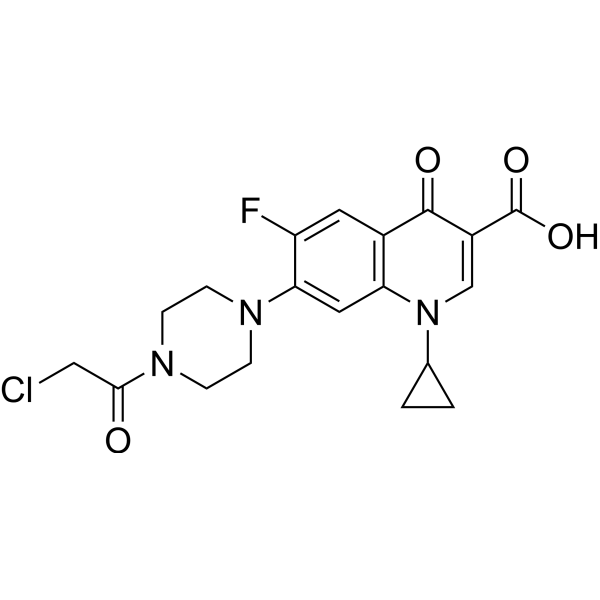
Anticancer agent 118, a N‑acylated ciprofloxacin derivative, has anti-bacterial and anticancer activities. Anticancer agent 118 shows high activity against Gram-positive strains and antiproliferative activities against prostate PC3 cells. Anticancer agent 118 can be used for antitumor research.
For research use only. We do not sell to patients.
- CAS No.: 864443-43-6
- Formula: C19H19ClFN3O4
- Molecular Weight:407.82
-
Storage:
Please store the product under the recommended conditions in the Certificate of Analysis.

To place orders, for customer services and technical support, please contact: MedChemExpress USA
Tel: 609-228-6898 E-mail: [email protected] [email protected]


-
 Biological Activity
-
Chemical Information
- Protocols
- Purity & Documentation
- References
-
 Help & FAQs




Biological Activity
Description
Cellular Effect
|
Cell Line

|
Type | Value | Description | References |
|---|---|---|---|---|
| A549 | IC50 |
10 μM
Compound: 2
|
Antitumor activity against human A549 cells after 5 days by MTT assay
Antitumor activity against human A549 cells after 5 days by MTT assay
|
[PMID: 19595598] |
| LoVo | IC50 |
17 μM
Compound: 2
|
Antitumor activity against human LoVo cells after 5 days by MTT assay
Antitumor activity against human LoVo cells after 5 days by MTT assay
|
[PMID: 19595598] |
| MCF7 | IC50 |
23 μM
Compound: 2
|
Antitumor activity against human MCF7 cells after 5 days by MTT assay
Antitumor activity against human MCF7 cells after 5 days by MTT assay
|
[PMID: 19595598] |
| PC-3 | IC50 |
8 μM
Compound: 2
|
Antitumor activity against human PC3 cells after 5 days by MTT assay
Antitumor activity against human PC3 cells after 5 days by MTT assay
|
[PMID: 19595598] |
| U-373MG ATCC | IC50 |
4 μM
Compound: 2
|
Antitumor activity against human U373MG cells after 5 days by MTT assay
Antitumor activity against human U373MG cells after 5 days by MTT assay
|
[PMID: 19595598] |
In Vitro
Anticancer agent 118 (Compound 3) (0-100 μΜ; 72 hours) shows high antiproliferative activities against prostate PC3 cells and induces apoptosis/necrosis in PC3 cells[1].
MedChemExpress (MCE) has not independently confirmed the accuracy of these methods. They are for reference only.
-
Cell Line:Prostate PC3 and HaCaT cells
-
Concentration:0-100 μΜ
-
Incubation Time:72 hours
-
Result:Showed high antiproliferative activities against prostate PC3 cells with an IC50 of 2.02 μM.
Reduced the growth and proliferation rates in prostate PC3cells, without acytotoxic action against normal HaCaT cell lines.
Induced apoptosis/necrosis in PC3 cells by increasing the intracellular ROS amount and diminished the IL-6 level in tumor cells.


Chemical Information
-
CAS No. 864443-43-6
-
Molecular Weight 407.82
-
Formula C19H19ClFN3O4
-
SMILES
O=C(C1=CN(C2CC2)C3=C(C=C(F)C(N4CCN(C(CCl)=O)CC4)=C3)C1=O)O
-
Shipping
Room temperature in continental US; may vary elsewhere.
-
Storage
Please store the product under the recommended conditions in the Certificate of Analysis.


Purity & Documentation
References

Calculators
Concentration (start) × Volume (start) = Concentration (final) × Volume (final)


Anticancer agent 118 Related Classifications
HY-154861 Related Classifications
 Powered by Bioz