



Antifungal agent 18

Based on 1 Customer Validation
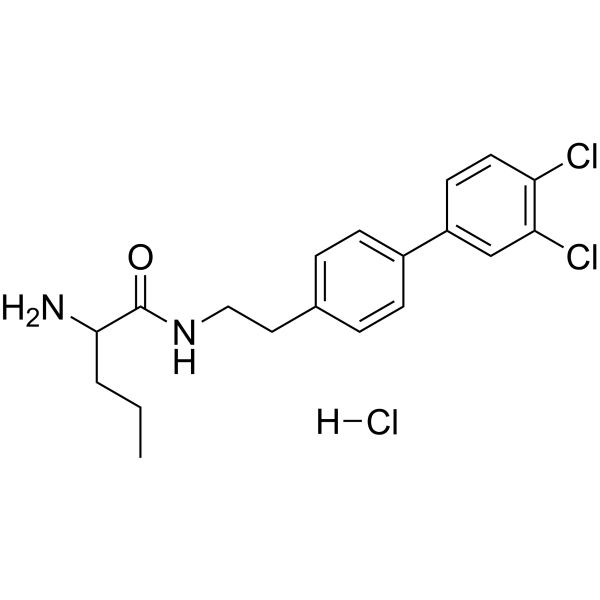
Antifungal agent 18 is an antifungal agent. Antifungal agent 18 shows a broad-spectrum antifungal activity against major human fungal pathogens. Antifungal agent 18 compromises fungal cell wall integrity by targeting the unfolded protein response (UPR), calcineurin, and MAPK pathways. Antifungal agent 18 shows antifungal activity in virto and vivo. Antifungal agent 18 can be used for the research of invasive fungal pathogens and cutaneous dermatophytes.
For research use only. We do not sell to patients.
- Purity : 98.08%
- CAS No.: 2572713-30-3
- Formula: C19H23Cl3N2O
- Molecular Weight:401.76
-
Storage:Powder -20°C, 3 years ; In solvent -80°C, 6 months , -20°C, 1 month

To place orders, for customer services and technical support, please contact: MedChemExpress USA
Tel: 609-228-6898 E-mail: [email protected] [email protected]


-
 Biological Activity
-
Chemical Information
-
Solvent & Solubility
- Purity & Documentation
- References
-
 Help & FAQs




Biological Activity
Description
In Vitro
Antifungal agent 18 (compound 22h) (0.5-128 μg/mL) shows antifungal activities to C.neoformans (H99), C.albicans (SC5314), C.glabrata (BG2), and A.fumigatus (af293) with MICs of 1, 2, 4, and 4 μg/mL, espectively[1].
Antifungal agent 18 (0.5-12.5 μM, 24 h) shows no significant cytotoxicity in HEK293T and HaCaT cells[1].
Antifungal agent 18 (0-32 μg/mL, 24 h) is a fast-acting fungicidal drug against a broad spectrum of human fungal pathogens causing invasive or cutaneous infection[1].
Antifungal agent 18 (40 days) does not induce resistance in C.albicans and C.glabrata[1].
Antifungal agent 18 (0-8 μg/mL, 24 h) distorts the cellular morphology and reduces the cell wall and capsule thickness of C.neoformans, and causes cytoplasmic detachment from the cell membrane in C.albicans[1].
Antifungal agent 18 (0-8 μg/mL, 0-2 h) activates the Mpk1 pathway, and increases HXL1 activation levels to activate the UPR pathway[1].
Antifungal agent 18 (8 μg/mL, 90 min) induces nuclear translocation of Crz1 to activate the calcineurin pathway[1].
Antifungal agent 18 (0.1 %-5 % w/w, 24 h) shows superior antifungal activity in a T.rubrum-infected nail model in a concentration-dependent manner[1].
MedChemExpress (MCE) has not independently confirmed the accuracy of these methods. They are for reference only. .
-
Cell Line:C.neoformans WT cells and C.neoformans H99 cells
-
Concentration:4 and 8 μg/mL
-
Incubation Time:30, 60, 90 min, and 2 h
-
Result:Increased pMpk1 levels within 30 min, which peaked at 60 min and decreased after 90 min.
Increased the ratio of HXL1s/HXL1u in a dose-dependent manner.
Parmacokinetics
| Species | Dose | Route | Cmax | AUC0-t | AUC0-∞ | T1/2 | MRT0-∞ | Vd | CL | F |
|---|---|---|---|---|---|---|---|---|---|---|
| Dog | 1 mg/kg | i.v. | 296.3 ng/mL | 2678 ng·h/mL | 5158 ng·h/mL | 24.27 h | 34.62 h | 7495 mL/kg | 205.1 mL/h/kg | / |
| Dog | 10 mg/kg | i.v. | 4389 ng/mL | 30527 ng·h/mL | 50507 ng·h/mL | 17.96 h | 25.25 h | 5148 mL/kg | 202.0 mL/h/kg | / |
| Dog | 10 mg/kg | p.o. | 1366 ng/mL | 23479 ng·h/mL | 42092 ng·h/mL | 19.59 h | 29.24 h | / | / | 76.9 % |
| Monkey | 10 mg/kg | i.v. | 1083 ng/mL | 7147 ng·h/mL | 17355 ng·h/mL | 31.29 h | 42.9 h | 27182 mL/kg | 754.3 mL/h/kg | / |
| Rat | 10 mg/kg | p.o. | 97.34 ng/mL | 526.7 ng·h/mL | 677.1 ng·h/mL | 2.84 h | 5.78 h | / | / | 39.8 % |
| Rat | 2 mg/kg | i.v. | 190.5 ng/mL | 264.9 ng·h/mL | 278.7 ng·h/mL | 1.91 h | 2.39 h | 19846 mL/kg | 7160 mL/h/kg | / |
In Vivo
MedChemExpress (MCE) has not independently confirmed the accuracy of these methods. They are for reference only.
-
Animal Model:Female BALB/c mice (7-week-old) subcutaneously injected with C.albicans cells[1]
-
Dosage:2 % w/w
-
Administration:topical application., 6, 24, and 48 h
-
Result:Resulted in a marked reduction in the size of inflammation.
Resulted in a relatively softer epidermal stratum corneum and a more compact epidermal keratin layer compared to the vehicle group.


Chemical Information
-
CAS No. 2572713-30-3
-
Appearance Solid
-
Molecular Weight 401.76
-
Formula C19H23Cl3N2O
-
Color White to off-white
-
SMILES
NC(CCC)C(NCCC1=CC=C(C2=CC(Cl)=C(Cl)C=C2)C=C1)=O.[H]Cl
-
Shipping
Room temperature in continental US; may vary elsewhere.
-
Storage
Powder -20°C 3 years In solvent -80°C 6 months -20°C 1 month


Solvent & Solubility
In Vitro:
DMSO : 100 mg/mL (248.90 mM; Need ultrasonic; Hygroscopic DMSO has a significant impact on the solubility of product, please use newly opened DMSO)
Please refer to the solubility information to select the appropriate solvent. Once prepared, please aliquot and store the solution to prevent product inactivation from repeated freeze-thaw cycles.
Storage method and period of stock solution: -80°C, 6 months; -20°C, 1 month. When stored at -80°C, please use it within 6 months. When stored at -20°C, please use it within 1 month.
Please refer to the solubility information to select the appropriate solvent. Once prepared, please aliquot and store the solution to prevent product inactivation from repeated freeze-thaw cycles.
Storage method and period of stock solution: -80°C, 6 months; -20°C, 1 month. When stored at -80°C, please use it within 6 months. When stored at -20°C, please use it within 1 month.
Concentration (start) × Volume (start) = Concentration (final) × Volume (final)


Purity & Documentation
-
Data Sheet (272 KB)
-
SDS (251 KB)
- English - EN (251 KB)
- Français - FR (251 KB)
- Deutsch - DE (251 KB)
- Norwegian - NO (251 KB)
- Español - ES (251 KB)
- Swedish - SV (251 KB)
- Italian - IT (251 KB)
- Korean - KR (251 KB)
- Portuguese - PT (251 KB)
-
Handling Instructions (2659 KB)
References


Complete Stock Solution Preparation Table
Please refer to the solubility information to select the appropriate solvent. Once prepared, please aliquot and store the solution to prevent product inactivation from repeated freeze-thaw cycles.
Storage method and period of stock solution: -80°C, 6 months; -20°C, 1 month. When stored at -80°C, please use it within 6 months. When stored at -20°C, please use it within 1 month.
| Optional Solvent | Concentration Solvent Mass | 1 mg | 5 mg | 10 mg | 25 mg |
|---|---|---|---|---|---|
| DMSO | 1 mM | 2.4890 mL | 12.4452 mL | 24.8905 mL | 62.2262 mL |
| 5 mM | 0.4978 mL | 2.4890 mL | 4.9781 mL | 12.4452 mL | |
| 10 mM | 0.2489 mL | 1.2445 mL | 2.4890 mL | 6.2226 mL | |
| 15 mM | 0.1659 mL | 0.8297 mL | 1.6594 mL | 4.1484 mL | |
| 20 mM | 0.1245 mL | 0.6223 mL | 1.2445 mL | 3.1113 mL | |
| 25 mM | 0.0996 mL | 0.4978 mL | 0.9956 mL | 2.4890 mL | |
| 30 mM | 0.0830 mL | 0.4148 mL | 0.8297 mL | 2.0742 mL | |
| 40 mM | 0.0622 mL | 0.3111 mL | 0.6223 mL | 1.5557 mL | |
| 50 mM | 0.0498 mL | 0.2489 mL | 0.4978 mL | 1.2445 mL | |
| 60 mM | 0.0415 mL | 0.2074 mL | 0.4148 mL | 1.0371 mL | |
| 80 mM | 0.0311 mL | 0.1556 mL | 0.3111 mL | 0.7778 mL | |
| 100 mM | 0.0249 mL | 0.1245 mL | 0.2489 mL | 0.6223 mL |


Antifungal agent 18 Related Classifications
HY-139903 Related Classifications
 Powered by Bioz
Keywords
- Antifungal agent 18
- 2572713-30-3
- Antifungal agent18
- Antifungal agent-18
- Fungal
- Calcineurin
- p38 MAPK
- antifungal
- broad-spectrum
- cell wall integrity
- UPR
- calcineurin
- Mpk1
- MAPK
- invasive fungal pathogens
- cutaneous dermatophytes
- C.neoformans
- C.albicans
- C.glabrata
- A.fumigatus
- T.rubrum-infected nail model
- C.albicans Infection model
- Inhibitor
- inhibitor
- inhibit