



Antifungal agent 42
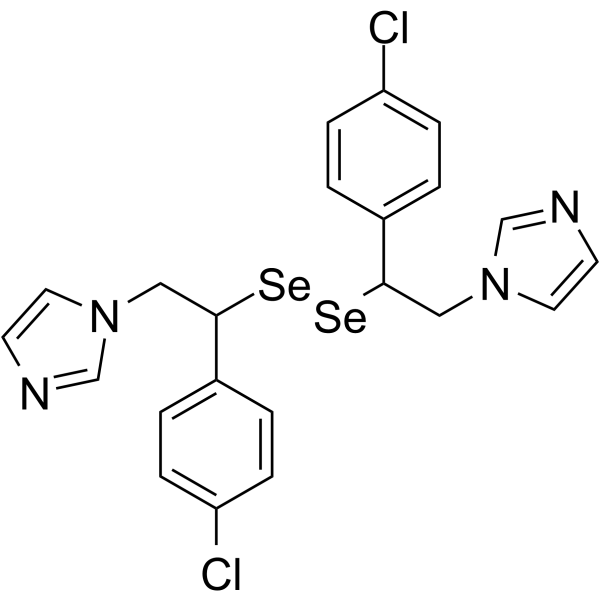
Antifungal agent 42 is an antifungal agent. Antifungal agent 42 has an inhibitory effect on lanosterol 14α-demethylase (CYP51) of C.alb.. Antifungal agent 42 inhibits biofilm formation.
For research use only. We do not sell to patients.
- CAS No.: 3033703-25-9
- Formula: C22H20Cl2N4Se2
- Molecular Weight:569.25
-
Storage:
Please store the product under the recommended conditions in the Certificate of Analysis.

To place orders, for customer services and technical support, please contact: MedChemExpress USA
Tel: 609-228-6898 E-mail: [email protected] [email protected]


-
 Biological Activity
-
Chemical Information
- Protocols
- Purity & Documentation
- References
-
 Help & FAQs




Biological Activity
Description
IC50 & Target
CYP51[1]
Cellular Effect
|
Cell Line

|
Type | Value | Description | References |
|---|---|---|---|---|
| HL-60 | IC50 |
12.5 μM
Compound: B03
|
Cytotoxicity against human HL-60 cells by MTT assay
Cytotoxicity against human HL-60 cells by MTT assay
|
[PMID: 36057236] |
| MDA-MB-231 | IC50 |
5.5 μM
Compound: B03
|
Cytotoxicity against human MDA-MB-231 cells by MTT assay
Cytotoxicity against human MDA-MB-231 cells by MTT assay
|
[PMID: 36057236] |
| PC-3 | IC50 |
2.91 μM
Compound: B03
|
Cytotoxicity against human PC-3 cells by MTT assay
Cytotoxicity against human PC-3 cells by MTT assay
|
[PMID: 36057236] |
In Vitro
Antifungal agent 42 (compound B03, 0.25-128 μg/mL) inhibits fungal activity with MIC values of 1-64 μg/mL[1].
Antifungal agent 42 (0.5 μg/mL, 1.5-24 h) displays antibiofilm activity against FCZ-Resistant C.alb[1].
Antifungal agent 42 (0-20 μM approximately) shows cytotoxicity against HL-60, MDA-MB-231 and PC-3 cells with IC50 values of 12.5, 5.5, 2.91 μM respectively[1].
MedChemExpress (MCE) has not independently confirmed the accuracy of these methods. They are for reference only. Further protocols information, click here.


Chemical Information
-
CAS No. 3033703-25-9
-
Molecular Weight 569.25
-
Formula C22H20Cl2N4Se2
-
SMILES
ClC1=CC=C(C([Se][Se]C(C2=CC=C(Cl)C=C2)CN3C=CN=C3)CN4C=CN=C4)C=C1
-
Shipping
Room temperature in continental US; may vary elsewhere.
-
Storage
Please store the product under the recommended conditions in the Certificate of Analysis.

Protocols
-
Fungal Biofilm Culture
Fungal biofilm culture is an in vitro method for growing surface-attached fungal communities, most commonly Candida albicans, on abiotic substrates such as polystyrene wells, silicone elastomer, or polymethylmethacrylate; the assay models adhesion, proliferation, filamentation, extracellular-matrix-associated maturation, and dispersion. Biofilm output can be read by optical density at 600 nm for adherent biomass, XTT reduction for metabolic activity, CFU recovery for viable attached or dispersed cells, and microscopy for architecture.


Purity & Documentation
References

Calculators
Concentration (start) × Volume (start) = Concentration (final) × Volume (final)


Antifungal agent 42 Related Classifications
HY-151440 Related Classifications
 Powered by Bioz