



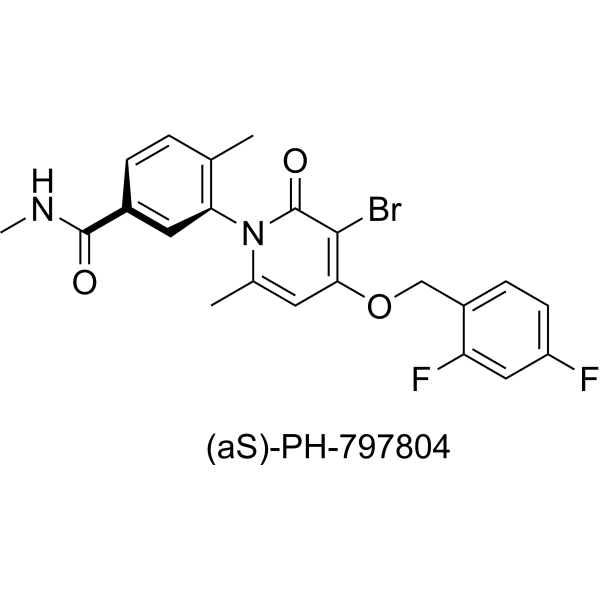
(aS)-PH-797804
Based on 7 publication(s) in Google Scholar
(aS)-PH-797804 is a selective p38 MAPK inhibitor with IC50 values for p38 α /β of 26 nM and 102 nM, respectively. (aS)-PH-797804 has anti-inflammatory activity.
For research use only. We do not sell to patients.
- CAS No.: 1358027-80-1
- Formula: C22H19BrF2N2O3
- Molecular Weight:477.30
-
Storage:
Please store the product under the recommended conditions in the Certificate of Analysis.

To place orders, for customer services and technical support, please contact: MedChemExpress USA
Tel: 609-228-6898 E-mail: [email protected] [email protected]


-
 Biological Activity
-
Chemical Information
- Protocols
- Purity & Documentation
- References
-
 Help & FAQs


Publications Citing Use of MedChemExpress (MCE) (aS)-PH-797804
More- Sci Transl Med. 2018 Jul 18;10(450):eaaq1093. [Abstract]
- Cell Death Dis. 2021 Oct 23;12(11):994. [Abstract]
- Cell Death Dis. 2018 May 1;9(5):500. [Abstract]
- Osteoarthritis Cartilage. 2022 Aug;30(8):1140-1153. [Abstract]
- J Pharmacol Exp Ther. 2019 Aug;370(2):219-230. [Abstract]
- Oral Dis. 2025 Oct 27. [Abstract]
- bioRxiv. 2023 Feb 8.


Biological Activity
Description
IC50 & Target
|
p38α 26 nM (IC50) |
p38β 102 nM (IC50) |


Chemical Information
-
CAS No. 1358027-80-1
-
Molecular Weight 477.30
-
Formula C22H19BrF2N2O3
-
SMILES
O=C(NC)C1=CC(N2C(C)=CC(OCC3=CC=C(F)C=C3F)=C(Br)C2=O)=C(C)C=C1.[(aS)-PH-797804]
-
Shipping
Room temperature in continental US; may vary elsewhere.
-
Storage
Please store the product under the recommended conditions in the Certificate of Analysis.


Publications (7)
-
Journal Impact Factor
-
Most Recent
-
Sci Transl Med
PP2A inhibition is a druggable MEK inhibitor resistance mechanism in KRAS-mutant lung cancer cells. [Abstract]2018 Jul 18;10(450):eaaq1093. PMID: 30021885 -
Cell Death Dis
Quantitative analysis of phosphoproteome in necroptosis reveals a role of TRIM28 phosphorylation in promoting necroptosis-induced cytokine production. [Abstract]2021 Oct 23;12(11):994. PMID: 34689152 -
Cell Death Dis
Necroptosis promotes cell-autonomous activation of proinflammatory cytokine gene expression. [Abstract]2018 May 1;9(5):500. PMID: 29703889 -
Osteoarthritis Cartilage
Chondrocyte apoptosis in temporomandibular joint osteoarthritis promotes bone resorption by enhancing chemotaxis of osteoclast precursors. [Abstract]2022 Aug;30(8):1140-1153. PMID: 35513247 -
J Pharmacol Exp Ther
Clinically Advanced p38 Inhibitors Suppress DUX4 Expression in Cellular and Animal Models of Facioscapulohumeral Muscular Dystrophy. [Abstract]2019 Aug;370(2):219-230. PMID: 31189728 -
Oral Dis
2025 Oct 27. PMID: 41146398 -

Protocols
-
Cotton Pellet Granuloma
Cotton pellet granuloma is a classical in vivo chronic inflammation model used to evaluate the anti-inflammatory potential of test substances by measuring their ability to inhibit granuloma tissue formation around an implanted foreign body (cotton pellet) in rodents. The method is based on the biological response to a sterile implanted material, which induces proliferative phase inflammation characterized by fibroblast proliferation and collagen-rich granuloma formation, and the final readout reflects the extent of chronic inflammatory tissue growth surrounding the pellet. In multiple preclinical pharmacological evaluations, inhibition of cotton pellet-induced granuloma formation has been used as an indicator of anti-inflammatory activity in both synthetic and natural product screening contexts.
-
Carrageenan-Induced Paw Edema
Carrageenan-induced paw edema is an acute inflammation model in which intraplantar injection of carrageenan induces localized inflammatory swelling characterized by vascular permeability, leukocyte infiltration, and production of inflammatory mediators such as prostaglandins and cytokines, making it widely used to evaluate anti-inflammatory agents in vivo. The resulting paw volume or thickness increase is quantified over time as a direct readout of inflammatory intensity and drug efficacy, typically reflecting cyclooxygenase-mediated prostaglandin-driven edema formation and immune cell recruitment in peripheral tissue[20].
-
Research Protocol for Inflammation-related Diseases
The NLRP3 inflammasome is a cytosolic innate immune signaling platform that integrates priming signals and danger-signal activation to promote caspase-1 activation, maturation of IL-1β and IL-18, and gasdermin D-mediated pyroptotic cell death. The core experimental logic is to determine whether inflammatory disease phenotypes are driven by increased NLRP3 expression, ASC-containing inflammasome assembly, caspase-1 cleavage, GSDMD cleavage, and extracellular release of IL-1β/IL-18 rather than by nonspecific cell injury alone. The pathway is strongly linked to inflammation-related disease phenotypes because monosodium urate crystals activate NALP3/NLRP3 inflammasome signaling in gout-like crystal inflammation, cholesterol crystals activate NLRP3 inflammasomes in atherogenesis models, and DSS-induced intestinal inflammation has been reported to involve NLRP3 inflammasome activity. However, experimental colitis studies also show context-dependent protective effects of NLRP3 inflammasome co


Purity & Documentation
References
[1]. Hope HR, et al. Anti-inflammatory properties of a novel N-phenyl pyridinone inhibitor of p38 mitogen-activated protein kinase: preclinical-to-clinical translation. J Pharmacol Exp Ther. 2009 Dec;331(3):882-95. [Content Brief]
[2]. Selness SR, et al. Discovery of PH-797804, a highly selective and potent inhibitor of p38 MAP kinase. Bioorg Med Chem Lett. 2011 Jul 1;21(13):4066-71. [Content Brief]

Calculators
Concentration (start) × Volume (start) = Concentration (final) × Volume (final)


(aS)-PH-797804 Related Classifications
HY-10403A Related Classifications
 Powered by Bioz