



Alizapride
Based on 1 publication(s) in Google Scholar
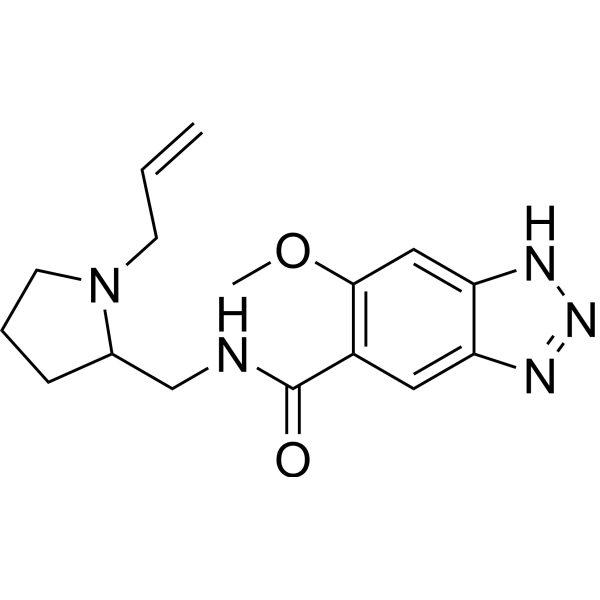
Alizapride is a potent antiemetic, acting as a dopamine receptor antagonist. Alizapride also used in human digestive disorders.
Nur für Forschungszwecke. Wir verkaufen nicht an Patienten.
- CAS. Nr.: 59338-93-1
- Formel: C16H21N5O2
- Molecular Weight:315.37
-
Speicherung:
Please store the product under the recommended conditions in the Certificate of Analysis.

To place orders, for customer services and technical support, please contact: MedChemExpress USA
Tel: 609-228-6898 E-mail: [email protected] [email protected]


-
 Biologische Aktivität
-
Chemical Information
- Reinheit & Dokumentation
- Verweise
-
 Help & FAQs


Publications Citing Use of MedChemExpress (MCE) Alizapride
MoreAlle Dopamine Receptor Isoform-spezifische Produkte anzeigen
More

Biologische Aktivität
Beschreibung
IC50 & Target
Dopamine 2 receptor
In Vivo
MedChemExpress (MCE) has not independently confirmed the accuracy of these methods. They are for reference only.
-
Animal Model:Male Duncan–Hartley guinea pigs[2]
-
Dosage:2.5, 5, 10, 25 μg/kg
-
Administration:Alizapride (2.5, 5, 10, 25 μg/kg; SC; 7 consecutive days)
-
Result:Reduced the clearance of IgG-sensitized RBCs.


Chemical Information
-
CAS. Nr. 59338-93-1
-
Molecular Weight 315.37
-
Formel C16H21N5O2
-
SMILES
O=C(C1=C(OC)C=C(NN=N2)C2=C1)NCC3N(CC=C)CCC3
-
Versand
Room temperature in continental US; may vary elsewhere.
-
Speicherung
Please store the product under the recommended conditions in the Certificate of Analysis.


Publications (1)
-
Journal Impact Factor
-
Most Recent
-
bioRxiv
A drug repurposing screen reveals dopamine signaling as a candidate therapeutic pathway for PIGA-CDG. [Abstract]2026 Apr 18:2026.04.17.719256. PMID: 42039650


Reinheit & Dokumentation
Verweise
[1]. P L Warzee, et al. Manometric study of the activity of alizapride on the motor function of the human sphincter of Oddi. J Clin Pharm Ther. 1988 Aug;13(4):281-4. [Content Brief]
[2]. Gomez, et al. Macrophage Fcgamma receptors expression is altered by treatment with dopaminergic drugs. Clinical immunology (Orlando, Fla.) vol. 90,3 (1999): 375-87. [Content Brief]
[3]. Seng, et al. Anti-emetic effect of high-dose metoclopramide vs alizapride--a randomised crossover study. British journal of clinical pharmacology vol. 38,3 (1994): 282-4. [Content Brief]

Calculators
Konzentration (Stammlösung) × Volumen (Stammlösung) = Konzentration (Ziellösung) × Volumen (Ziellösung)


Alizapride Related Classifications
HY-A0125 Related Classifications
 Powered by Bioz