



BI-9627
Based on 4 publication(s) in Google Scholar
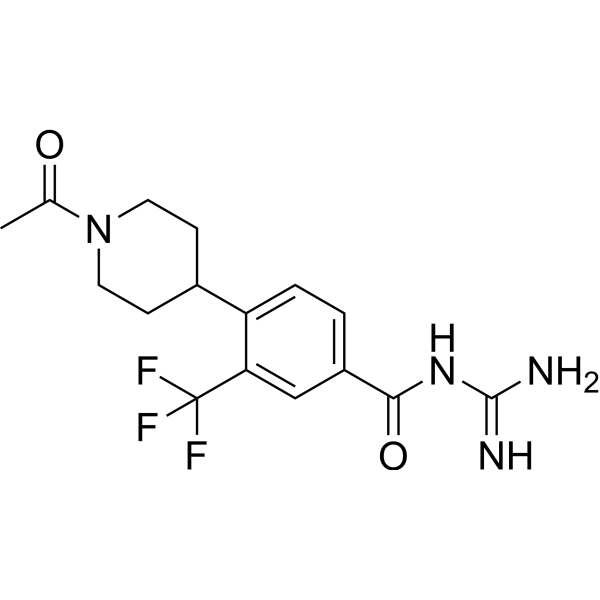
BI-9627, a chemical probe, is a potent sodium-hydrogen exchanger isoform 1 (NHE1) inhibitor (IC50 = 6 and 31 nM in intracellular pH recovery (pHi) and human platelet swelling assays). BI-9627 displays >30-fold selectivity against NHE2 and with no measurable inhibitory activity against the NHE3 isoform. BI-9627 decreases autophagy in HTR-8/SVneo cells. BI-9627 can significantly reduce the pHi of human sperm and partially reverse the effect of DMA. BI-9627 prolongs Ca2+ recovery time in KO hiPSC-CMs. BI-9627 shows low DDI (agent-agent interaction) potential, excellent pharmacokinetics in rat and dog, and remarkably potent activity in the isolated heart model of ischemia-reperfusion injury.
Nur für Forschungszwecke. Wir verkaufen nicht an Patienten.
The BI-9627 was designed by Boehringer Ingelheim and could be obtained free of charge through the Boehringer Ingelheim open innovation portal opnMe.com, associated with its negative control.
- Reinheit: 99.71%
- CAS. Nr.: 1204329-34-9
- Formel: C16H19F3N4O2
- Molecular Weight:356.34
-
Speicherung:Powder -20°C, 3 years , 4°C, 2 years ; In solvent -80°C, 6 months , -20°C, 1 month

To place orders, for customer services and technical support, please contact: MedChemExpress USA
Tel: 609-228-6898 E-mail: [email protected] [email protected]


-
 Biologische Aktivität
-
Chemical Information
-
Lösungsmittel & Löslichkeit
- Reinheit & Dokumentation
- Verweise
-
 Help & FAQs


Publications Citing Use of MedChemExpress (MCE) BI-9627
More

Biologische Aktivität
Beschreibung
IC50 & Target
IC50: 6 nM (NHE1 in intracellular pH recovery assay), 31 nM (NHE1 in human platelet swelling assay)[1]
Cellular Effect
|
Cell Line

|
Type | Value | Description | References |
|---|---|---|---|---|
| HEK293 | IC50 |
>30 μM
Compound: 60
|
Inhibition of human ERG expressed in HEK 293 cells by PatchXpress assay
Inhibition of human ERG expressed in HEK 293 cells by PatchXpress assay
|
[PMID: 22803959] |
| HT-29 | IC50 |
6 nM
Compound: 60
|
Inhibition of NHE1 in human HT-29 cells assessed as intracellular pH change after 30 mins
Inhibition of NHE1 in human HT-29 cells assessed as intracellular pH change after 30 mins
|
[PMID: 22803959] |
In Vitro
BI-9627 (Compound 60) exhibits the most potent inhibition of NHE1 among all tested compounds with IC50 of 6 and 31 nM in pHi assay and platelet swelling assay[1].
BI-9627 (10-100 nM, 0-80 min) provides a significantly beneficial effect on left-ventricular end diastolic pressure, preventing much of the increase seen postreperfusion for the vehicle control in the Langendorff isolated perfused rat heart model[1].
BI-9627 (50 nM, 2 h) leads to a significant decrease in LC3-II/I ratio in HTR-8/SVneo cells as well as human trophoblast cells, suggesting a decrease in autophagy[2].
BI-9627 (100 nM, 24 h) reverses the abnormalities in Ca2+-transient-related parameters in KO hiPSC-CMs[4].
BI-9627 (100 nM, 7 d) elevates diastolic Ca2+ levels and prolongs Ca2+ recovery time in KO hiPSC-CMs[4].
MedChemExpress (MCE) has not independently confirmed the accuracy of these methods. They are for reference only.
In Vivo
MedChemExpress (MCE) has not independently confirmed the accuracy of these methods. They are for reference only.


Chemical Information
-
CAS. Nr. 1204329-34-9
-
Appearance Solid
-
Molecular Weight 356.34
-
Formel C16H19F3N4O2
-
Color White to yellow
-
SMILES
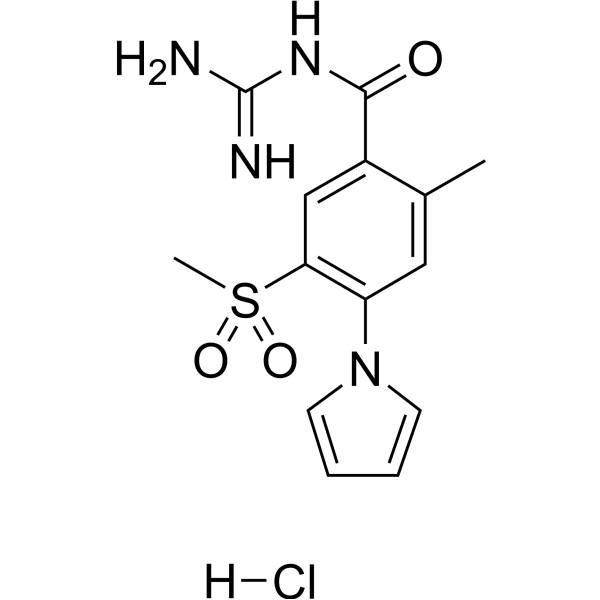
NC(NC(C1=CC=C(C2CCN(C(C)=O)CC2)C(C(F)(F)F)=C1)=O)=N
-
Versand
Room temperature in continental US; may vary elsewhere.
-
Speicherung
Powder -20°C 3 years 4°C 2 years In solvent -80°C 6 months -20°C 1 month


Publications (4)
-
Journal Impact Factor
-
Most Recent
-
Nat Commun
Human iPSC-based Modeling of Pulmonary Fibrosis Reveals p300/CBP Inhibition Suppresses Alveolar Transitional Cell State. [Abstract]2026 Feb 12;17(1):1214. PMID: 41680175 -
Cell Rep
Mitochondrial transplantation rescues Ca2+ homeostasis imbalance and myocardial hypertrophy in SLC25A3-related hypertrophic cardiomyopathy. [Abstract]2024 Dec 12;43(12):115065. PMID: 39671292 -
Hum Reprod
Flagellar pH homeostasis mediated by Na+/H+ exchangers regulates human sperm functions through coupling with CatSper and KSper activation. [Abstract]2024 Apr 3;39(4):674-688. PMID: 38366201 -
J Reprod Immunol
2026 Jun 24:176:104927. PMID: 42364290


Lösungsmittel & Löslichkeit
In Vitro:
DMSO : 100 mg/mL (280.63 mM; Need ultrasonic; Hygroscopic DMSO has a significant impact on the solubility of product, please use newly opened DMSO)
Please refer to the solubility information to select the appropriate solvent. Once prepared, please aliquot and store the solution to prevent product inactivation from repeated freeze-thaw cycles.
Storage method and period of stock solution: -80°C, 6 months; -20°C, 1 month. When stored at -80°C, please use it within 6 months. When stored at -20°C, please use it within 1 month.
Please refer to the solubility information to select the appropriate solvent. Once prepared, please aliquot and store the solution to prevent product inactivation from repeated freeze-thaw cycles.
Storage method and period of stock solution: -80°C, 6 months; -20°C, 1 month. When stored at -80°C, please use it within 6 months. When stored at -20°C, please use it within 1 month.
Konzentration (Stammlösung) × Volumen (Stammlösung) = Konzentration (Ziellösung) × Volumen (Ziellösung)
In Vivo:
Select the appropriate dissolution method based on your experimental animal and administration route.
- For the following dissolution methods, please ensure to first prepare a clear stock solution using an In Vitro approach and then sequentially add co-solvents:
- To ensure reliable experimental results, the clarified stock solution can be appropriately stored based on storage conditions. As for the working solution for In Vivo experiments, it is recommended to prepare freshly and use it on the same day.
- The percentages shown for the solvents indicate their volumetric ratio in the final prepared solution. If precipitation or phase separation occurs during preparation, heat and/or sonication can be used to aid dissolution.
Add each solvent one by one: 10% DMSO 40% PEG300 5% Tween-80 45% Saline
Solubility: ≥ 2.08 mg/mL (5.84 mM); Clear solution
This protocol yields a clear solution of ≥ 2.08 mg/mL (saturation unknown).
Taking 1 mL working solution as an example, add 100 μL DMSO stock solution (20.8 mg/mL) to 400 μL PEG300, and mix evenly; then add 50 μL Tween-80 and mix evenly; then add 450 μL Saline to adjust the volume to 1 mL.
Preparation of Saline: Dissolve 0.9 g sodium chloride in ddH₂O and dilute to 100 mL to obtain a clear Saline solution.
Add each solvent one by one: 10% DMSO 90% (20% SBE-β-CD in Saline)
Solubility: ≥ 2.08 mg/mL (5.84 mM); Clear solution
This protocol yields a clear solution of ≥ 2.08 mg/mL (saturation unknown).
Taking 1 mL working solution as an example, add 100 μL DMSO stock solution (20.8 mg/mL) to 900 μL 20% SBE-β-CD in Saline, and mix evenly.
Preparation of 20% SBE-β-CD in Saline (4°C, storage for one week): 2 g SBE-β-CD powder is dissolved in 10 mL Saline, completely dissolve until clear.
In Vivo Dissolution Calculator
Please enter the basic information of animal experiments:
-
-
-
-
Recommended: Prepare an additional quantity of animals to account for potential losses during experiments.
Please enter your animal formula composition:
-
%DMSO +
Recommended: Keep the proportion of DMSO in working solution below 2% if your animal is weak.
-
%+
-
+%Tween-80 + +
-
%Saline +
The co-solvents required include: DMSO, . All of co-solvents are available by MedChemExpress (MCE). , Tween 80. All of co-solvents are available by MedChemExpress (MCE).
Working solution concentration: 0.22 mg/mL
Method for preparing stock solution: mg drug dissolved in μL DMSO. Stock solution concentration: mg/mL.
1. Take μL DMSO stock solution;
2. Add μL .
μL , mix evenly;
3. Then add μL Tween 80, mix evenly;
4. Then add μL
Please ensure that the stock solution in the first step is dissolved to a clear state, and add co-solvents in sequence. You can use ultrasonic heating (ultrasonic cleaner, recommended frequency 20-40 kHz), vortexing, etc. to assist dissolution.


Reinheit & Dokumentation
-
Data Sheet (275 KB)
-
SDS (251 KB)
- English - EN (251 KB)
- Français - FR (251 KB)
- Deutsch - DE (251 KB)
- Norwegian - NO (251 KB)
- Español - ES (251 KB)
- Swedish - SV (251 KB)
- Italian - IT (251 KB)
- Korean - KR (251 KB)
- Portuguese - PT (251 KB)
-
Handling Instructions (2659 KB)
Verweise
[1]. Huber JD, et al. Identification of a potent sodium hydrogen exchanger isoform 1 (NHE1) inhibitor with a suitableprofile for chronic dosing and demonstrated cardioprotective effects in a preclinical model of myocardial infarction in the rat. J Med Chem. 2012 Aug 23;55(16):7114-40. [Content Brief]
[2]. Chen, M., et al., (2023). An abnormal LPA/LPAR1-NHE1 axis leads to the autophagy deficiency of trophoblast cells in recurrent spontaneous abortion. Reproduction (Cambridge, England), 166(5), 357–368. [Content Brief]
[3]. Liang, M., et al., (2024). Flagellar pH homeostasis mediated by Na+/H+ exchangers regulates human sperm functions through coupling with CatSper and KSper activation. Human reproduction (Oxford, England), 39(4), 674–688. [Content Brief]
[4]. Li, S., et al., (2024). Mitochondrial transplantation rescues Ca2+ homeostasis imbalance and myocardial hypertrophy in SLC25A3-related hypertrophic cardiomyopathy. Cell reports, 43(12), 115065. [Content Brief]


Complete Stock Solution Preparation Table
Please refer to the solubility information to select the appropriate solvent. Once prepared, please aliquot and store the solution to prevent product inactivation from repeated freeze-thaw cycles.
Storage method and period of stock solution: -80°C, 6 months; -20°C, 1 month. When stored at -80°C, please use it within 6 months. When stored at -20°C, please use it within 1 month.
| Optional Solvent | Concentration Solvent Mass | 1 mg | 5 mg | 10 mg | 25 mg |
|---|---|---|---|---|---|
| DMSO | 1 mM | 2.8063 mL | 14.0315 mL | 28.0631 mL | 70.1577 mL |
| 5 mM | 0.5613 mL | 2.8063 mL | 5.6126 mL | 14.0315 mL | |
| 10 mM | 0.2806 mL | 1.4032 mL | 2.8063 mL | 7.0158 mL | |
| 15 mM | 0.1871 mL | 0.9354 mL | 1.8709 mL | 4.6772 mL | |
| 20 mM | 0.1403 mL | 0.7016 mL | 1.4032 mL | 3.5079 mL | |
| 25 mM | 0.1123 mL | 0.5613 mL | 1.1225 mL | 2.8063 mL | |
| 30 mM | 0.0935 mL | 0.4677 mL | 0.9354 mL | 2.3386 mL | |
| 40 mM | 0.0702 mL | 0.3508 mL | 0.7016 mL | 1.7539 mL | |
| 50 mM | 0.0561 mL | 0.2806 mL | 0.5613 mL | 1.4032 mL | |
| 60 mM | 0.0468 mL | 0.2339 mL | 0.4677 mL | 1.1693 mL | |
| 80 mM | 0.0351 mL | 0.1754 mL | 0.3508 mL | 0.8770 mL | |
| 100 mM | 0.0281 mL | 0.1403 mL | 0.2806 mL | 0.7016 mL |


BI-9627 Related Classifications
HY-18071 Related Classifications
 Powered by Bioz