



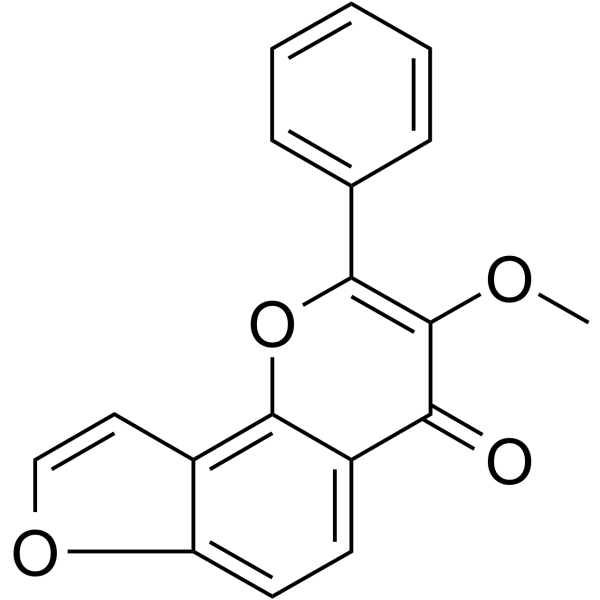
Karanjin
Based on 2 publication(s) in Google Scholar
Karanjin is an orally active furanoflavonoid which can be isolated from several Leguminosae. Karanjin exhibits evident anti-diabetic, anti-cancer, anti-inflammatory, antioxidant, anticolitis, anti-ulcer, anti-Alzheimer properties and multiple insect repellent/insecticidal, acaricide properties, suggesting the potential of Karanjin to be applied to relevant research.
For research use only. We do not sell to patients.
- Purity: 99.96%
- CAS No.: 521-88-0
- Formula: C18H12O4
- Molecular Weight:292.29
-
Storage:
4°C, sealed storage, away from moisture and light
* In solvent : -80°C, 6 months; -20°C, 1 month (sealed storage, away from moisture and light)

To place orders, for customer services and technical support, please contact: MedChemExpress USA
Tel: 609-228-6898 E-mail: [email protected] [email protected]


-
 Biological Activity
-
Chemical Information
-
Solvent & Solubility
- Purity & Documentation
- References
-
 Help & FAQs



Publications Citing Use of MedChemExpress (MCE) Karanjin
More Customer Validation & Images

-
Cell Proliferation/Viability Assay

-
Histological Imaging/Staining

-
RT-PCR

-
ELISA

-
WB

All AMPK Isoforms
More

Biological Activity
Description
Cellular Effect
|
Cell Line

|
Type | Value | Description | References |
|---|---|---|---|---|
| BV-2 | IC50 |
>100 μM
Compound: 5
|
Anti-neuroinflammatory activity against mouse BV2 cells assessed as inhibition of LPS-induced nitric oxide production after 24 hrs by Griess assay
Anti-neuroinflammatory activity against mouse BV2 cells assessed as inhibition of LPS-induced nitric oxide production after 24 hrs by Griess assay
|
[PMID: 25466192] |
In Vitro
Karanjin (10-25 μM, 16 h) enhances glucose uptake in L6-GLUT4 myc cells through stimulates translocation of GLUT4 to plasma membrane-associated with activation of AMPK pathway and inhibits the activity of PTPase in a dose-dependent manner. Shows no significant effect on cell viability[1].
Karanjin (4-8 μM, 72 h) blocks the cell cycle of A549 and HL-60 markedly as well as induces significant cell apoptosis[1].
Karanjin (80, 160 μM, 30 min) decreases ROS level by inhibition of I-κB degradation resulting in restriction of NF-κB nuclear translocation in Hela cells[1].
MedChemExpress (MCE) has not independently confirmed the accuracy of these methods. They are for reference only.
-
Cell Line:A549, HL-60
-
Concentration:4, 6, 8 μM for A549, 2, 4, 6 μM for HL-60
-
Incubation Time:72 h
-
Result:Blocked the cell cycle markedly at G2/M phase of A549 (>60% for 8 μM) and HL-60 (>40% for 6 μM)
In Vivo
Karanjin (20 mg/kg/d, p.o., 21 d) reduces joint injury and cartilage damage along with edema and erythema in the AIA model rats[1].
Karanjin (10, 20 mg/kg/d, p.o., 14 d) significantly decreases serum ACP, ALP and TNFα levels in the AIA model rats [1].
Karanjin (25 or 50 mg/kg/d, p.o. or i.g., 8 d) improved learning and memory in Diazepam-induced amnesia mice[1].
MedChemExpress (MCE) has not independently confirmed the accuracy of these methods. They are for reference only.
-
Animal Model:Streptozotocin-induced diabetic rats[1]
-
Dosage:50, 100 mg/kg
-
Administration:Oral gavage (p.o.), wait for 6h
-
Result:Lowered the blood glucose level by 11.7% and 20.7% at 50 and 100 mg/kg gavage.
-
Animal Model:Adjuvant induced arthritis model (AIA) Wistar strain male albino rats[1]
-
Dosage:10, 20 mg/kg/d
-
Administration:Oral gavage (p.o.), 14 d for serum assay, 21 d for histological examination
-
Result:Reduced articular cartilage damage, cellular infiltration in the articular cartilage and spongy bone damage significantly. Decreased serum acid phosphatase, alkaline phosphatase levels and TNFα level markedly.
-
Animal Model:Diazepam-induced male swiss albino mice [1]
-
Dosage:25, 50 mg/kg/d
-
Administration:Oral gavage (p.o.) or Intraperitoneal injection (i.p.) for 8 d
-
Result:Decreased the transfer latency on all the observation days, significantly reversed diazepam-induced amnesia, indicating improved learning and memory in treated mice.


Chemical Information
-
CAS No. 521-88-0
-
Appearance Solid
-
Molecular Weight 292.29
-
Formula C18H12O4
-
Color White to off-white
-
SMILES
O=C1C2=CC=C(OC=C3)C3=C2OC(C4=CC=CC=C4)=C1OC
-
Structure Classification
-
Initial Source
-
Shipping
Room temperature in continental US; may vary elsewhere.
-
Storage
4°C, sealed storage, away from moisture and light
* In solvent : -80°C, 6 months; -20°C, 1 month (sealed storage, away from moisture and light)


Publications (2)
-
Journal Impact Factor
-
Most Recent
-
Phytomedicine
2025 Oct:146:157099. PMID: 40774011 -
Chem Biol Drug Des
The protective effect of karanjin against sepsis-induced acute lung injury in mice is involved in the suppression of the TLR4 pathway. [Abstract]2024 Jul;104(1):e14579. PMID: 39013775
Karanjin purchased from MedChemExpress. Usage Cited in: Chem Biol Drug Des. 2024 Jul;104(1):e14579. [Abstract]
The MLE-12 cell viability was scrutinized by CCK-8 assay treated with Karanjin (0, 5, 10, 15 μg/mL).
Karanjin purchased from MedChemExpress. Usage Cited in: Chem Biol Drug Des. 2024 Jul;104(1):e14579. [Abstract]
The histological changes of the lung tissues were evaluated by H&E staining treated with Karanjin (200 mg/kg, i.g.).
Karanjin purchased from MedChemExpress. Usage Cited in: Chem Biol Drug Des. 2024 Jul;104(1):e14579. [Abstract]
The mRNA levels of IL-1β, IL-6, and TNF-α in lung tissues were assessed by qRT-PCR treated with Karanjin (200 mg/kg, i.g.).
Karanjin purchased from MedChemExpress. Usage Cited in: Chem Biol Drug Des. 2024 Jul;104(1):e14579. [Abstract]
The secretion levels of IL-1β, IL-6, and TNF-α in BALF were assessed by ELISA treated with Karanjin (200 mg/kg, i.g.).
Karanjin purchased from MedChemExpress. Usage Cited in: Chem Biol Drug Des. 2024 Jul;104(1):e14579. [Abstract]
The protein level of nuclear NF-κB p65 in lung tissues were determined by western blotting treated with Karanjin (200 mg/kg, i.g.).


Solvent & Solubility
In Vitro:
DMSO : 25 mg/mL (85.53 mM; ultrasonic and warming and heat to 60°C; Hygroscopic DMSO has a significant impact on the solubility of product, please use newly opened DMSO)
Please refer to the solubility information to select the appropriate solvent. Once prepared, please aliquot and store the solution to prevent product inactivation from repeated freeze-thaw cycles.
Storage method and period of stock solution: -80°C, 6 months; -20°C, 1 month (sealed storage, away from moisture and light). When stored at -80°C, please use it within 6 months. When stored at -20°C, please use it within 1 month.
Please refer to the solubility information to select the appropriate solvent. Once prepared, please aliquot and store the solution to prevent product inactivation from repeated freeze-thaw cycles.
Storage method and period of stock solution: -80°C, 6 months; -20°C, 1 month (sealed storage, away from moisture and light). When stored at -80°C, please use it within 6 months. When stored at -20°C, please use it within 1 month.
Concentration (start) × Volume (start) = Concentration (final) × Volume (final)
In Vivo:
Select the appropriate dissolution method based on your experimental animal and administration route.
- For the following dissolution methods, please ensure to first prepare a clear stock solution using an In Vitro approach and then sequentially add co-solvents:
- To ensure reliable experimental results, the clarified stock solution can be appropriately stored based on storage conditions. As for the working solution for In Vivo experiments, it is recommended to prepare freshly and use it on the same day.
- The percentages shown for the solvents indicate their volumetric ratio in the final prepared solution. If precipitation or phase separation occurs during preparation, heat and/or sonication can be used to aid dissolution.
In Vivo Dissolution Calculator
Please enter the basic information of animal experiments:
-
-
-
-
Recommended: Prepare an additional quantity of animals to account for potential losses during experiments.
Please enter your animal formula composition:
-
%DMSO +
Recommended: Keep the proportion of DMSO in working solution below 2% if your animal is weak.
-
%+
-
+%Tween-80 + +
-
%Saline +
The co-solvents required include: DMSO, . All of co-solvents are available by MedChemExpress (MCE). , Tween 80. All of co-solvents are available by MedChemExpress (MCE).
Working solution concentration: 0.22 mg/mL
Method for preparing stock solution: mg drug dissolved in μL DMSO. Stock solution concentration: mg/mL. * In solvent : -80°C, 6 months; -20°C, 1 month (sealed storage, away from moisture and light)
1. Take μL DMSO stock solution;
2. Add μL .
μL , mix evenly;
3. Then add μL Tween 80, mix evenly;
4. Then add μL
Please ensure that the stock solution in the first step is dissolved to a clear state, and add co-solvents in sequence. You can use ultrasonic heating (ultrasonic cleaner, recommended frequency 20-40 kHz), vortexing, etc. to assist dissolution.


Purity & Documentation
-
Data Sheet (284 KB)
-
SDS (396 KB)
- English - EN (396 KB)
- Français - FR (396 KB)
- Deutsch - DE (396 KB)
- Norwegian - NO (396 KB)
- Español - ES (396 KB)
- Swedish - SV (396 KB)
- Italian - IT (396 KB)
- Korean - KR (396 KB)
- Portuguese - PT (396 KB)
-
Handling Instructions (2659 KB)
References
[1]. Singh A, et al. Karanjin. Phytochemistry. 2021,183:112641. [Content Brief]
[2]. Jaiswal N, et al.Karanjin from Pongamia pinnata induces GLUT4 translocation in skeletal muscle cells in a phosphatidylinositol-3-kinase-independent manner. Eur J Pharmacol. 2011 Nov 16;670(1):22-8. [Content Brief]
[3]. Guo JR, et al. Effects of karanjin on cell cycle arrest and apoptosis in human A549, HepG2 and HL-60 cancercells. Biol Res. 2015 Jul 26;48:40. [Content Brief]


Complete Stock Solution Preparation Table
Please refer to the solubility information to select the appropriate solvent. Once prepared, please aliquot and store the solution to prevent product inactivation from repeated freeze-thaw cycles.
Storage method and period of stock solution: -80°C, 6 months; -20°C, 1 month (sealed storage, away from moisture and light). When stored at -80°C, please use it within 6 months. When stored at -20°C, please use it within 1 month.
| Optional Solvent | Concentration Solvent Mass | 1 mg | 5 mg | 10 mg | 25 mg |
|---|---|---|---|---|---|
| DMSO | 1 mM | 3.4213 mL | 17.1063 mL | 34.2126 mL | 85.5315 mL |
| 5 mM | 0.6843 mL | 3.4213 mL | 6.8425 mL | 17.1063 mL | |
| 10 mM | 0.3421 mL | 1.7106 mL | 3.4213 mL | 8.5531 mL | |
| 15 mM | 0.2281 mL | 1.1404 mL | 2.2808 mL | 5.7021 mL | |
| 20 mM | 0.1711 mL | 0.8553 mL | 1.7106 mL | 4.2766 mL | |
| 25 mM | 0.1369 mL | 0.6843 mL | 1.3685 mL | 3.4213 mL | |
| 30 mM | 0.1140 mL | 0.5702 mL | 1.1404 mL | 2.8510 mL | |
| 40 mM | 0.0855 mL | 0.4277 mL | 0.8553 mL | 2.1383 mL | |
| 50 mM | 0.0684 mL | 0.3421 mL | 0.6843 mL | 1.7106 mL | |
| 60 mM | 0.0570 mL | 0.2851 mL | 0.5702 mL | 1.4255 mL | |
| 80 mM | 0.0428 mL | 0.2138 mL | 0.4277 mL | 1.0691 mL |


Karanjin Related Classifications
HY-N2534 Related Classifications
 Powered by Bioz