



ATG7-IN-2
Based on 2 publication(s) in Google Scholar
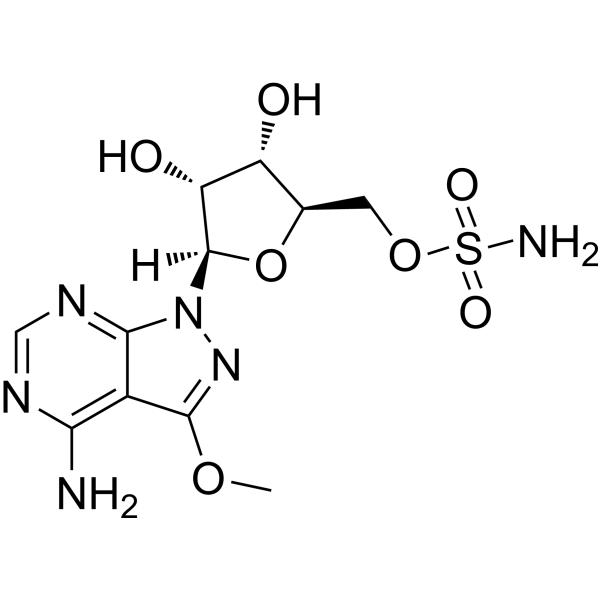
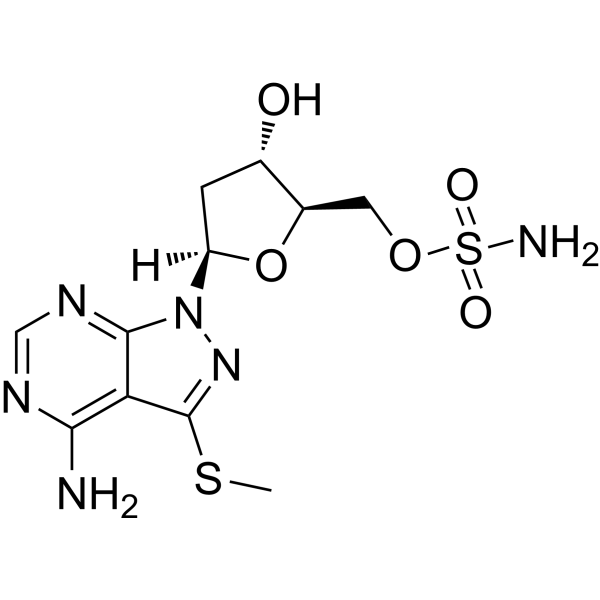
ATG7-IN-2 (compound 1) is a potent ATG7 inhibitor, with an IC50 of 0.089 μM. ATG7-IN-2 inhibits autophagy marker LC3B.
For research use only. We do not sell to patients.
- Purity : 99.32%
- CAS No.: 2226227-75-2
- Formula: C11H16N6O7S
- Molecular Weight:376.35
-
Storage:Powder -20°C, 3 years , 4°C, 2 years ; In solvent -80°C, 6 months , -20°C, 1 month

To place orders, for customer services and technical support, please contact: MedChemExpress USA
Tel: 609-228-6898 E-mail: [email protected] [email protected]


-
 Biological Activity
-
Chemical Information
-
Solvent & Solubility
- Protocols
- Purity & Documentation
- References
-
 Help & FAQs


Publications Citing Use of MedChemExpress (MCE) ATG7-IN-2
More

Biological Activity
Description
IC50 & Target
IC50: 0.089 μM (ATG7)[1]
Cellular Effect
|
Cell Line

|
Type | Value | Description | References |
|---|---|---|---|---|
| NCI-H1650 | EC50 |
5.94 μM
Compound: 1
|
Antiproliferative activity against human H1650 cells assessed as reduction in cell viability after 72 hrs by cell titer glow assay
Antiproliferative activity against human H1650 cells assessed as reduction in cell viability after 72 hrs by cell titer glow assay
|
[PMID: 32912429] |
In Vitro
ATG7-IN-2 inhibits the formation of the ATG7-ATG8 thioester in HEK293 cell with an IC50 of 0.335 μM, suppresses the LC3B lipidation in H4 cell with an IC50 of 2.6 μM, and reduces the cell viability H1650 with an EC50 of 2.6 μM[1].
MedChemExpress (MCE) has not independently confirmed the accuracy of these methods. They are for reference only.


Chemical Information
-
CAS No. 2226227-75-2
-
Appearance Solid
-
Molecular Weight 376.35
-
Formula C11H16N6O7S
-
Color White to off-white
-
SMILES
O[C@H]1[C@](O[C@@H]([C@H]1O)COS(N)(=O)=O)([H])N2C3=NC=NC(N)=C3C(OC)=N2
-
Shipping
Room temperature in continental US; may vary elsewhere.
-
Storage
Powder -20°C 3 years 4°C 2 years In solvent -80°C 6 months -20°C 1 month


Publications (2)
-
Journal Impact Factor
-
Most Recent
-
Cell
2026 Apr 2;189(7):1923-1941.e26. PMID: 41785850 -


Solvent & Solubility
In Vitro:
DMSO : 100 mg/mL (265.71 mM; Need ultrasonic; Hygroscopic DMSO has a significant impact on the solubility of product, please use newly opened DMSO)
H2O : 0.5 mg/mL (1.33 mM; ultrasonic and warming and heat to 60°C)
Please refer to the solubility information to select the appropriate solvent. Once prepared, please aliquot and store the solution to prevent product inactivation from repeated freeze-thaw cycles.
Storage method and period of stock solution: -80°C, 6 months; -20°C, 1 month. When stored at -80°C, please use it within 6 months. When stored at -20°C, please use it within 1 month.
* Note: If you choose water as the stock solution, please dilute it to the working solution, then filter and sterilize it with a 0.22 μm filter before use.
Please refer to the solubility information to select the appropriate solvent. Once prepared, please aliquot and store the solution to prevent product inactivation from repeated freeze-thaw cycles.
Storage method and period of stock solution: -80°C, 6 months; -20°C, 1 month. When stored at -80°C, please use it within 6 months. When stored at -20°C, please use it within 1 month.
* Note: If you choose water as the stock solution, please dilute it to the working solution, then filter and sterilize it with a 0.22 μm filter before use.
Concentration (start) × Volume (start) = Concentration (final) × Volume (final)
In Vivo:
For the following dissolution methods, please prepare the working solution directly:
It is recommended to prepare fresh solutions and use them promptly within a short period of time.
The percentages shown for the solvents indicate their volumetric ratio in the final prepared solution. If precipitation or phase separation occurs during preparation, heat and/or sonication can be used to aid dissolution.
Add each solvent one by one: Saline
Solubility: 25 mg/mL (66.43 mM); Clear solution; Need ultrasonic and adjust pH to 1 with 1M HCl
Add each solvent one by one: 20% HP-β-CD in Saline
Solubility: 25 mg/mL (66.43 mM); Clear solution; Need ultrasonic and adjust pH to 4 with 1M HCl


Purity & Documentation
-
Data Sheet (278 KB)
-
SDS (251 KB)
- English - EN (251 KB)
- Français - FR (251 KB)
- Deutsch - DE (251 KB)
- Norwegian - NO (251 KB)
- Español - ES (251 KB)
- Swedish - SV (251 KB)
- Italian - IT (251 KB)
- Korean - KR (251 KB)
- Portuguese - PT (251 KB)
-
Handling Instructions (2659 KB)
References


Complete Stock Solution Preparation Table
Please refer to the solubility information to select the appropriate solvent. Once prepared, please aliquot and store the solution to prevent product inactivation from repeated freeze-thaw cycles.
Storage method and period of stock solution: -80°C, 6 months; -20°C, 1 month. When stored at -80°C, please use it within 6 months. When stored at -20°C, please use it within 1 month.
| Optional Solvent | Concentration Solvent Mass | 1 mg | 5 mg | 10 mg | 25 mg |
|---|---|---|---|---|---|
| H2O / DMSO | 1 mM | 2.6571 mL | 13.2855 mL | 26.5710 mL | 66.4275 mL |
| DMSO | 5 mM | 0.5314 mL | 2.6571 mL | 5.3142 mL | 13.2855 mL |
| 10 mM | 0.2657 mL | 1.3286 mL | 2.6571 mL | 6.6428 mL | |
| 15 mM | 0.1771 mL | 0.8857 mL | 1.7714 mL | 4.4285 mL | |
| 20 mM | 0.1329 mL | 0.6643 mL | 1.3286 mL | 3.3214 mL | |
| 25 mM | 0.1063 mL | 0.5314 mL | 1.0628 mL | 2.6571 mL | |
| 30 mM | 0.0886 mL | 0.4429 mL | 0.8857 mL | 2.2143 mL | |
| 40 mM | 0.0664 mL | 0.3321 mL | 0.6643 mL | 1.6607 mL | |
| 50 mM | 0.0531 mL | 0.2657 mL | 0.5314 mL | 1.3286 mL | |
| 60 mM | 0.0443 mL | 0.2214 mL | 0.4429 mL | 1.1071 mL | |
| 80 mM | 0.0332 mL | 0.1661 mL | 0.3321 mL | 0.8303 mL | |
| 100 mM | 0.0266 mL | 0.1329 mL | 0.2657 mL | 0.6643 mL |
* Note: If you choose water as the stock solution, please dilute it to the working solution, then filter and sterilize it with a 0.22 μm filter before use.


ATG7-IN-2 Related Classifications
HY-146130 Related Classifications
 Powered by Bioz