



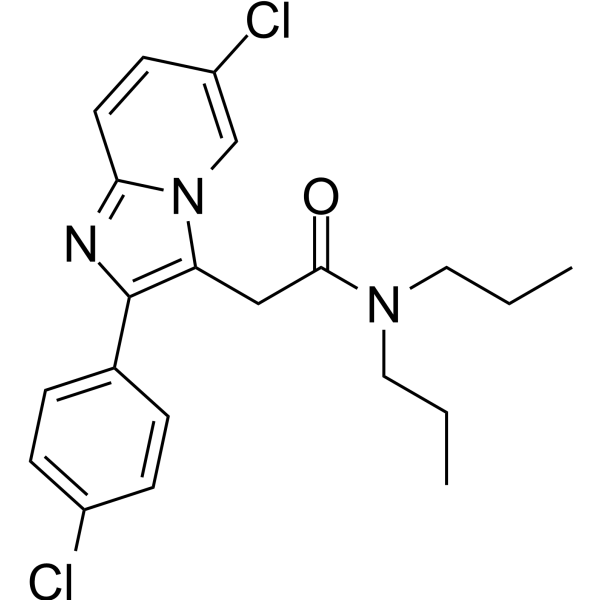
Alpidem

Based on 1 Customer Validation
Alpidem, an anxiolytic agent, is an orally active and brain-penetrant GABAA receptor ligand, binds to α1β2γ2 subunit-containing GABAA receptors (IC50 of 17 nM) over α5β2γ2 subunit-containing GABAA receptors (IC50 of >10 μM). Alpidem modulates calcium-induced mitochondrial permeability transition, induces glutathione depletion and hepatocyte necrosis, potentiates TNF-α toxicity, inhibits marble-burying and locomotor activity, enhances stressed rodent feeding behavior, and exerts anticonvulsant effects. Alpidem can be used for the research of anxiety, anxiety disorders, and convulsions.
For research use only. We do not sell to patients.
- Purity: 99.70%
- CAS No.: 82626-01-5
- Formula: C21H23Cl2N3O
- Molecular Weight:404.34
-
Storage:Powder -20°C, 3 years , 4°C, 2 years ; In solvent -80°C, 6 months , -20°C, 1 month

To place orders, for customer services and technical support, please contact: MedChemExpress USA
Tel: 609-228-6898 E-mail: [email protected] [email protected]


-
 Biological Activity
-
Chemical Information
-
Solvent & Solubility
- Purity & Documentation
- References
-
 Help & FAQs




Biological Activity
Description
Cellular Effect
|
Cell Line

|
Type | Value | Description | References |
|---|---|---|---|---|
| Sf21 | IC50 |
23 μM
Compound: Alpidem
|
Inhibition of Sprague-Dawley rat Bsep expressed in plasma membrane vesicles of Sf21 cells assessed as inhibition of ATP-dependent [3H]taurocholate uptake
Inhibition of Sprague-Dawley rat Bsep expressed in plasma membrane vesicles of Sf21 cells assessed as inhibition of ATP-dependent [3H]taurocholate uptake
|
[PMID: 21965623] |
| Sf21 | IC50 |
9.2 μM
Compound: Alpidem
|
Inhibition of human BSEP expressed in plasma membrane vesicles of Sf21 cells assessed as inhibition of ATP-dependent [3H]taurocholate uptake
Inhibition of human BSEP expressed in plasma membrane vesicles of Sf21 cells assessed as inhibition of ATP-dependent [3H]taurocholate uptake
|
[PMID: 21965623] |
In Vitro
Alpidem selectively binds to the omega-1 receptor, shows much lower affinity for the omega-2 receptor, and displays extremely high affinity for the omega-3 receptor in rat brain membrane preparations[1].
Alpidem binds to immobilised Human Serum Albumin with a Kd of 2 μM[2].
Alpidem (25-500 μM) exerts dual concentration-dependent effects on calcium-induced mitochondrial permeability transition in isolated rat liver mitochondria, accelerating MPT at 25-50 μM and preventing MPT at 250-500 μM, while having no effect on MPT when tested alone without Ca2+[3].
Alpidem (10-500 μM) induces concentration-dependent toxicity in isolated rat hepatocytes, causing glutathione depletion and necrotic cell death at 250-500 μM (prevented by cystine but not cyclosporin A), glutathione-independent cell death at 25-50 μM (prevented by Cyclosporin A (HY-B0579) but not cystine), and enhanced TNF-α toxicity at 10 μM[3].
Alpidem exhibits nanomolar binding affinity for both peripheral benzodiazepine receptors (Ki = 0.5-7 nM) and central benzodiazepine receptors (Ki = 1-28 nM) in rat tissue preparations[4].
Alpidem (increasing concentrations; 60 min at 4°C) displays monophasic displacement of [3H]Flumazenil binding in adult rat cerebellum with an IC50 of 6.3 nM, and triphasic displacement in adult rat hippocampus with high (IC50 6.3 nM), intermediate (IC50 122 nM), and low (IC50 2300 nM) affinity components accounting for 35%, 42%, and 24% of total binding, respectively[8].
Alpidem binds to both central and peripheral benzodiazepine receptors in rat cerebral cortex membrane preparations[9].
MedChemExpress (MCE) has not independently confirmed the accuracy of these methods. They are for reference only.
Parmacokinetics
In Vivo
Alpidem (20-100 mg/kg; p.o.; i.p.) exerts anxiolytic-like effects in rat anxiety models, with a unique profile compared to benzodiazepines, including lack of anticonflict activity in punished lever-pressing and no benzodiazepine-like discriminative stimulus[1].
Alpidem (10-30 mg/kg; i.p.) exhibits anticonvulsant activity in multiple mouse convulsion models with ED50 values ranging from 10 mg/kg to 30 mg/kg, and its effects are mediated by central omega receptors as demonstrated by Flumazenil (HY-B0009) antagonism[1].
Alpidem (8.5-100 mg/kg; i.p.; 40-80 mg/kg; p.o.) induces motor impairment in mice at ED50 values of 70 mg/kg (rotarod) and 100 mg/kg (loaded grid) (i.p.), and impairs memory only at high doses (40-80 mg/kg, p.o.) that also reduce exploratory activity[1].
Alpidem (3 mg/kg; i.v., p.o.; single dose) shows preferential localization in lipid-rich tissues including the central nervous system, high biliary and fecal excretion, and a terminal plasma half-life of 1.2-1.7 hours in Sprague-Dawley rats[6].
Alpidem (4 mg/kg; i.p.; single dose) produces a weak anxiolytic effect in the mouse four plates test, significantly increasing punished crossings by 40%[10].
Alpidem (0.25-8 mg/kg; i.p.; single dose) does not produce significant myorelaxant effects in the mouse rotarod test at doses up to 8 mg/kg, with increased falls at higher doses linked to sedation[10].
Alpidem (4-32 mg/kg; i.p.; single dose) dose-dependently reduces spontaneous locomotor activity in mice, with significant suppression starting at 8 mg/kg and maximum suppression at 32 mg/kg[10].
Alpidem (4-32 mg/kg; i.p.; single dose; 30 minutes pre-test) produces a weak anti-conflict effect in the rat operant conflict paradigm only at the highest tested dose of 32 mg/kg, which also causes significant suppression of unpunished lever press performance[10].
MedChemExpress (MCE) has not independently confirmed the accuracy of these methods. They are for reference only.
-
Animal Model:Mice[1]
-
Dosage:1 mg/kg; 10 mg/kg; up to 60 mg/kg
-
Administration:p.o.
-
Result:Increased food intake in mice in a novel environment and inhibited marble-burying behavior at 10 mg/kg (p.o.).
Antagonized shock-induced suppression of Y-maze exploration at 1 mg/kg (p.o.).
Was inactive in the shock-induced fighting test and four-plate test at doses up to 60 mg/kg (p.o.).
-
Animal Model:Rat[1]
-
Dosage:20 mg/kg (p.o.); 30 mg/kg (i.p. and p.o.); 60 mg/kg (i.p.); 100 mg/kg (p.o.); up to 80 mg/kg (i.p.)
-
Administration:p.o.; i.p.
-
Result:Increased food consumption in habituated rats at 20 mg/kg (p.o.).
Decreased rearing activity in the staircase test at 30 mg/kg (p.o.).
Increased the number of shocks received in the punished drinking test to 12.4 at 30 mg/kg (i.p.), 13.1 at 60 mg/kg (i.p.), and 21.9 at 100 mg/kg (p.o.).
Was inactive in the punished lever-pressing test at doses up to 80 mg/kg (i.p.).
Did not produce a benzodiazepine-like discriminative stimulus in trained rats at doses up to 30 mg/kg (i.p.); decreased overall lever-pressing rates at 30 mg/kg (i.p.) and 100 mg/kg (p.o.).
-
Animal Model:albino Wistar rats (male)[7]
-
Dosage:3 mg/kg; 10 mg/kg; 30 mg/kg
-
Administration:i.p.; 30 minutes before test sessions
-
Result:Produced 0% substitution for zolpidem's discriminative stimulus at 3 mg/kg, ~65% at 10 mg/kg, 100% at 30 mg/kg.
Achieved response rates relative to saline of ~100% at 3 mg/kg, ~70% at 10 mg/kg, and ~20% at 30 mg/kg (statistically significant decrease at 30 mg/kg).
-
Animal Model:Swiss mice (male, 4 weeks old, average body weight 22 g)[10]
-
Dosage:4 mg/kg
-
Administration:i.p.; single dose
-
Result:Increased punished crossings to 7, compared to control values of 5.
-
Animal Model:Swiss mice (male, 4 weeks old, average body weight 22 g)[10]
-
Dosage:0.25 mg/kg, 0.5 mg/kg, 1 mg/kg, 2 mg/kg, 4 mg/kg, 8 mg/kg
-
Administration:i.p.; single dose
-
Result:Showed no significant myorelaxant effects at any tested dose; the number of falls remained close to control levels (0.2), with the highest dose tested (8 mg/kg) resulting in 2.6 falls, attributed to sedative rather than myorelaxant effects.
-
Animal Model:Wistar rats (male, starting weight 100 g, test weight 250-300 g)[10]
-
Dosage:4 mg/kg, 8 mg/kg, 16 mg/kg, 32 mg/kg
-
Administration:i.p.; single dose; 30 minutes pre-test
-
Result:Doses of 4, 8, and 16 mg/kg did not significantly increase punished responding.
Weakly increased punished responses to 4 at 32 mg/kg, compared to control values of 0.58.
Significantly reduced total unpunished performance to 445 at 32 mg/kg, compared to control values of 1090.


Chemical Information
-
CAS No. 82626-01-5
-
Appearance Solid
-
Molecular Weight 404.34
-
Formula C21H23Cl2N3O
-
Color White to off-white
-
SMILES
O=C(N(CCC)CCC)CC1=C(C2=CC=C(Cl)C=C2)N=C3C=CC(Cl)=CN31
-
Shipping
Room temperature in continental US; may vary elsewhere.
-
Storage
Powder -20°C 3 years 4°C 2 years In solvent -80°C 6 months -20°C 1 month


Solvent & Solubility
In Vitro:
DMSO : 25 mg/mL (61.83 mM; Need ultrasonic; Hygroscopic DMSO has a significant impact on the solubility of product, please use newly opened DMSO)
Please refer to the solubility information to select the appropriate solvent. Once prepared, please aliquot and store the solution to prevent product inactivation from repeated freeze-thaw cycles.
Storage method and period of stock solution: -80°C, 6 months; -20°C, 1 month. When stored at -80°C, please use it within 6 months. When stored at -20°C, please use it within 1 month.
Please refer to the solubility information to select the appropriate solvent. Once prepared, please aliquot and store the solution to prevent product inactivation from repeated freeze-thaw cycles.
Storage method and period of stock solution: -80°C, 6 months; -20°C, 1 month. When stored at -80°C, please use it within 6 months. When stored at -20°C, please use it within 1 month.
Concentration (start) × Volume (start) = Concentration (final) × Volume (final)
In Vivo:
Select the appropriate dissolution method based on your experimental animal and administration route.
- For the following dissolution methods, please ensure to first prepare a clear stock solution using an In Vitro approach and then sequentially add co-solvents:
- To ensure reliable experimental results, the clarified stock solution can be appropriately stored based on storage conditions. As for the working solution for In Vivo experiments, it is recommended to prepare freshly and use it on the same day.
- The percentages shown for the solvents indicate their volumetric ratio in the final prepared solution. If precipitation or phase separation occurs during preparation, heat and/or sonication can be used to aid dissolution.
In Vivo Dissolution Calculator
Please enter the basic information of animal experiments:
-
-
-
-
Recommended: Prepare an additional quantity of animals to account for potential losses during experiments.
Please enter your animal formula composition:
-
%DMSO +
Recommended: Keep the proportion of DMSO in working solution below 2% if your animal is weak.
-
%+
-
+%Tween-80 + +
-
%Saline +
The co-solvents required include: DMSO, . All of co-solvents are available by MedChemExpress (MCE). , Tween 80. All of co-solvents are available by MedChemExpress (MCE).
Working solution concentration: 0.22 mg/mL
Method for preparing stock solution: mg drug dissolved in μL DMSO. Stock solution concentration: mg/mL.
1. Take μL DMSO stock solution;
2. Add μL .
μL , mix evenly;
3. Then add μL Tween 80, mix evenly;
4. Then add μL
Please ensure that the stock solution in the first step is dissolved to a clear state, and add co-solvents in sequence. You can use ultrasonic heating (ultrasonic cleaner, recommended frequency 20-40 kHz), vortexing, etc. to assist dissolution.


Purity & Documentation
-
Data Sheet (305 KB)
-
SDS (393 KB)
- English - EN (393 KB)
- Français - FR (393 KB)
- Deutsch - DE (393 KB)
- Norwegian - NO (393 KB)
- Español - ES (393 KB)
- Swedish - SV (393 KB)
- Italian - IT (393 KB)
- Korean - KR (393 KB)
- Portuguese - PT (393 KB)
-
Handling Instructions (2659 KB)
References
[1]. Faure-Halley C, et al. Expression and properties of recombinant alpha 1 beta 2 gamma 2 and alpha 5 beta 2 gamma 2 forms of the rat GABAA receptor. Eur J Pharmacol. 1993 Aug 15;246(3):283-7. [Content Brief]
[2]. Zivkovic B, et al. Pharmacological and behavioral profile of alpidem as an anxiolytic. Pharmacopsychiatry. 1990;23 Suppl 3:108-113. [Content Brief]
[4]. Berson A, et al. Toxicity of alpidem, a peripheral benzodiazepine receptor ligand, but not zolpidem, in rat hepatocytes: role of mitochondrial permeability transition and metabolic activation. J Pharmacol Exp Ther. 2001;299(2):793-800. [Content Brief]
[5]. Anzini M, et al. Molecular basis of peripheral vs central benzodiazepine receptor selectivity in a new class of peripheral benzodiazepine receptor ligands related to alpidem. J Med Chem. 1996;39(21):4275-4284. [Content Brief]
[7]. Garrigou-Gadenne D, et al. The disposition and pharmacokinetics of alpidem, a new anxiolytic, in the rat. Drug Metab Dispos. 1991 May-Jun;19(3):574-9. [Content Brief]
[8]. Sanger DJ, et al. Discriminative stimulus effects of alpidem, a new imidazopyridine anxiolytic. Psychopharmacology (Berl). 1994;113(3-4):395-403. [Content Brief]
[9]. Benavides J, et al. Comparative autoradiographic distribution of central omega (benzodiazepine) modulatory site subtypes with high, intermediate and low affinity for zolpidem and alpidem. Brain Res. 1993;604(1-2):240-250. [Content Brief]
[10]. Trapani G, et al. Alpidem analogues containing a GABA or glycine moiety as new anticonvulsant agents. Eur J Pharm Sci. 2003;18(3-4):231-240. [Content Brief]
[11]. Hascoët M, et al. Anticonflict effect of alpidem as compared with the benzodiazepine alprazolam in rats. Pharmacol Biochem Behav. 1997;56(2):317-324. [Content Brief]


Complete Stock Solution Preparation Table
Please refer to the solubility information to select the appropriate solvent. Once prepared, please aliquot and store the solution to prevent product inactivation from repeated freeze-thaw cycles.
Storage method and period of stock solution: -80°C, 6 months; -20°C, 1 month. When stored at -80°C, please use it within 6 months. When stored at -20°C, please use it within 1 month.
| Optional Solvent | Concentration Solvent Mass | 1 mg | 5 mg | 10 mg | 25 mg |
|---|---|---|---|---|---|
| DMSO | 1 mM | 2.4732 mL | 12.3658 mL | 24.7317 mL | 61.8292 mL |
| 5 mM | 0.4946 mL | 2.4732 mL | 4.9463 mL | 12.3658 mL | |
| 10 mM | 0.2473 mL | 1.2366 mL | 2.4732 mL | 6.1829 mL | |
| 15 mM | 0.1649 mL | 0.8244 mL | 1.6488 mL | 4.1219 mL | |
| 20 mM | 0.1237 mL | 0.6183 mL | 1.2366 mL | 3.0915 mL | |
| 25 mM | 0.0989 mL | 0.4946 mL | 0.9893 mL | 2.4732 mL | |
| 30 mM | 0.0824 mL | 0.4122 mL | 0.8244 mL | 2.0610 mL | |
| 40 mM | 0.0618 mL | 0.3091 mL | 0.6183 mL | 1.5457 mL | |
| 50 mM | 0.0495 mL | 0.2473 mL | 0.4946 mL | 1.2366 mL | |
| 60 mM | 0.0412 mL | 0.2061 mL | 0.4122 mL | 1.0305 mL |


Alpidem Related Classifications
HY-W013150 Related Classifications
 Powered by Bioz