



Crusekitug

Based on 1 Customer Validation
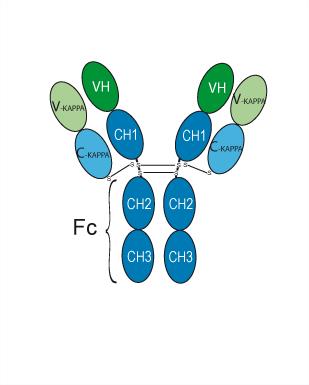
Crusekitug is a humanized monoclonal antibody targeting human interleukin 17A (IL-17A). Crusekitug specifically binds to IL-17A, blocking its signal transduction, thus exerting immunosuppressive and anti-inflammatory activities. Crusekitug is promising for research of autoimmune and inflammatory diseases, such as psoriasis and rheumatoid arthritis.
Nos produits utilisent uniquement pour la recherche. Nous ne vendons pas aux patients.
- Pureté : 97.949%
- CAS No.: 2956768-50-4
- Masse moléculaire:144.985 kDa
-
Stockage:
Please store the product under the recommended conditions in the Certificate of Analysis.


To place orders, for customer services and technical support, please contact: MedChemExpress USA
Tel: 609-228-6898 E-mail: [email protected] [email protected]


-
 Activité biologique
-
Chemical Information
- Protocole
- Pureté et documentation
- Références
-
 Help & FAQs




Activité biologique
Description
Isotype
Human IgG1 kappa
Recommend Isotype Controls
Species Reactivity
Human
IC50 & Target
|
IL-17A |
Gene ID
Accession
Conjugated
Unconjugated
Reconsititution
The product can be reconstituted/diluted with sterile PBS or saline.
Format
-
IgG1-kappa
Application
ELISA, FACS, Functional assay
Verified Bioactivity
-
 Immobilized HY-P70527 IL-17A Protein, Human (HEK293, His) can bind Crusekitug. The EC50 for this effect is 43.03 ng/mL.


Chemical Information
-
CAS No. 2956768-50-4
-
Appearance Liquid
-
Masse moléculaire 144.985 kDa
-
Color Colorless to light yellow
-
SMILES
[Crusekitug]
-
Synonyms
QX-002N
-
Livraison
Shipping with dry ice.
-
Formulation
Please refer to the lot-specific COA for specific buffer information.
-
Stockage
Please store the product under the recommended conditions in the Certificate of Analysis.


Pureté et documentation
-
Fiche technique (255 KB)
-
SDS (251 KB)
- English - EN (251 KB)
- Français - FR (251 KB)
- Deutsch - DE (251 KB)
- Norwegian - NO (251 KB)
- Español - ES (251 KB)
- Swedish - SV (251 KB)
- Italian - IT (251 KB)
- Korean - KR (251 KB)
- Portuguese - PT (251 KB)
-
Inhibitory Antibodies User Guide (603 KB)
Références

Calculators
Concentration (start) × Volume (start) = Concentration (final) × Volume (final)


Crusekitug Related Classifications
HY-P991129 Related Classifications
 Powered by Bioz