



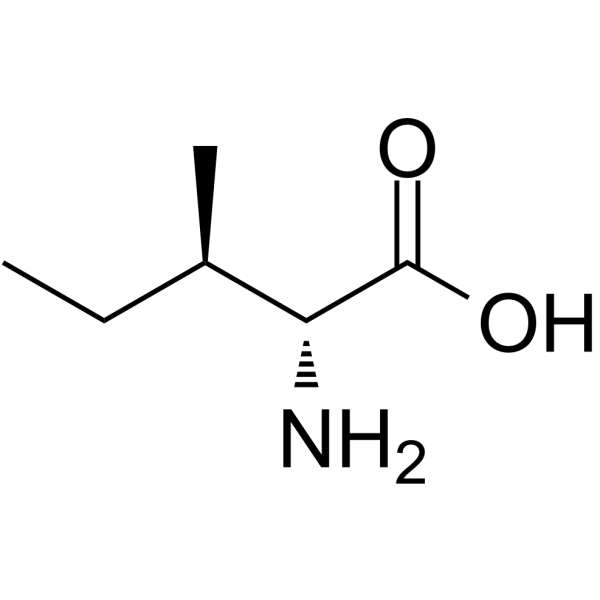
D-Isoleucine

Based on 1 Customer Validation
D-Isoleucine is a selective competitive activator of the Asc-1 antiporter (Ki=0.98 mM). D-Isoleucine promotes the release of D-serine and glycine by binding to the Asc-1 protein on the neuronal cell membrane, and enhances NMDA receptor-dependent synaptic plasticity. D-Isoleucine can be used in the study of neurodegenerative diseases (such as Alzheimer's disease and schizophrenia). D-Isoleucine also acts as a non-classical D-amino acid, interferes with bacterial peptidoglycan synthesis, and inhibits the formation of Staphylococcus aureus biofilm, and has potential antibacterial application value[1][2].
Nos produits utilisent uniquement pour la recherche. Nous ne vendons pas aux patients.
- Pureté : 99.83%
- CAS No.: 319-78-8
- Formule: C6H13NO2
- Masse moléculaire:131.17
-
Stockage:Powder -20°C, 3 years , 4°C, 2 years ; In solvent -80°C, 6 months , -20°C, 1 month

To place orders, for customer services and technical support, please contact: MedChemExpress USA
Tel: 609-228-6898 E-mail: [email protected] [email protected]


-
 Activité biologique
-
Chemical Information
-
Solvant et solubilité
- Protocole
- Pureté et documentation
- Références
-
 Help & FAQs


-
HY-N0197
BaicalinAutophagy Inducer -
HY-W010378
D-AsparagineAsparagine -
HY-N0621
MorinFlavonoid Compound -
HY-N0898
CatechinCOX-1 Inhibitor -
HY-41700
D-AlanineGlyR/PMBA Agonist -
HY-W001941
D-CystineASADH Inhibitor -
HY-Y0378
D-Leucine -
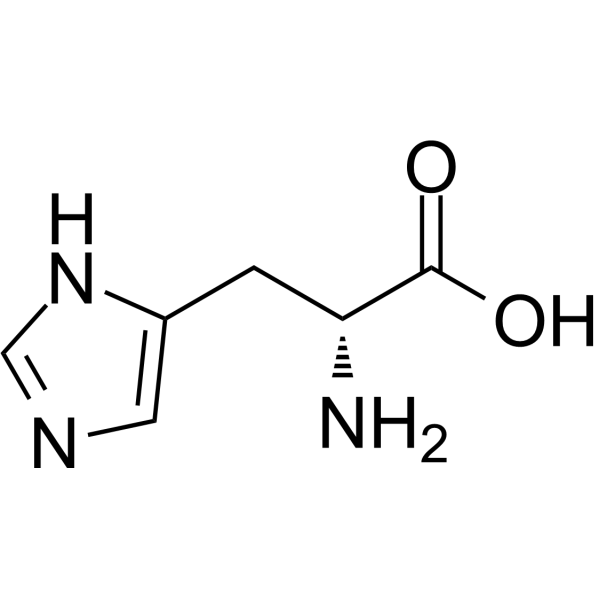
HY-W012572
D-HistidineAnti-biofilm Agent -
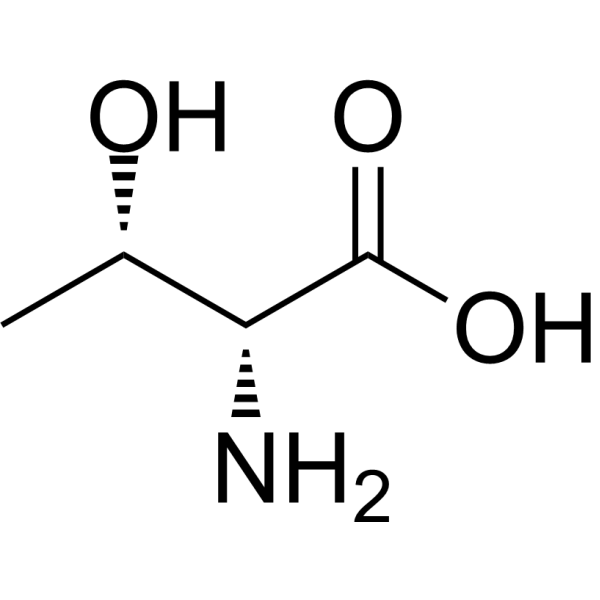
HY-W012874
D-ThreonineNon-natural Amino Acid -
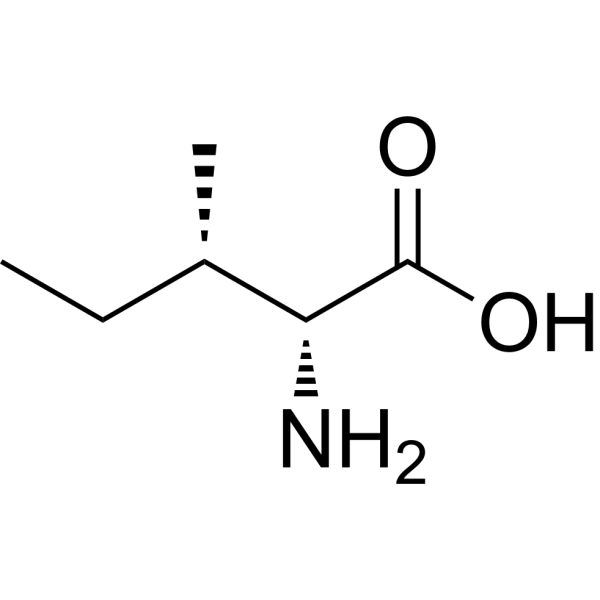
HY-78912
D-AlloisoleucineAmino Acid Derivative -
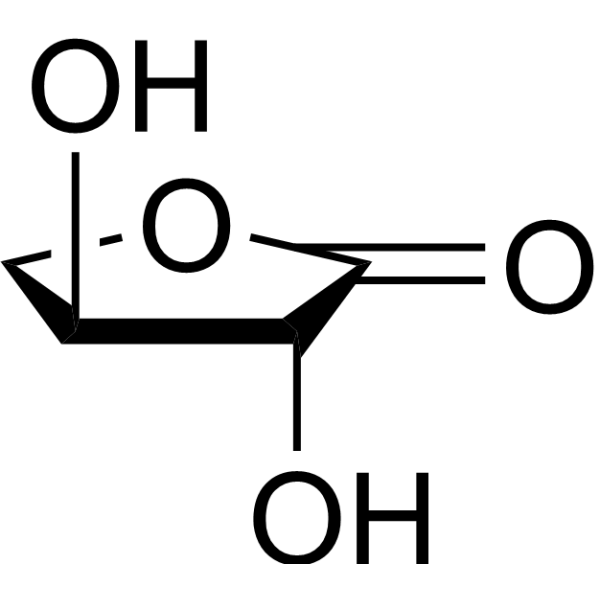
HY-W357137
L-ThreonolactonePurine Nucleoside Analog


Activité biologique
Description
In Vitro
D-Isoleucine (1 mM, 2 mM; 15 min) significantly enhances LTP in hippocampal slices and promotes D-serine release from neurons via activation of Asc-1, which is dependent on NMDA receptors[1]. D-Isoleucine can be identified in the supernatant of Staphylococcus aureus grown in RPMI medium, and can be further used to track the amino acid metabolic footprint of the bacteria[2].
MedChemExpress (MCE) has not independently confirmed the accuracy of these methods. They are for reference only.


Chemical Information
-
CAS No. 319-78-8
-
Appearance Solid
-
Masse moléculaire 131.17
-
Formule C6H13NO2
-
Color White to off-white
-
SMILES
CC[C@@H](C)[C@@H](N)C(O)=O
-
Synonyms
(R)-Isoleucine
-
Structure Classification
-
Initial Source
-
Livraison
Room temperature in continental US; may vary elsewhere.
-
Stockage
Powder -20°C 3 years 4°C 2 years In solvent -80°C 6 months -20°C 1 month


Solvant et solubilité
In Vitro:
H2O : 5.56 mg/mL (42.39 mM; Need ultrasonic)
Please refer to the solubility information to select the appropriate solvent. Once prepared, please aliquot and store the solution to prevent product inactivation from repeated freeze-thaw cycles.
Storage method and period of stock solution: -80°C, 6 months; -20°C, 1 month. When stored at -80°C, please use it within 6 months. When stored at -20°C, please use it within 1 month.
* Note: If you choose water as the stock solution, please dilute it to the working solution, then filter and sterilize it with a 0.22 μm filter before use.
Please refer to the solubility information to select the appropriate solvent. Once prepared, please aliquot and store the solution to prevent product inactivation from repeated freeze-thaw cycles.
Storage method and period of stock solution: -80°C, 6 months; -20°C, 1 month. When stored at -80°C, please use it within 6 months. When stored at -20°C, please use it within 1 month.
* Note: If you choose water as the stock solution, please dilute it to the working solution, then filter and sterilize it with a 0.22 μm filter before use.
Concentration (start) × Volume (start) = Concentration (final) × Volume (final)


Pureté et documentation
-
Fiche technique (293 KB)
-
SDS (396 KB)
- English - EN (396 KB)
- Français - FR (396 KB)
- Deutsch - DE (396 KB)
- Norwegian - NO (396 KB)
- Español - ES (396 KB)
- Swedish - SV (396 KB)
- Italian - IT (396 KB)
- Korean - KR (396 KB)
- Portuguese - PT (396 KB)
-
Instruction de manipulation (2659 KB)
Références
[1]. Rosenberg D, et, al. Neuronal D-serine and glycine release via the Asc-1 transporter regulates NMDA receptor-dependent synaptic activity. J Neurosci. 2013 Feb 20;33(8):3533-44. [Content Brief]
[2]. Dörries K, et al. Metabolic footprint analysis uncovers strain specific overflow metabolism and D-isoleucine production of Staphylococcus aureus COL and HG001. PLoS One. 2013 Dec 3;8(12):e81500. [Content Brief]


Complete Stock Solution Preparation Table
Please refer to the solubility information to select the appropriate solvent. Once prepared, please aliquot and store the solution to prevent product inactivation from repeated freeze-thaw cycles.
Storage method and period of stock solution: -80°C, 6 months; -20°C, 1 month. When stored at -80°C, please use it within 6 months. When stored at -20°C, please use it within 1 month.
| Optional Solvent | Concentration Solvent Mass | 1 mg | 5 mg | 10 mg | 25 mg |
|---|---|---|---|---|---|
| H2O | 1 mM | 7.6237 mL | 38.1185 mL | 76.2369 mL | 190.5924 mL |
| 5 mM | 1.5247 mL | 7.6237 mL | 15.2474 mL | 38.1185 mL | |
| 10 mM | 0.7624 mL | 3.8118 mL | 7.6237 mL | 19.0592 mL | |
| 15 mM | 0.5082 mL | 2.5412 mL | 5.0825 mL | 12.7062 mL | |
| 20 mM | 0.3812 mL | 1.9059 mL | 3.8118 mL | 9.5296 mL | |
| 25 mM | 0.3049 mL | 1.5247 mL | 3.0495 mL | 7.6237 mL | |
| 30 mM | 0.2541 mL | 1.2706 mL | 2.5412 mL | 6.3531 mL | |
| 40 mM | 0.1906 mL | 0.9530 mL | 1.9059 mL | 4.7648 mL |
* Note: If you choose water as the stock solution, please dilute it to the working solution, then filter and sterilize it with a 0.22 μm filter before use.


D-Isoleucine Related Classifications
HY-I1070 Related Classifications
 Powered by Bioz