



HS-291
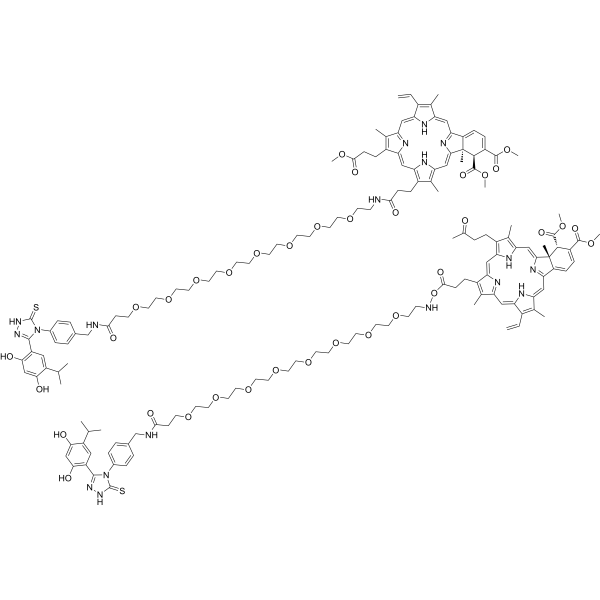
HS-291 is a HtpG inhibitor of Borrelia burgdorferi (Bb). HS-291 contains BX-2819 (high affinity for Bb HtpG), PEG linker, and Verteporfin (HY-B0146) (a photoactive toxin).HS-291 produces reactive oxygen species under light activation to oxidize HtpG and a discrete protein subset near chaperone proteins and can quickly and irreversibly inactivate Bb.
Nos produits utilisent uniquement pour la recherche. Nous ne vendons pas aux patients.
- Formule: C156H194N18O36S2
- Masse moléculaire:2961.44
-
Stockage:
Please store the product under the recommended conditions in the Certificate of Analysis.

To place orders, for customer services and technical support, please contact: MedChemExpress USA
Tel: 609-228-6898 E-mail: [email protected] [email protected]


-
 Activité biologique
-
Chemical Information
- Protocole
- Pureté et documentation
- Références
-
 Help & FAQs




Activité biologique
Description
In Vitro
HS-291 (0.1-10 μM, 24 h) inhibits Bb culture viability when excited with nrIR (Ex: 693nm 5 J/cm2)[1].
HS-291 (10 μM, 90 min) can specifically target Bb in Bb culture[1].
HS-291 (0-10 μM, 24 h) causes cell wall blebbing, nucleoid condensation and loss of cell wall integrity of cells when excited with nrIR (Ex: 693nm 5 J/cm2)[1].
MedChemExpress (MCE) has not independently confirmed the accuracy of these methods. They are for reference only.


Chemical Information
-
Masse moléculaire 2961.44
-
Formule C156H194N18O36S2
-
SMILES
O=C(NCCOCCOCCOCCOCCOCCOCCOCCOCCC(NCC1=CC=C(N2C(C3=C(O)C=C(O)C(C(C)C)=C3)=NNC2=S)C=C1)=O)CCC4=C(/C=C5C(CCC(OC)=O)=C(C(/C=C6N/C(C(C)=C\6C=C)=C\C(C7=CC=C(C(OC)=O)[C@@H](C(OC)=O)[C@]7/8C)=NC8=C/9)=N/5)C)NC9=C4C.CC(CCC%10=C%11NC(/C=C([C@@]%12%13C)\N=C(C%12=CC=C([C@H]%13C(OC)=O)C(OC)=O)/C=C(C(C)=C/%14C=C)\NC%14=C/C(C(C)=C/%15CCC(ONCCOCCOCCOCCOCCOCCOCCOCCOCCC(NCC%16=CC=C(C=C%16)N%17C(NN=C%17C%18=C(C=C(C(C(C)C)=C%18)O)O)=S)=O)=O)=NC%15=C/%11)=C%10C)=O
-
Livraison
Room temperature in continental US; may vary elsewhere.
-
Stockage
Please store the product under the recommended conditions in the Certificate of Analysis.


Pureté et documentation
Références

Calculators
Concentration (start) × Volume (start) = Concentration (final) × Volume (final)


HS-291 Related Classifications
HY-157084 Related Classifications
 Powered by Bioz