



MIPS-21335

Based on 1 Customer Validation
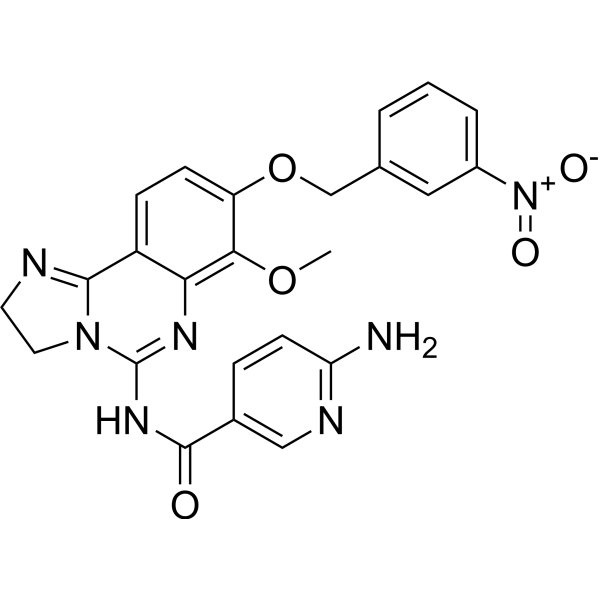
MIPS-21335 is a PI3KC2α inhibitor with an IC50 of 7 nM. MIPS-21335 also inhibits PI3KC2β, p110α, p110β and p110δ, with IC50 values of 43, 140, 386 and 742 nM, respectively. MIPS-21335 has antithrombotic effect. MIPS-21335 can be used for the researches of cardiovascular disease and metabolic disease, such as thrombosis and hyperlipidemia.
Nos produits utilisent uniquement pour la recherche. Nous ne vendons pas aux patients.
- Pureté : 99.61%
- CAS No.: 2569296-51-9
- Formule: C24H21N7O5
- Masse moléculaire:487.47
-
Stockage:
4°C, sealed storage, away from moisture
* In solvent : -80°C, 6 months; -20°C, 1 month (sealed storage, away from moisture)

To place orders, for customer services and technical support, please contact: MedChemExpress USA
Tel: 609-228-6898 E-mail: [email protected] [email protected]


-
 Activité biologique
-
Chemical Information
-
Solvant et solubilité
- Protocole
- Pureté et documentation
- Références
-
 Help & FAQs




Activité biologique
Description
IC50 & Target
[1]|
PI3KC2α 7 nM (IC50) |
PI3KC2β 43 nM (IC50) |
p110α 140 nM (IC50) |
p110β 386 nM (IC50) |
p110δ 742 nM (IC50) |
In Vitro
MIPS-21335 (10 μM, 10 mins) impairs platelet-dependent thrombus growth on a collagen surface in blood[1].
MIPS-21335 (0.1-10 μM, 10 mins) reduces thrombosis in blood isolated from hypercholesterolemic mice[2].
MedChemExpress (MCE) has not independently confirmed the accuracy of these methods. They are for reference only.
In Vivo
MedChemExpress (MCE) has not independently confirmed the accuracy of these methods. They are for reference only.
-
Animal Model:Thrombosis mice models[1]
-
Dosage:1 mg/kg
-
Administration:Intravenously injection, 10 mins before tail transection
-
Result:Showed smaller fibrin-rich thrombi with very few platelets.
Had no impact on bleeding time.


Chemical Information
-
CAS No. 2569296-51-9
-
Appearance Solid
-
Masse moléculaire 487.47
-
Formule C24H21N7O5
-
Color Off-white to light yellow
-
SMILES
COC1=C2N=C(N3CCN=C3C2=CC=C1OCC4=CC([N+]([O-])=O)=CC=C4)NC(C5=CN=C(C=C5)N)=O
-
Livraison
Room temperature in continental US; may vary elsewhere.
-
Stockage
4°C, sealed storage, away from moisture
* In solvent : -80°C, 6 months; -20°C, 1 month (sealed storage, away from moisture)


Solvant et solubilité
In Vitro:
DMSO : 25 mg/mL (51.29 mM; Need ultrasonic; Hygroscopic DMSO has a significant impact on the solubility of product, please use newly opened DMSO)
Please refer to the solubility information to select the appropriate solvent. Once prepared, please aliquot and store the solution to prevent product inactivation from repeated freeze-thaw cycles.
Storage method and period of stock solution: -80°C, 6 months; -20°C, 1 month (sealed storage, away from moisture). When stored at -80°C, please use it within 6 months. When stored at -20°C, please use it within 1 month.
Please refer to the solubility information to select the appropriate solvent. Once prepared, please aliquot and store the solution to prevent product inactivation from repeated freeze-thaw cycles.
Storage method and period of stock solution: -80°C, 6 months; -20°C, 1 month (sealed storage, away from moisture). When stored at -80°C, please use it within 6 months. When stored at -20°C, please use it within 1 month.
Concentration (start) × Volume (start) = Concentration (final) × Volume (final)


Pureté et documentation
-
Fiche technique (277 KB)
-
SDS (252 KB)
- English - EN (252 KB)
- Français - FR (252 KB)
- Deutsch - DE (252 KB)
- Norwegian - NO (252 KB)
- Español - ES (252 KB)
- Swedish - SV (252 KB)
- Italian - IT (252 KB)
- Korean - KR (252 KB)
- Portuguese - PT (252 KB)
-
Instruction de manipulation (2659 KB)
Références
[1]. Selvadurai MV, et al. Disrupting the platelet internal membrane via PI3KC2α inhibition impairs thrombosis independently of canonical platelet activation. Sci Transl Med. 2020 Jul 22;12(553):eaar8430. [Content Brief]
[2]. Setiabakti NM, et al. PI3KC2α inhibition is antithrombotic in blood from hypercholesterolemic mice. J Thromb Haemost. 2024 Jan;22(1):249-254. [Content Brief]


Complete Stock Solution Preparation Table
Please refer to the solubility information to select the appropriate solvent. Once prepared, please aliquot and store the solution to prevent product inactivation from repeated freeze-thaw cycles.
Storage method and period of stock solution: -80°C, 6 months; -20°C, 1 month (sealed storage, away from moisture). When stored at -80°C, please use it within 6 months. When stored at -20°C, please use it within 1 month.
| Optional Solvent | Concentration Solvent Mass | 1 mg | 5 mg | 10 mg | 25 mg |
|---|---|---|---|---|---|
| DMSO | 1 mM | 2.0514 mL | 10.2570 mL | 20.5141 mL | 51.2852 mL |
| 5 mM | 0.4103 mL | 2.0514 mL | 4.1028 mL | 10.2570 mL | |
| 10 mM | 0.2051 mL | 1.0257 mL | 2.0514 mL | 5.1285 mL | |
| 15 mM | 0.1368 mL | 0.6838 mL | 1.3676 mL | 3.4190 mL | |
| 20 mM | 0.1026 mL | 0.5129 mL | 1.0257 mL | 2.5643 mL | |
| 25 mM | 0.0821 mL | 0.4103 mL | 0.8206 mL | 2.0514 mL | |
| 30 mM | 0.0684 mL | 0.3419 mL | 0.6838 mL | 1.7095 mL | |
| 40 mM | 0.0513 mL | 0.2564 mL | 0.5129 mL | 1.2821 mL | |
| 50 mM | 0.0410 mL | 0.2051 mL | 0.4103 mL | 1.0257 mL |


MIPS-21335 Related Classifications
HY-156371 Related Classifications
 Powered by Bioz