



Mtb-IN-4
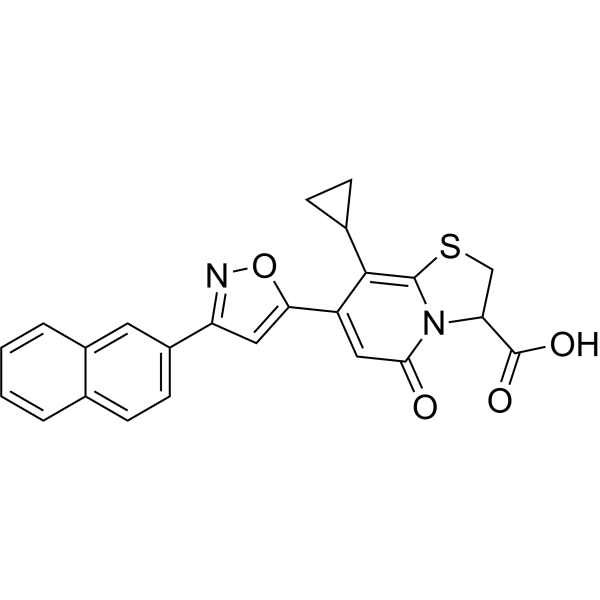
Mtb-IN-4 (compound 17h) is a nontoxic isoxazole, with anti-Mycobacterium tuberculosis (Mtb) activity (IC50=0.70 μM). Mtb-IN-4 inhibits Mtb respiration and biofilm formation in macrophage, and enhances antibiotic isoniazid (INH) inhibition against INH-resistant Mtb mutant.
Nos produits utilisent uniquement pour la recherche. Nous ne vendons pas aux patients.
- CAS No.: 2306039-13-2
- Formule: C24H18N2O4S
- Masse moléculaire:430.48
-
Stockage:
Please store the product under the recommended conditions in the Certificate of Analysis.

To place orders, for customer services and technical support, please contact: MedChemExpress USA
Tel: 609-228-6898 E-mail: [email protected] [email protected]


-
 Activité biologique
-
Chemical Information
- Protocole
- Pureté et documentation
- Références
-
 Help & FAQs




Activité biologique
Description
IC50 & Target
Mycobacterium tuberculosis (Mtb)[1]
In Vitro
Mtb-IN-4 potently resensitizes an Mtb katG mutant to inhibition by INH[1].
Mtb-IN-4 inhibits the growth of intracellular Mtb within murine RAW 264.7 macrophages with IC50 of 3.467 μM[1].
MedChemExpress (MCE) has not independently confirmed the accuracy of these methods. They are for reference only. Further protocols information, click here.


Chemical Information
-
CAS No. 2306039-13-2
-
Masse moléculaire 430.48
-
Formule C24H18N2O4S
-
SMILES
O=C(C1CSC2=C(C3CC3)C(C4=CC(C5=CC=C6C=CC=CC6=C5)=NO4)=CC(N21)=O)O
-
Livraison
Room temperature in continental US; may vary elsewhere.
-
Stockage
Please store the product under the recommended conditions in the Certificate of Analysis.

Protocole
-
Phagocytosis Functional Assay
A phagocytosis functional assay measures the ability of phagocytic cells, such as neutrophils, macrophages, monocytes, or microglia/macrophages, to bind and internalize particulate targets including bacteria, yeast particles, beads, or myelin particles. Fluorescent flow-cytometry assays detect target uptake as fluorescence associated with gated phagocytes, while pH-sensitive dyes such as pHrodo increase signal in acidic phagosomal compartments and therefore preferentially report internalized particles rather than particles remaining outside the cell. Microscopy or high-content imaging can be used to confirm intracellular localization and, in some protocols, to follow uptake kinetics.
-
Fungal Biofilm Culture
Fungal biofilm culture is an in vitro method for growing surface-attached fungal communities, most commonly Candida albicans, on abiotic substrates such as polystyrene wells, silicone elastomer, or polymethylmethacrylate; the assay models adhesion, proliferation, filamentation, extracellular-matrix-associated maturation, and dispersion. Biofilm output can be read by optical density at 600 nm for adherent biomass, XTT reduction for metabolic activity, CFU recovery for viable attached or dispersed cells, and microscopy for architecture.


Pureté et documentation
Références

Calculators
Concentration (start) × Volume (start) = Concentration (final) × Volume (final)


Mtb-IN-4 Related Classifications
HY-155720 Related Classifications
 Powered by Bioz