



Tarextumab

Based on 1 Customer Validation
Tarextumab (OMP-59R5) is a cross-reactive, fully human IgG2 antibody that selectively inhibits Notch2 and Notch3 signaling. Tarextumab demonstrates broad-spectrum antitumor efficacy in xenograft models of epithelial tumors. Tarextumab can be used for the study of pancreatic cancer.
Nos produits utilisent uniquement pour la recherche. Nous ne vendons pas aux patients.
- Pureté : 99.83%
- CAS No.: 1359940-55-8
- Masse moléculaire:142.94 kDa
-
Stockage:
Please store the product under the recommended conditions in the Certificate of Analysis.


To place orders, for customer services and technical support, please contact: MedChemExpress USA
Tel: 609-228-6898 E-mail: [email protected] [email protected]


-
 Activité biologique
-
Chemical Information
- Protocole
- Pureté et documentation
- Références
-
 Help & FAQs


-

HY-P99258
BrontictuzumabNotch1 Inhibitor -

HY-P99261
Demcizumabanti-DLL4 mAb -
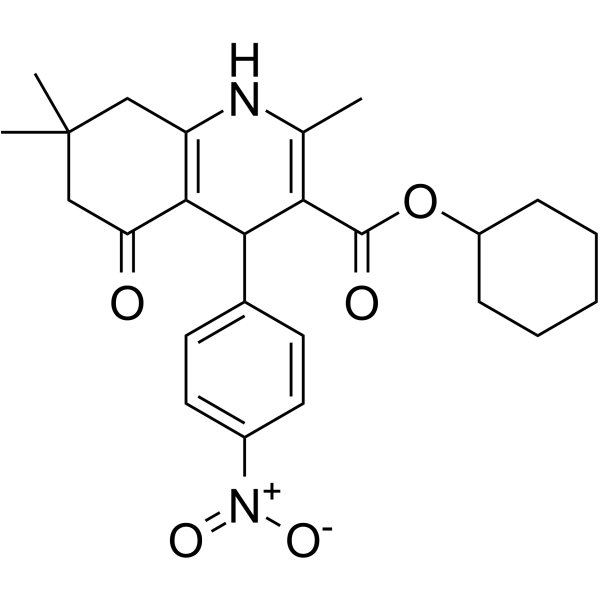
HY-15860
FLI-06Notch Inhibitor -
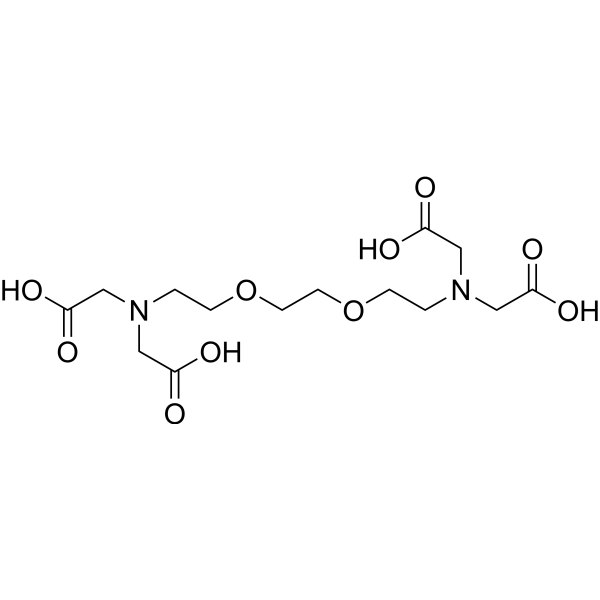
HY-D0861
EGTACalcium Ion Chelator -

HY-P9904
AtezolizumabAnti-PD-L1 Antibody -

HY-P99041
PanitumumabAnti-EGFR Monoclonal Antibody -
HY-K0207
Anti-Flag Magnetic Beads -

HY-P99756
NirsevimabAnti-RSV Antibody -

HY-P99333
VolociximabIntegrin α5β1 mAb -

HY-P99575
Tarlatamabanti-DLL3/CD3 BiTE antibody -
HY-P99002
Human IgG2 kappa, Isotype ControlIgG2κ Isotype Control -

HY-P99854
DisitamabAnti-HER2 Antibody


Activité biologique
Description
Isotype
Human IgG2 kappa
Recommend Isotype Controls
Species Reactivity
Human
IC50 & Target
NOTCH3
In Vitro
Tarextumab inhibits human Notch2 and Notch3 signaling activity (reduces RLU values) without affecting Notch1 in HeLa cells using a Notch-responsive luciferase reporter assay[1].
Tarextumab downregulates mRNA expression of human Notch2, Notch3, HES1, NANOG, and OCT4, and reverses Gemcitabine (HY-17026)-induced upregulation of EMT-related genes (CDH2, VIM, FN1) in OMP-PN17 pancreatic tumor cells[1].
Tarextumab reduces protein levels of Notch3 extracellular domain (ECD) and active intracellular domain (ICD) in OMP-PN17 pancreatic tumor cells, and decreases the number of cells with high Notch3 ECD staining[1].
MedChemExpress (MCE) has not independently confirmed the accuracy of these methods. They are for reference only.
In Vivo
Tarextumab (40 mg/kg, i.p., once weekly, 4 weeks) does not induce marked tumor growth inhibition in MDA-MB-468 and HCC70 TNBC cell line-derived xenograft models in BALB/c nude mice[2].
MedChemExpress (MCE) has not independently confirmed the accuracy of these methods. They are for reference only.
-
Animal Model:Human pancreatic cancer cells (from PDX models including OMP-PN4, OMP-PN8, OMP-PN17) were subcutaneously implanted into NOD/SCID mice[1]
-
Dosage:40 mg/kg combined with Gemcitabine (HY-17026)
-
Administration:i.p., every other week
-
Result:Achieved enhanced antitumor efficacy.
Showed striking tumor regression.
Reduced cancer stem cell (CSC) frequency.
Delayed tumor recurrence.
Decreased tumor cell proliferation.
Increased pericyte maturation (enhanced desmin-positive pericyte association with CD31-positive endothelial cells) and tumor vascular perfusion and reduced intratumoral hypoxia.
-
Animal Model:Triple-negative breast cancer (TNBC) cells (from cell lines including MDA-MB-468, HCC70) were subcutaneously implanted into BALB/c nude mice[2]
-
Dosage:40 mg/kg
-
Administration:i.p., once weekly, 4 weeks
-
Result:Reduced tumor-initiating cell (TIC) frequency.
Essai clinique
| NCT Number | Sponsor | Condition | Start Date |
Phase

|
|---|---|---|---|---|
| NCT01329991 | Plexxikon| | 2011-05 | PHASE1 |
Gene ID
Accession
Conjugated
Unconjugated
Reconsititution
The product can be reconstituted/diluted with sterile PBS or saline.
Format
-
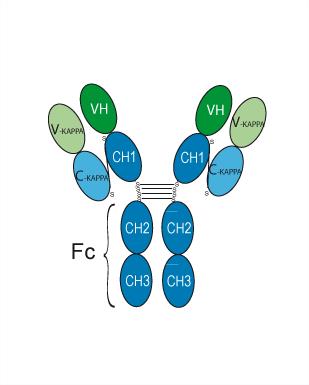
Human IgG2 kappa
Application
ELISA, FACS, Functional assay
Verified Bioactivity
-
 Immobilized NOTCH2 Protein (His Tag), Human can bind Tarextumab. The EC50 for this effect is 1.22 ng/mL.
 -
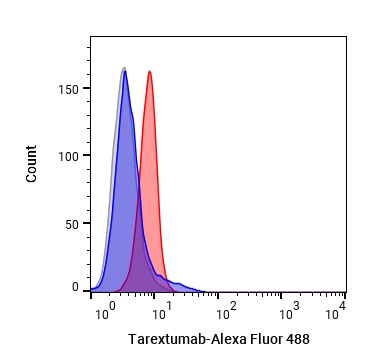 Flow cytometric analysis of 1X10⁶ MCF-7 cells with Tarextumab (HY-P99320, red). Cells were fixed with 4% paraformaldehyde. Then stained with the primary antibody at 1/200 dilution for an hour at 4℃. Alexa Fluor 488-conjugated AffiniPure Goat Anti-Human IgG H&L (AF488) (HY-P83776) was used as the secondary antibody at 1/1,000 dilution for 30 minutes at 4℃. Human IgG2 kappa (HY-P99002, blue) was used as the isotype control, cells without incubation with primary antibody were used as the unlabeled control (black).


Chemical Information
-
CAS No. 1359940-55-8
-
Appearance Liquid
-
Masse moléculaire 142.94 kDa
-
Color Colorless to light yellow
-
SMILES
[Tarextumab]
-
Synonyms
OMP-59R5; Anti-Human NOTCH2 Recombinant Antibody
-
Livraison
Shipping with dry ice.
-
Formulation
Please refer to the lot-specific COA for specific buffer information.
-
Stockage
Please store the product under the recommended conditions in the Certificate of Analysis.


Pureté et documentation
-
Fiche technique (278 KB)
-
SDS (251 KB)
- English - EN (251 KB)
- Français - FR (251 KB)
- Deutsch - DE (251 KB)
- Norwegian - NO (251 KB)
- Español - ES (251 KB)
- Swedish - SV (251 KB)
- Italian - IT (251 KB)
- Korean - KR (251 KB)
- Portuguese - PT (251 KB)
-
Inhibitory Antibodies User Guide (603 KB)
Références
[1]. Yen WC, et al. Targeting Notch signaling with a Notch2/Notch3 antagonist (tarextumab) inhibits tumor growth and decreases tumor-initiating cell frequency. Clin Cancer Res. 2015 May 1;21(9):2084-95. [Content Brief]
[2]. Fu W, et al. EGFR/Notch Antagonists Enhance the Response to Inhibitors of the PI3K-Akt Pathway by Decreasing Tumor-Initiating Cell Frequency. Clin Cancer Res. 2019 May 1;25(9):2835-2847. [Content Brief]

Calculators
Concentration (start) × Volume (start) = Concentration (final) × Volume (final)


Tarextumab Related Classifications
HY-P99320 Related Classifications
 Powered by Bioz