



19408-84-5
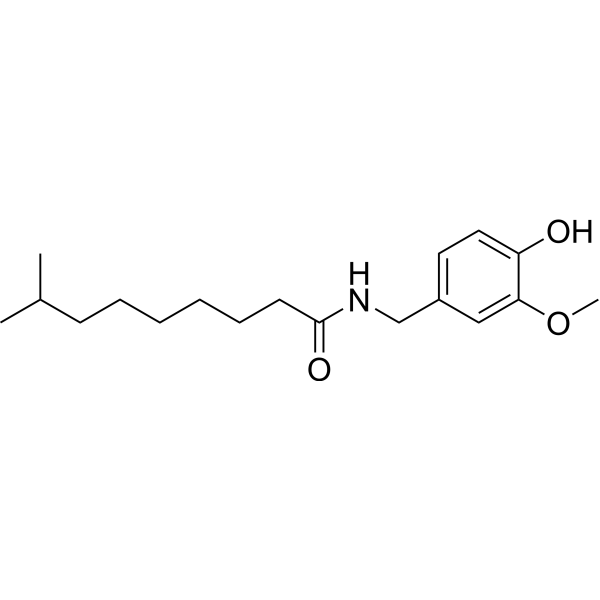
Chemical Structure
Dihydrocapsaicin
- CAS No.: 19408-84-5
- Formula:C18H29NO3
- Molecular Weight:307.43
IUPAC Name: N-(4-hydroxy-3-methoxybenzyl)-8-methylnonanamide
InChIKey: XJQPQKLURWNAAH-UHFFFAOYSA-N
SMILES: CC(C)CCCCCCC(NCC1=CC=C(O)C(OC)=C1)=O
Biological Activity: Dihydrocapsaicin, a capsaicin, is a potent and selective TRPV1 (transient receptor potential vanilloid channel 1) agonist. Dihydrocapsaicin reduces AIF, Bax, and Caspase-3 expressions, and increased Bcl-2, Bcl-xL and p-Akt levels. Dihydrocapsaicin enhances the hypothermia-induced neuroprotection following ischemic stroke via PI3K/Akt regulation in rat[1][2][3].
| Cat. No. | Product Name | Purity | Description | Pricing | |||||||||||||||||||
|---|---|---|---|---|---|---|---|---|---|---|---|---|---|---|---|---|---|---|---|---|---|---|---|
|
|
Dihydrocapsaicin | 99.93% | Dihydrocapsaicin, a capsaicin, is a potent and selective TRPV1 (transient receptor potential vanilloid channel 1) agonist. Dihydrocapsaicin reduces AIF, Bax, and Caspase-3 expressions, and increased Bcl-2, Bcl-xL and p-Akt levels. Dihydrocapsaicin enhances the hypothermia-induced neuroprotection following ischemic stroke via PI3K/Akt regulation in rat. | ||||||||||||||||||||
|
loading...
/
|
|||||||||||||||||||||||
|
|
Dihydrocapsaicin (Standard) | ≥98% | Dihydrocapsaicin (Standard) is the analytical standard of Dihydrocapsaicin. This product is intended for research and analytical applications. Dihydrocapsaicin, a capsaicin, is a potent and selective TRPV1 (transient receptor potential vanilloid channel 1) agonist. Dihydrocapsaicin reduces AIF, Bax, and Caspase-3 expressions, and increased Bcl-2, Bcl-xL and p-Akt levels. Dihydrocapsaicin enhances the hypothermia-induced neuroprotection following ischemic stroke via PI3K/Akt regulation in rat. | ||||||||||||||||||||
|
loading...
/
|
|||||||||||||||||||||||
|
|
Dihydrocapsaicin-d3 | Dihydrocapsaicin-d3 is the deuterium labeled Dihydrocapsaicin (HY-N0361). Dihydrocapsaicin, a capsaicin, is a potent and selective TRPV1 (transient receptor potential vanilloid channel 1) agonist. Dihydrocapsaicin reduces AIF, Bax, and Caspase-3 expressions, and increased Bcl-2, Bcl-xL and p-Akt levels. Dihydrocapsaicin enhances the hypothermia-induced neuroprotection following ischemic stroke via PI3K/Akt regulation in rat. | |||||||||||||||||||||
|
loading...
/
|
|||||||||||||||||||||||
-
Similarity Score 0.97
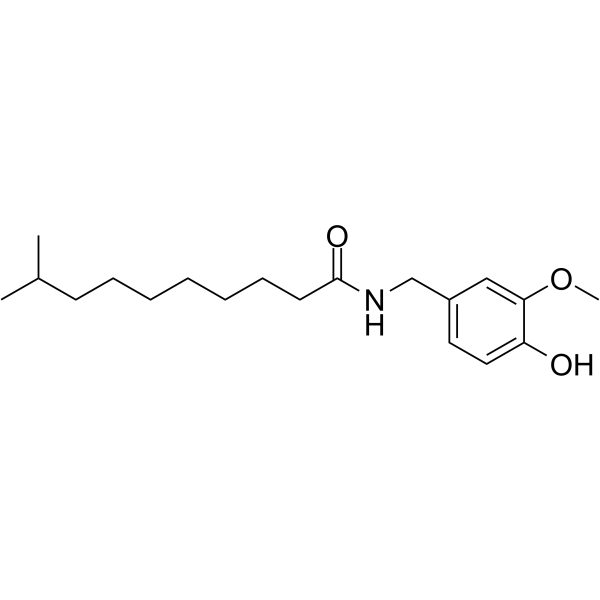 HY-N5082Homodihydrocapsaicin I
-
Similarity Score 0.97
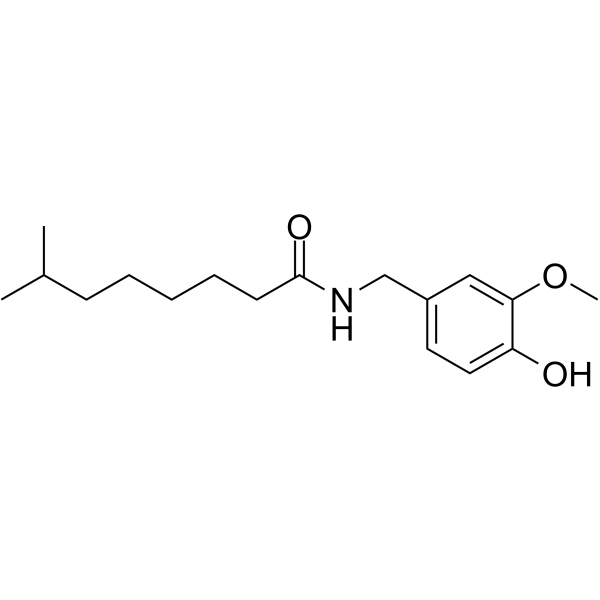 HY-N0449Nordihydrocapsaicin
-
Similarity Score 0.92
 HY-W712539Homodihydrocapsaicin II
-
Similarity Score 0.90
 HY-N11950N-Vanillyloctanamide
-
Similarity Score 0.89
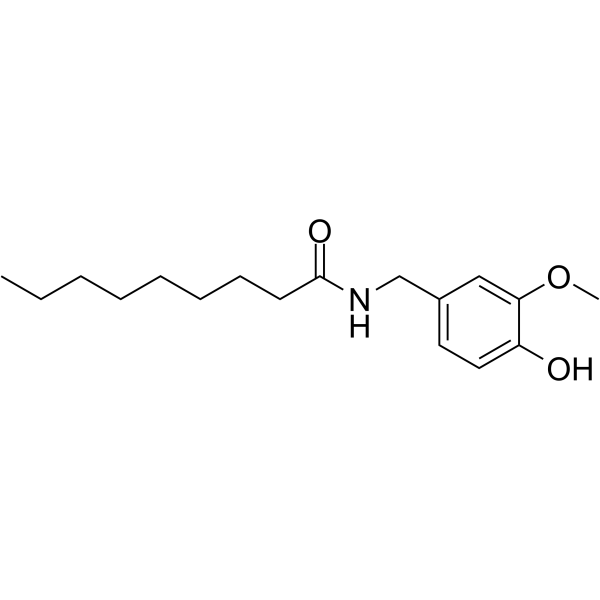 HY-17568Nonivamide
-
Similarity Score 0.88
 HY-N5099RN-Vanillyldecanamide (Standard)
-
Similarity Score 0.85
 HY-10448ARCapsaicin (Purity 65%) (Standard)
-
Similarity Score 0.85
 HY-B1583R(Z)-Capsaicin (Standard)
-
Similarity Score 0.84
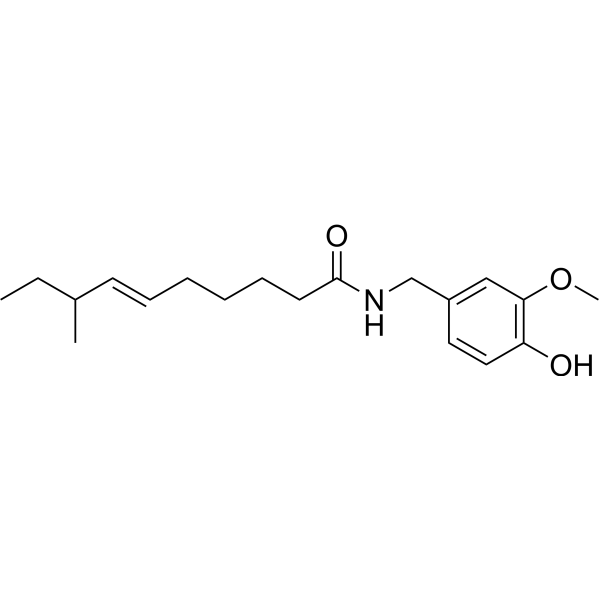 HY-N11468Homocapsaicin II
-

Explore the MedChemAI to find more analogs


References
- [1]. Gao F, et al. Impairment in function and expression of transient receptor potential vanilloid type 4 in Dahl salt-sensitive rats: significance and mechanism. Hypertension. 2010 Apr;55(4):1018-25. [Content Brief]
- [2]. Dihydrocapsaicin, et al. Dihydrocapsaicin (DHC) enhances the hypothermia-induced neuroprotection following ischemic stroke via PI3K/Akt regulation in rat. Brain Res. 2017 Sep 15;1671:18-25. [Content Brief]
- [3]. Adams MJ, et al. Effect of capsaicin and dihydrocapsaicin on in vitro blood coagulation and platelet aggregation. Thromb Res. 2009 Dec;124(6):721-3. [Content Brief]



