



214358-33-5
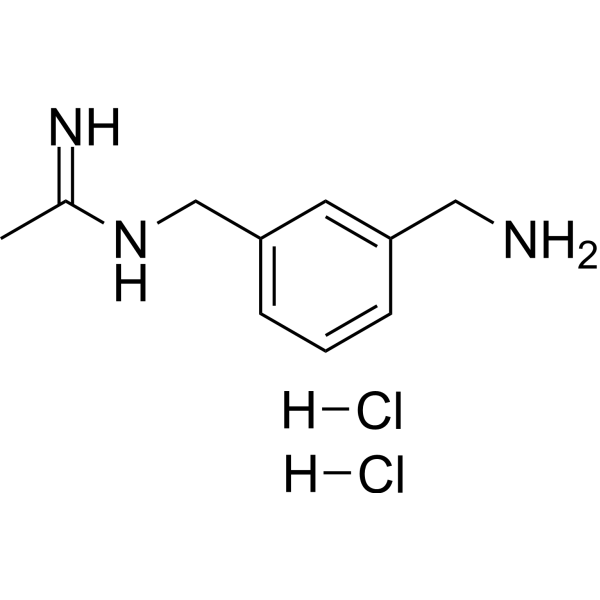
Chemical Structure
1400W Dihydrochloride
- CAS No.: 214358-33-5
- Formula:C10H17Cl2N3
- Molecular Weight:250.17
IUPAC Name: N-(3-(aminomethyl)benzyl)acetimidamide dihydrochloride
InChIKey: WDJHSQZCZGPGAA-UHFFFAOYSA-N
SMILES: CC(NCC1=CC=CC(CN)=C1)=N.[H]Cl.[H]Cl
Biological Activity: 1400W dihydrochloride is the dihydrochloride form of 1400W (HY-18730). 1400W is a slow, tight binding, and highly selective inducible nitric-oxide synthase (iNOS) inhibitor, with a Kd value ≤ 7 nM. 1400W inhibits iNOS induction in microglial cells, and reduces generation of NO, thereby mitigating oxidative stress and neuronal cell apoptosis in the rat cerebral cortex, and improving the spatial memory dysfunction caused by acute hypobaric hypoxia-reoxygenation[1][2].
| Cat. No. | Product Name | Purity | Description | Pricing | |||||||||||||||||||
|---|---|---|---|---|---|---|---|---|---|---|---|---|---|---|---|---|---|---|---|---|---|---|---|
|
|
1400W Dihydrochloride | 99.94% | 1400W dihydrochloride is the dihydrochloride form of 1400W (HY-18730). 1400W is a slow, tight binding, and highly selective inducible nitric-oxide synthase (iNOS) inhibitor, with a Kd value ≤ 7 nM. 1400W inhibits iNOS induction in microglial cells, and reduces generation of NO, thereby mitigating oxidative stress and neuronal cell apoptosis in the rat cerebral cortex, and improving the spatial memory dysfunction caused by acute hypobaric hypoxia-reoxygenation. | ||||||||||||||||||||
|
loading...
/
|
|||||||||||||||||||||||
|
|
1400W Dihydrochloride (Standard) | ≥98% | 1400W (Dihydrochloride) (Standard) is the analytical standard of 1400W (Dihydrochloride). This product is intended for research and analytical applications. 1400W dihydrochloride is the dihydrochloride form of 1400W (HY-18730). 1400W is a slow, tight binding, and highly selective inducible nitric-oxide synthase (iNOS) inhibitor, with a Kd value ≤ 7 nM. 1400W inhibits iNOS induction in microglial cells, and reduces generation of NO, thereby mitigating oxidative stress and neuronal cell apoptosis in the rat cerebral cortex, and improving the spatial memory dysfunction caused by acute hypobaric hypoxia-reoxygenation. | ||||||||||||||||||||
|
loading...
/
|
|||||||||||||||||||||||
-
Similarity Score 0.95
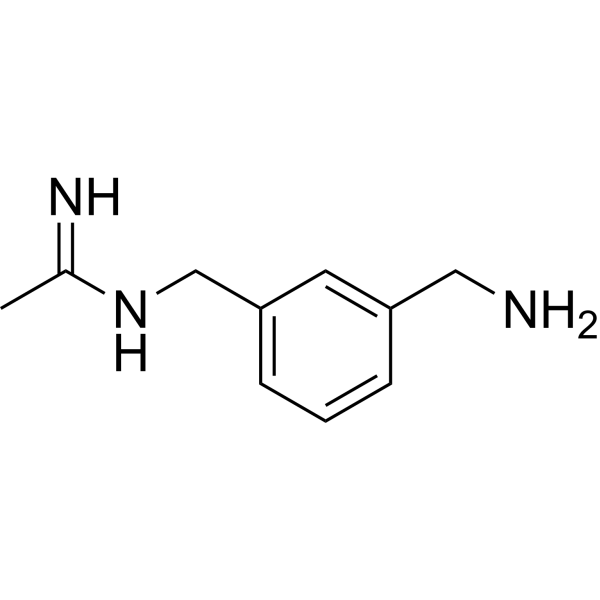 HY-187301400W
-
Similarity Score 0.80
 HY-W408607N-Benzylacetamidine hydrobromide
-
Similarity Score 0.78
 HY-129040m-Iodobenzylguanidine
-
Similarity Score 0.76
 HY-W1405381,4-Phenylenedimethanamine dihydrochloride
-
Similarity Score 0.76
 HY-W3402902-(3-(Aminomethyl)phenyl)acetic acid
-
Similarity Score 0.73
 HY-W052051N-Benzylacetamide
-
Similarity Score 0.72
 HY-16397RPhenformin (Standard)
-
Similarity Score 0.72
 HY-W0158081,4-Bis(aminomethyl)benzene
-
Similarity Score 0.72
 HY-W666088(2-Phenylethyl)hydrazine dihydrochloride
-

Explore the MedChemAI to find more analogs


References
- [1]. Garvey EP, et al. 1400W is a slow, tight binding, and highly selective inhibitor of inducible nitric-oxide synthase in vitro and in vivo. J Biol Chem. 1997 Feb 21;272(8):4959-63. [Content Brief]
- [2]. Shi Q, et al. 1400W ameliorates acute hypobaric hypoxia/reoxygenation-induced cognitive deficits by suppressing the induction of inducible nitric oxide synthase in rat cerebral cortex microglia. Behav Brain Res. 2017 Feb 15;319:188-199. [Content Brief]



