



29560-58-5
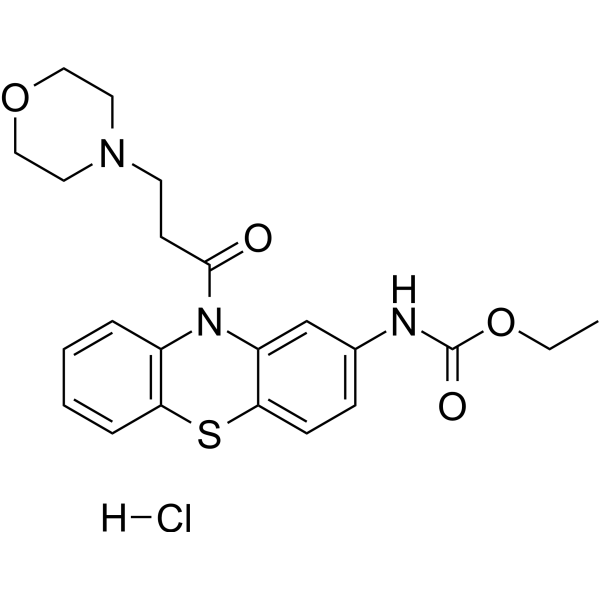
Chemical Structure
Moricizine Hydrochloride
Synonym(s): EN 313; Ethmozin; Moracizine
- CAS No.: 29560-58-5
- Formula:C22H26ClN3O4S
- Molecular Weight:463.98
IUPAC Name: ethyl (10-(3-morpholinopropanoyl)-10H-phenothiazin-2-yl)carbamate hydrochloride
InChIKey: GAQAKFHSULJNAK-UHFFFAOYSA-N
SMILES: O=C(OCC)NC(C=C1N2C(CCN3CCOCC3)=O)=CC=C1SC4=C2C=CC=C4.[H]Cl
Biological Activity: Moricizine Hydrochloride (EN 313) is an orally active cardiac sodium channel blocker. Moricizine Hydrochloride blocks inactivated sodium channels in a slow dissociation manner, inhibiting late and peak sodium currents, p-CaMKII, atrial enlargement, and cardiac hypertrophy. Moricizine Hydrochloride can be used in research on atrial fibrillation and arrhythmias[1][2][3][4][5][6][7].
| Cat. No. | Product Name | Purity | Description | Pricing | |||||||||||||||||||
|---|---|---|---|---|---|---|---|---|---|---|---|---|---|---|---|---|---|---|---|---|---|---|---|
|
|
Moricizine Hydrochloride | 98.0% | Moricizine Hydrochloride (EN 313) is an orally active cardiac sodium channel blocker. Moricizine Hydrochloride blocks inactivated sodium channels in a slow dissociation manner, inhibiting late and peak sodium currents, p-CaMKII, atrial enlargement, and cardiac hypertrophy. Moricizine Hydrochloride can be used in research on atrial fibrillation and arrhythmias. | ||||||||||||||||||||
|
loading...
/
|
|||||||||||||||||||||||
|
|
Moricizine-d8 Hydrochloride | 99.61% | Moricizine-d8 Hydrochloride (EN 313-d8; Ethmozin-d8; Moracizine-d8) is the deuterated-labeled Moricizine Hydrochloride (HY-B0615A). Moricizine Hydrochloride (EN 313) is an orally active cardiac sodium channel blocker. Moricizine Hydrochloride blocks inactivated sodium channels in a slow dissociation manner, inhibiting late and peak sodium currents, p-CaMKII, atrial enlargement, and cardiac hypertrophy. Moricizine Hydrochloride can be used in research on atrial fibrillation and arrhythmias. | ||||||||||||||||||||
|
loading...
/
|
|||||||||||||||||||||||
-
Similarity Score 0.78
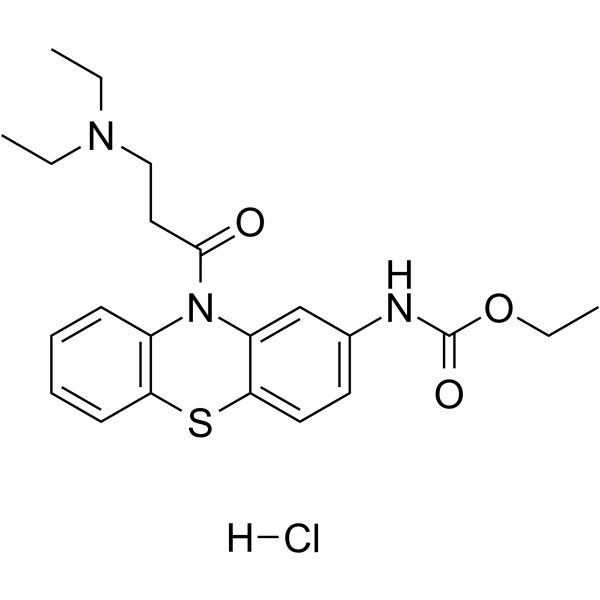 HY-135121Ethacizine hydrochloride
-
Similarity Score 0.77
 HY-131987Ethacizine
-
Similarity Score 0.60
 HY-121215Chloracyzine
-
Similarity Score 0.60
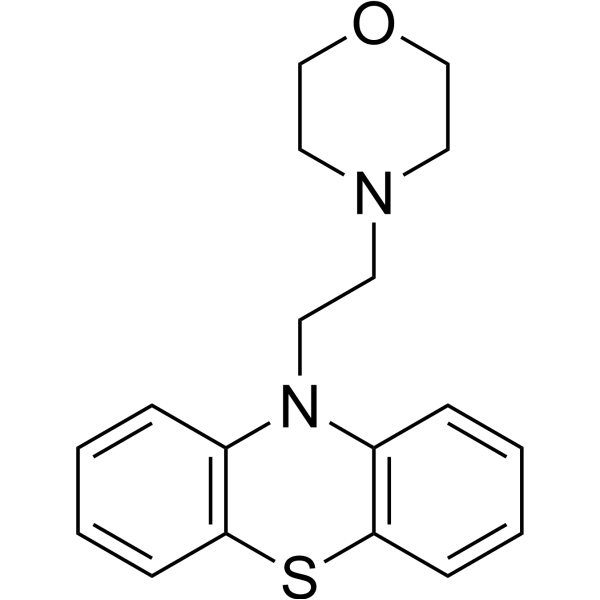 HY-149213LSD1/TLK1-IN-1
-
Similarity Score 0.57
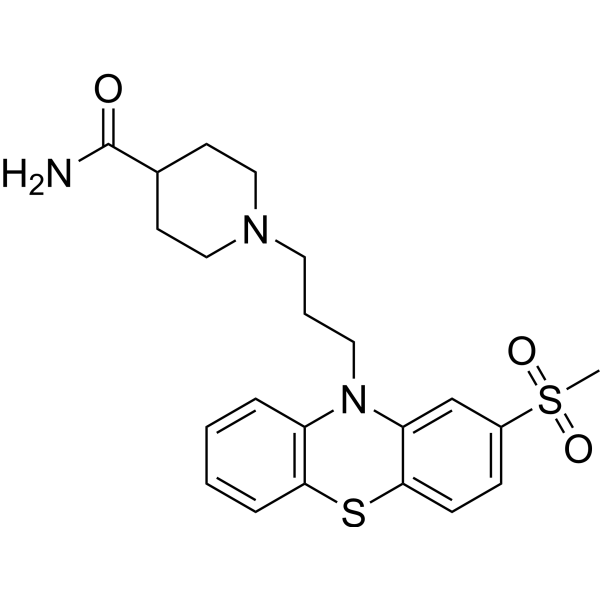 HY-116578Metopimazine
-
Similarity Score 0.56
 HY-123721Tiracizine hydrochloride
-
Similarity Score 0.56
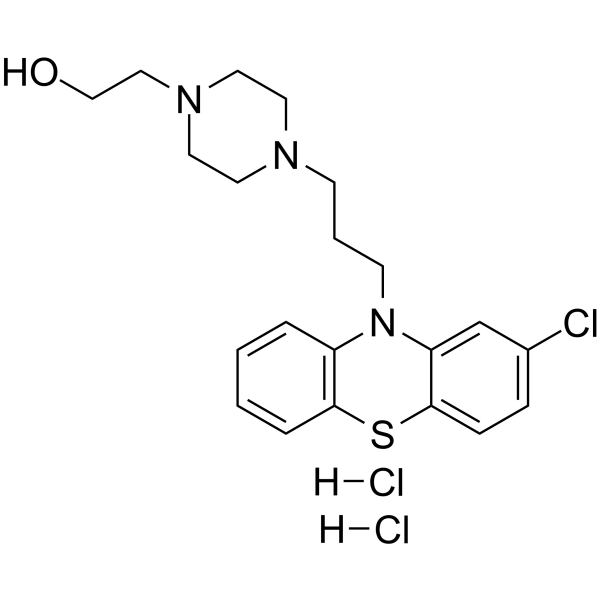 HY-A0077APerphenazine dihydrochloride
-
Similarity Score 0.56
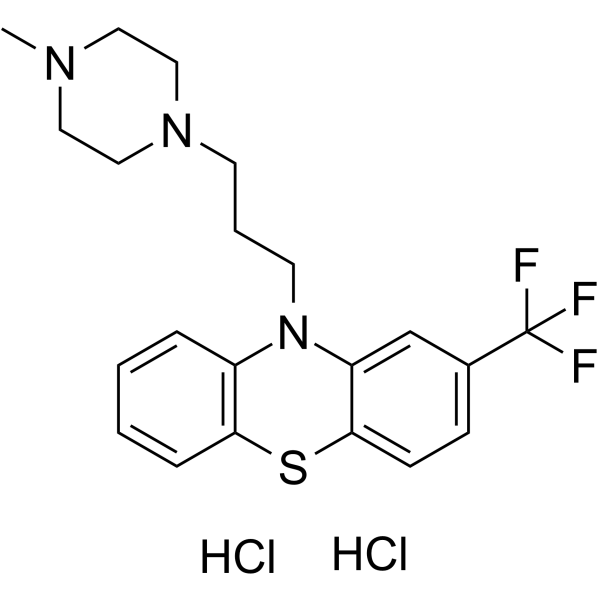 HY-B0532ATrifluoperazine dihydrochloride
-
Similarity Score 0.56
 HY-B1794RThiethylperazine (Standard)
-

Explore the MedChemAI to find more analogs


References
- [1]. Zou T, et al. Moricizine prevents atrial fibrillation by late sodium current inhibition in atrial myocytes. Journal of thoracic disease. 2022 Jun;14(6):2187-2200.
- [2]. Han C, et al. Clock-Modulating Activities of the Anti-Arrhythmic Drug Moricizine. Clocks & sleep. 2021 Jun 22;3(3):351-365.
- [3]. Konishi H, et al. Moricizine, an antiarrhythmic agent, as a potent inhibitor of hepatic microsomal CYP1A. Pharmacology. 2002 Dec;66(4):190-8.
- [4]. Abalakov GA, et al. Moricizine (ethmozine) can break electrical coupling between rat right atrial working cardiomyocytes in vitro. Bulletin of Experimental Biology and Medicine. 2018 Jul;165(3):351-5.
- [5]. Ahmmed GU, et al. Analysis of moricizine block of sodium current in isolated guinea-pig atrial myocytes. Atrioventricular difference of moricizine block. Vascular pharmacology. 2002 Mar;38(3):131-41. [Content Brief]
- [6]. Saeki T, et al. Block of Na+ channel by moricizine hydrochloride in isolated feline ventricular myocytes. European journal of pharmacology. 1994 Aug 22;261(3):249-56.
- [7]. Maruyama K, et al. Electrophysiological effects of Ro 22-9194, a new antiarrhythmic agent, on guinea-pig ventricular cells. British journal of pharmacology. 1995 Jan;114(1):19-26.



