



5534-95-2
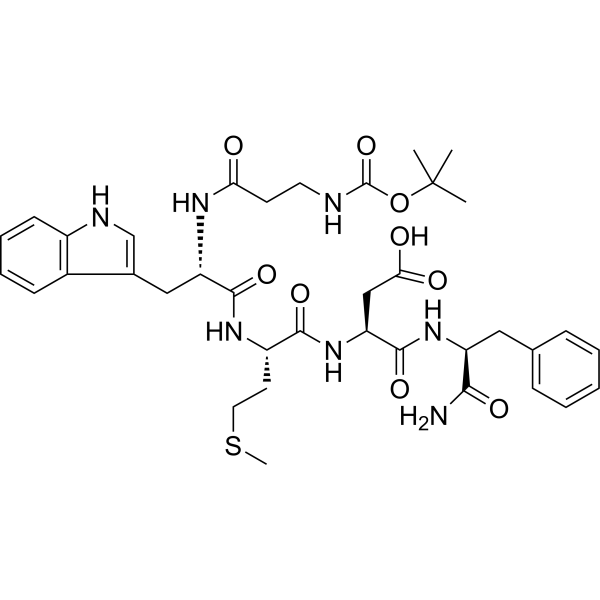
Chemical Structure
Pentagastrin
Synonym(s): ICI-50123
- CAS No.: 5534-95-2
- Formula:C37H49N7O9S
- Molecular Weight:767.89
IUPAC Name: (10S,13S,16S)-10-((1H-indol-3-yl)methyl)-16-(((S)-1-amino-1-oxo-3-phenylpropan-2-yl)carbamoyl)-2,2-dimethyl-13-(2-(methylthio)ethyl)-4,8,11,14-tetraoxo-3-oxa-5,9,12,15-tetraazaoctadecan-18-oic acid
InChIKey: NEYNJQRKHLUJRU-DZUOILHNSA-N
SMILES: O=C(N[C@@H](CCSC)C(N[C@@H](CC(O)=O)C(N[C@H](C(N)=O)CC1=CC=CC=C1)=O)=O)[C@@H](NC(CCNC(OC(C)(C)C)=O)=O)CC2=CNC3=C2C=CC=C3
Biological Activity: Pentagastrin (ICI-50123) is a potent, selective Cholecystokinin B (CCKB) receptor agonist with an EC50 value of 11 nM. Pentagastrin enhances gastric mucosal defense mechanisms against acid and protects the gastric mucosa from experimental injury[1][2].
| Cat. No. | Product Name | Purity | Description | Pricing | |||||||||||||||||||
|---|---|---|---|---|---|---|---|---|---|---|---|---|---|---|---|---|---|---|---|---|---|---|---|
|
|
Pentagastrin | 98.97% | Pentagastrin (ICI-50123) is a potent, selective Cholecystokinin B (CCKB) receptor agonist with an EC50 value of 11 nM. Pentagastrin enhances gastric mucosal defense mechanisms against acid and protects the gastric mucosa from experimental injury. | ||||||||||||||||||||
|
loading...
/
|
|||||||||||||||||||||||
-
Similarity Score 0.86
 HY-124192Amogastrin
-
Similarity Score 0.86
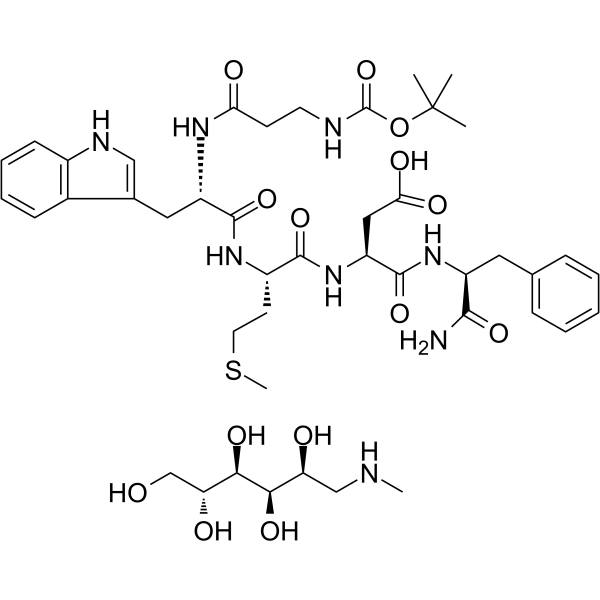 HY-A0261APentagastrin meglumine
-
Similarity Score 0.80
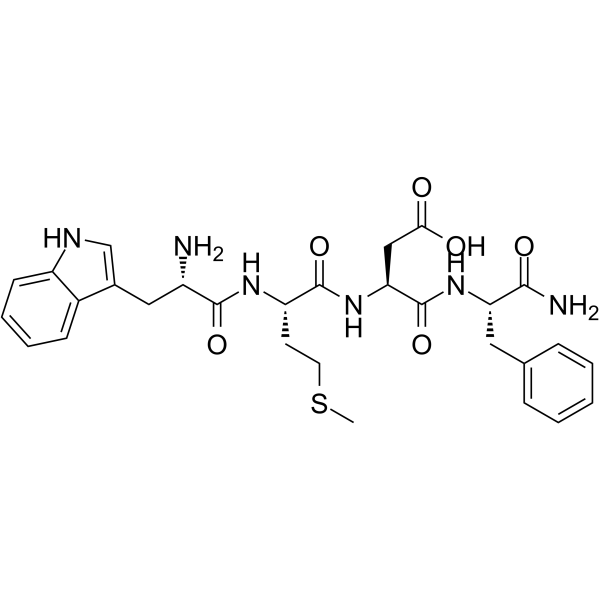 HY-125556Tetragastrin
-
Similarity Score 0.78
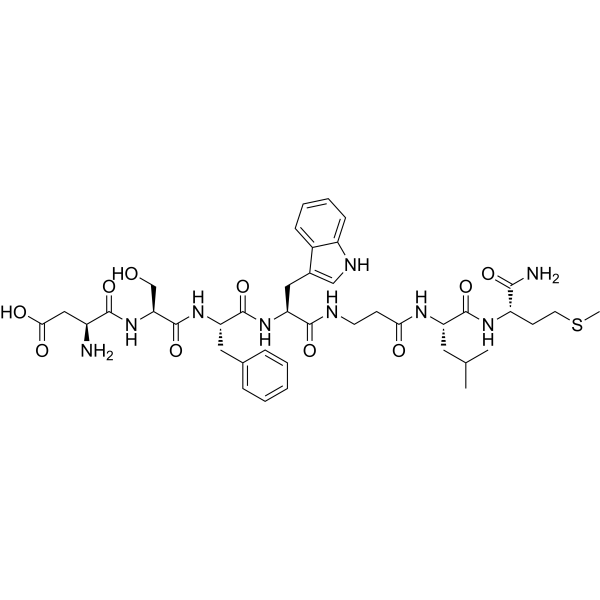 HY-P4709(Trp7,β-Ala8)-Neurokinin A (4-10)
-
Similarity Score 0.78
 HY-P2055A-57696
-
Similarity Score 0.76
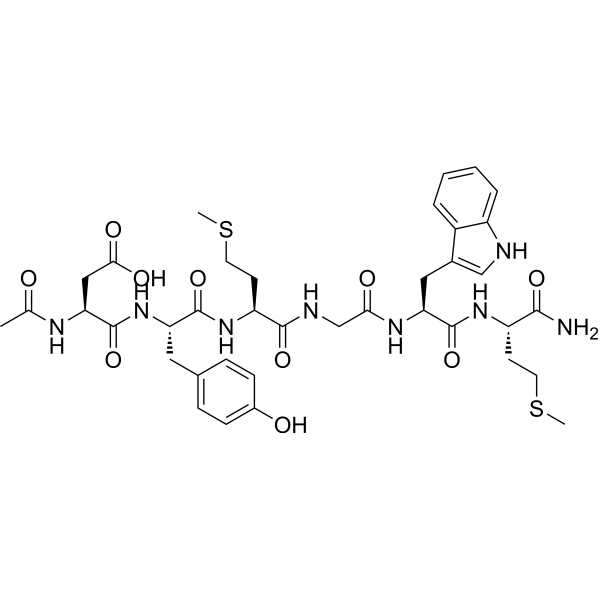 HY-P2678CCK (26-31) non-sulfated
-
Similarity Score 0.76
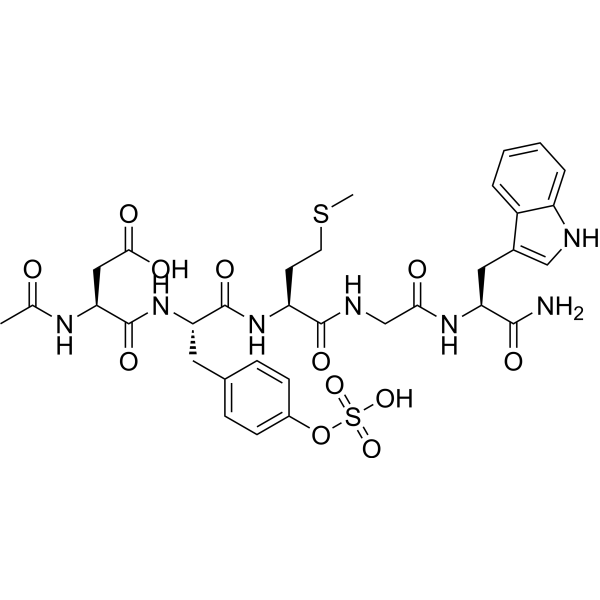 HY-P2165N-acetyl CCK-(26-30) amide
-
Similarity Score 0.74
 HY-P2593L-659874
-
Similarity Score 0.74
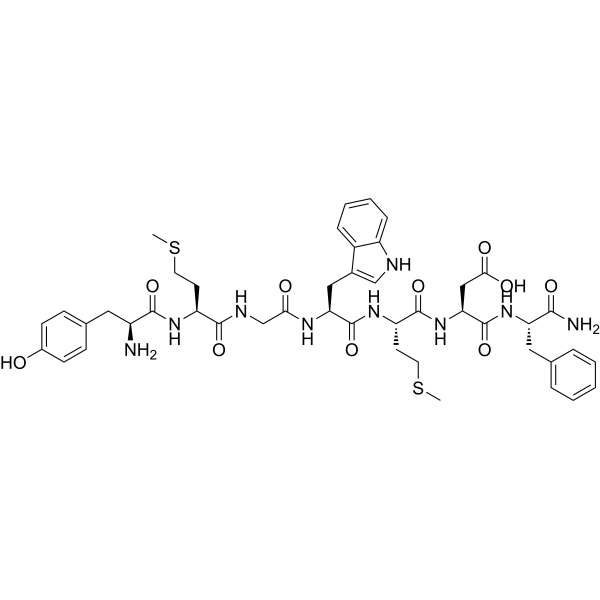 HY-P2627CCK (27-33)
-

Explore the MedChemAI to find more analogs


References
- [1]. Smith AJ, et al. Characterisation of CCKB receptors on GH3 pituitary cells: receptor activation is linked to Ca2+ mobilisation. Eur J Pharmacol. 1994 Apr 15;267(2):215-23. [Content Brief]
- [2]. Tanaka S, et al. Pentagastrin gastroprotection against acid is related to H2 receptor activation but not acid secretion. Gut. 1998 Sep;43(3):334-41. [Content Brief]



