CDK14
CDK14 (cyclin-dependent kinase 14, also known as PFTAIRE1/PFTK1) is a serine/threonine kinase that functions in cell-cycle regulation through association with cyclins and participates in the G2/M transition of mitosis.[1][2] Mechanistically, CDK14 forms an active complex with Cyclin Y and phosphorylates the Wnt co-receptor LRP6, thereby promoting canonical Wnt/β-catenin signaling and facilitating progression into mitosis.[2][2] Through regulation of Wnt pathway activity, CDK14 contributes to cell proliferation, stem-cell maintenance, and tissue development.[2][2] In disease contexts, elevated CDK14 activity has been linked to tumor progression, and experimental depletion or inhibition of CDK14 suppresses mammary stem-cell regeneration, triple-negative breast cancer growth, and metastatic potential through attenuation of Wnt/β-catenin signaling.[2] Genetic studies further demonstrate that Cdk14 deficiency impairs epithelial and endothelial cell proliferation, induces G2/M cell-cycle arrest, and exacerbates lung injury responses in mouse models, highlighting its role in tissue repair and regeneration.[3] Compared with other cyclin-dependent kinases, CDK14 belongs to the CDK5 subfamily and is distinguished by its Cyclin Y-dependent regulation of LRP6 phosphorylation and canonical Wnt signaling.[3] For experimental applications, the covalent CDK14 inhibitor FMF-04-159-2 has been used to reduce Wnt signaling, suppress triple-negative breast cancer progression, and decrease pathological α-synuclein accumulation in cellular and animal models of synucleinopathy, supporting CDK14 as a pharmacologically tractable research target.[2][4]
Verweise:
- [1]. CDK14 gene information from NCBI.
- [2]. Klein AB, et al. The GDF15-GFRAL pathway is dispensable for the effects of metformin on energy balance. Cell Rep. 2022 Aug 23;40(8):111258. [Content Brief]
- [3]. Chen JW, et al. CDK14 regulates the development and repair of lung. Cell Death Discov. 2025 Jan 18;11(1):12. [Content Brief]
- [4]. Parmasad JA, et al. Genetic and pharmacological reduction of CDK14 mitigates synucleinopathy. Cell Death Dis. 2024 Apr 4;15(4):246. [Content Brief]
All Product Categories
-
CDK14 Verwandte Produkte (6)
Verwandte Produkte (6)

-
Tambiciclib
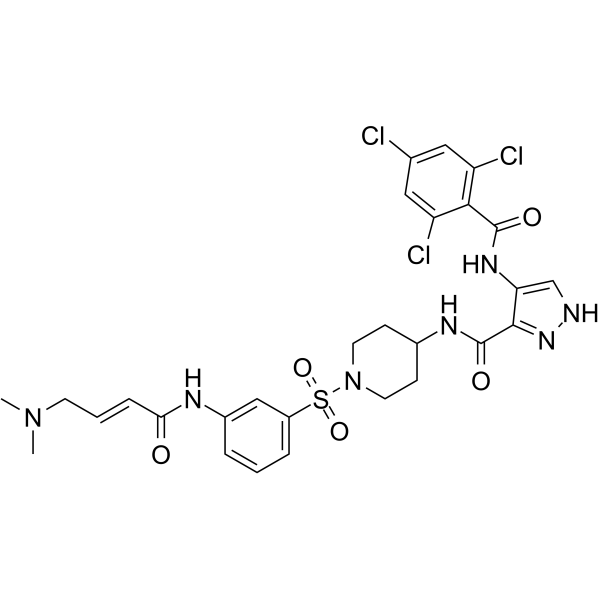
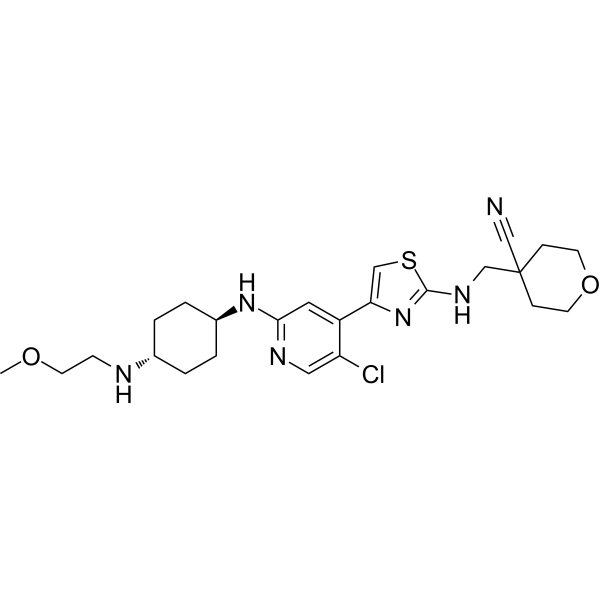
 0 ImagesSynonyms: GFH009; JSH-009; SLS009Tambiciclib (GFH009, JSH-009) is an orally active, highly potent and selective CDK9 inhibitor (IC50 = 1 nM), demonstrating >200-fold selectivity over other CDKs, >100-fold selectivity over DYRK1A/B, and excellent selectivity over 468 kinases/mutants. Tambiciclib demonstrates potent in vitro and in vivo antileukemic efficacy in acute myeloid leukemia (AML) mouse models by inhibiting RNA Pol II phosphorylation, downregulating MCL1 and MYC, and inducing apoptosis. Tambiciclib can be used for AML research.
-
SB1-G-187
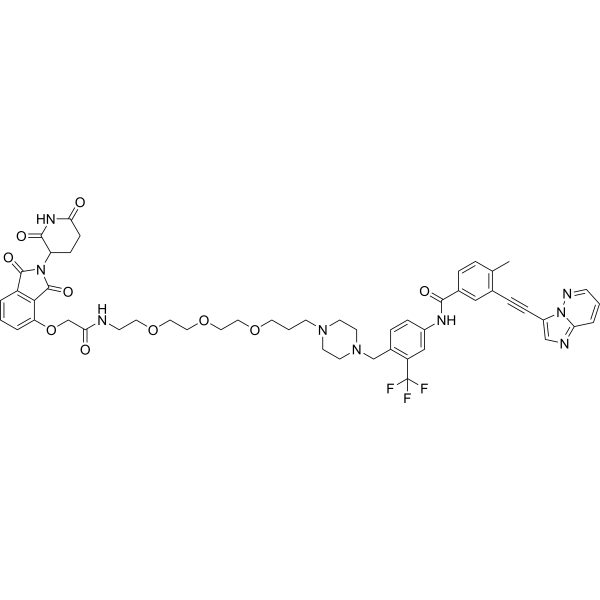 0 ImagesSB1-G-187 is a multi-target kinase PROTAC degrader with activity against various kinases including GCK, YES1, IRAK1 and LYN. SB1-G-187 induces degradation of target kinases via a p97-dependent pathway, and forms ternary complexes with CRBN and specific functional kinases. SB1-G-187 can be used in tumor-related research.
-
Tambiciclib dimaleate
 0 ImagesSynonyms: GFH009 dimaleate; JSH-009 dimaleate; SLS009 dimaleateTambiciclib (GFH009, JSH-009) dimaleate is an orally active, highly potent and selective CDK9 inhibitor (IC50 = 1 nM), demonstrating >200-fold selectivity over other CDKs, >100-fold selectivity over DYRK1A/B, and excellent selectivity over 468 kinases/mutants. Tambiciclib dimaleate demonstrates potent in vitro and in vivo antileukemic efficacy in acute myeloid leukemia (AML) mouse models by inhibiting RNA Pol II phosphorylation, downregulating MCL1 and MYC, and inducing apoptosis. Tambiciclib dimaleate can be used for AML research.