



IFNAR1
IFNAR1 (interferon alpha/beta receptor 1) is a core subunit of the type I interferon receptor complex and forms a heterodimeric receptor with IFNAR2 to mediate cellular responses to interferon-α and interferon-β[1]. Upon type I interferon binding, IFNAR1-associated TYK2 and IFNAR2-associated JAK1 are brought into close proximity, triggering activation of the JAK-STAT signaling pathway and transcription of interferon-stimulated genes involved in antiviral and immune regulatory programs[4]. Mechanistically, phosphorylation of IFNAR1 creates docking sites for STAT proteins, enabling signal propagation from the plasma membrane to the nucleus and coordinating broad interferon-responsive gene expression networks[2]. In disease and experimental models, altered IFNAR1 signaling influences antiviral immunity, inflammatory responses, and susceptibility to viral infection, making the receptor a widely used model for studying type I interferon biology[3]. Compared with related receptor subunits, IFNAR1 exists as a single receptor isoform, whereas IFNAR2 undergoes alternative splicing to generate multiple isoforms with distinct signaling capacities, highlighting a key structural and functional distinction within the type I interferon receptor system[5]. Furthermore, IFNAR1 and IFNAR2 play distinct roles during initiation of type I interferon signaling, supporting receptor-specific regulatory mechanisms that influence downstream STAT activation[3]. For experimental and therapeutic applications, antagonism of IFNAR1 has been used to suppress excessive type I interferon signaling, whereas receptor activation remains central to studies of antiviral and immune-modulating interferon responses[7].
Verweise:
- [1]. Uniprotkb. [Content Brief]
- [2]. Yan H, et al. Phosphorylated interferon-alpha receptor 1 subunit (IFNaR1) acts as a docking site for the latent form of the 113 kDa STAT2 protein. EMBO J. 1996 Mar 1;15(5):1064-74. [Content Brief]
- [3]. Shemesh M, et al. IFNAR1 and IFNAR2 play distinct roles in initiating type I interferon-induced JAK-STAT signaling and activating STATs. Sci Signal. 2021 Nov 23;14(710):eabe4627. [Content Brief]
- [4]. UCSC.edu. DATAbase.
- [5]. Zanin N, et al. Interferon Receptor Trafficking and Signaling: Journey to the Cross Roads. Front Immunol. 2020;11:615603.
-
IFNAR1 Verwandte Produkte (7)
Verwandte Produkte (7)

-
Ezurpimtrostat hydrochloride
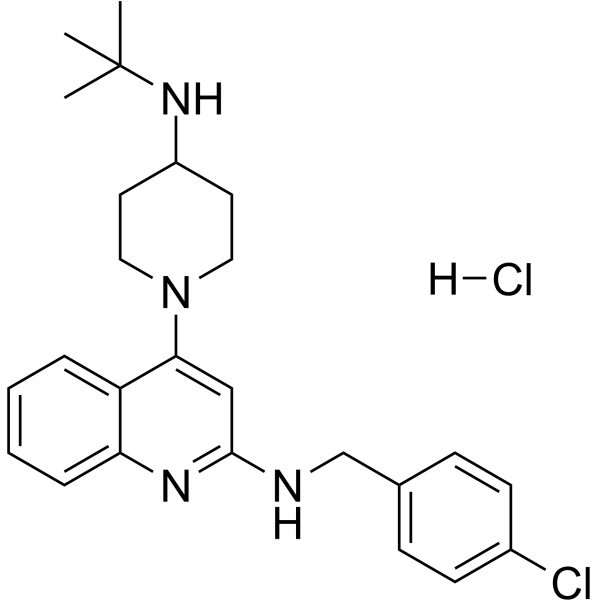 0 ImagesSynonyms: GNS561 hydrochlorideEzurpimtrostat hydrochloride (GNS561 hydrochloride) is an orally active PPT1 inhibitor, autophagy inhibitor, immunomodulator, anti-inflammatory agent, and anticancer agent. Ezurpimtrostat hydrochloride inhibits PPT1, dysregulates lysosomal function, redistributes mTOR, and induces apoptosis. Ezurpimtrostat hydrochloride reduces IFN‑α, CRP, immune complex deposition, and SARS‑CoV‑2 viral load. Ezurpimtrostat hydrochloride can be used for the study of systemic lupus erythematosus, SARS‑CoV‑2, hepatocellular carcinoma, fibrosis, and related disorders.
-
KMR-206
 0 ImagesKMR-206 is a PARP7 inhibitor with an IC50 of 13.7 nM. KMR-206 relieves AHR-mediated transcriptional repression and enhances CYP1A1 expression in the presence of TCDD. KMR-206 induces the STING-dependent IFN-β signaling pathway and increases the levels of STAT1, pSTAT1 and nuclear PARP7 in cancer cells. KMR-206 reduces the viability of lung adenocarcinoma cells, enhances radiation-induced immunogenic signals, and induces the production of immunogenic signals in glioblastoma cancer stem cells. KMR-206 destabilizes FRA1 to increase IRF1 levels and promotes the IRF3-CBP/p300 interaction. KMR-206 can be used in studies related to lung adenocarcinoma and glioblastoma.
-
Ezurpimtrostat
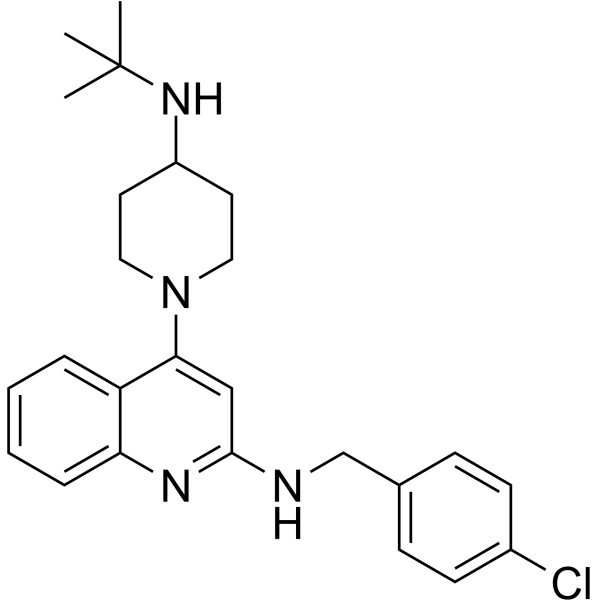 0 ImagesSynonyms: GNS561Ezurpimtrostat (GNS561) is an orally active PPT1 inhibitor, autophagy inhibitor, immunomodulator, anti-inflammatory agent, and anticancer agent. Ezurpimtrostat inhibits PPT1, dysregulates lysosomal function, redistributes mTOR, and induces apoptosis. Ezurpimtrostat reduces IFN‑α, CRP, immune complex deposition, and SARS‑CoV‑2 viral load. Ezurpimtrostat can be used for the study of systemic lupus erythematosus, SARS‑CoV‑2, hepatocellular carcinoma, fibrosis, and related disorders.
-
IFN-α Receptor Recognition Peptide 1
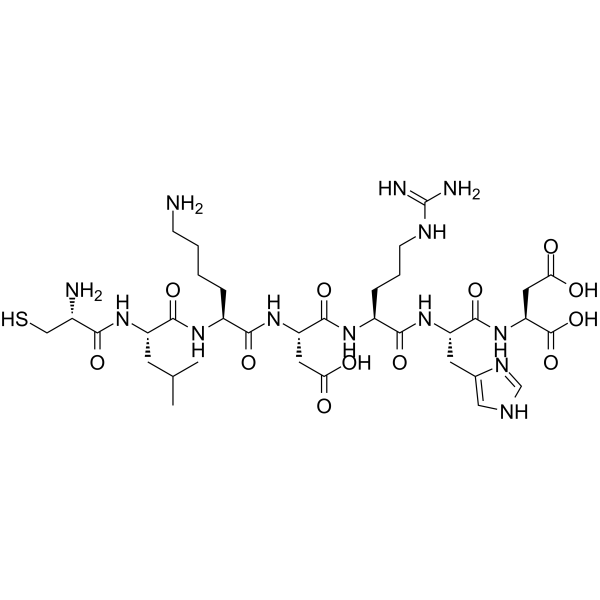 0 ImagesArt. -Nr.: HY-P1758CAS. Nr.: 153840-64-3Synonyms: IRRP1IFN-α Receptor Recognition Peptide 1 (IRRP1) is an amino acid synthetic peptide and also a regulator of IFN-α Receptor. IFN-α Receptor Recognition Peptide 1 binds to IFNAR2, enhances the binding capacity of IFN-α receptor, and slightly increases the IFN-α-induced growth inhibitory activity. IFN-α Receptor Recognition Peptide 1 inhibits IFN-α-induced STAT1 phosphorylation and STAT-DNA binding by blocking the activation of IFNAR by IFN-α. IFN-α Receptor Recognition Peptide 1 increases the occupancy of IFN-α on cell surface receptors, enhances the phosphorylation activation of ISGF3, and elevates IFN-α-induced antiviral activity. IFN-α Receptor Recognition Peptide 1 can be used in studies related to encephalomyocarditis virus infection.
-
IFN-α Receptor Recognition Peptide 1 acetate
 0 ImagesArt. -Nr.: HY-P1758AReinheit: 99.29%Synonyms: IRRP1 acetateIFN-α Receptor Recognition Peptide 1 acetate (IRRP1 acetate) is an amino acid synthetic peptide and also a regulator of IFN-α Receptor. IFN-α Receptor Recognition Peptide 1 acetate binds to IFNAR2, enhances the binding capacity of IFN-α receptor, and slightly increases the IFN-α-induced growth inhibitory activity. IFN-α Receptor Recognition Peptide 1 acetate inhibits IFN-α-induced STAT1 phosphorylation and STAT-DNA binding by blocking the activation of IFNAR by IFN-α. IFN-α Receptor Recognition Peptide 1 acetate increases the occupancy of IFN-α on cell surface receptors, enhances the phosphorylation activation of ISGF3, and elevates IFN-α-induced antiviral activity. IFN-α Receptor Recognition Peptide 1 acetate can be used in studies related to encephalomyocarditis virus infection.
-
ANB032
 0 ImagesArt. -Nr.: HY-P992182ANB032 is a human IgG4 kappa BTLA agonist monoclonal antibody. ANB032 inhibits activated T cell proliferation and reduces secretion of inflammatory cytokines. ANB032 can be used for the research of atopic dermatitis[1].
-
QX006N
 0 ImagesArt. -Nr.: HY-P991251Reinheit: 99.9%QX006N is a humanized monoclonal antibody inhibitor targeting human interferon α/β receptor 1 (IFNAR1). QX006N is promising for research of systemic lupus erythematosus (SLE) and other IFNAR1-related autoimmune diseases.



