



Dichotomitin
Based on 2 publication(s) in Google Scholar
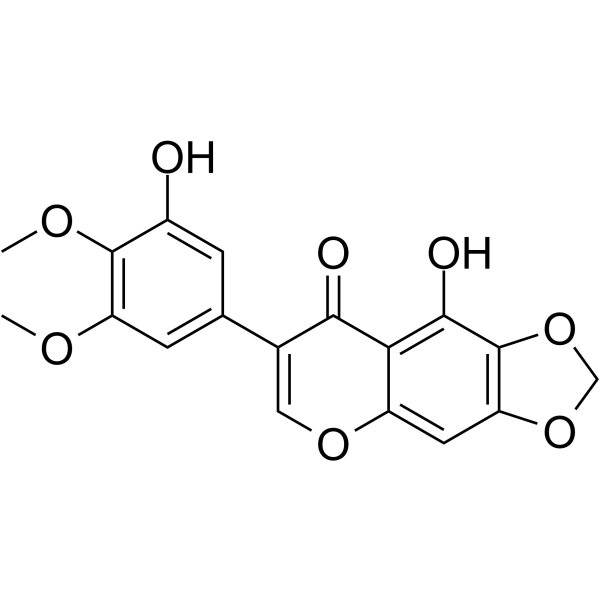
Dichotomitin is an isoflavonoid compound isolated from the rhizomes of Belamcanda chinensis. Dichotomitin exhibits antioxidant activity, alleviates oxidative stress, reduces intracellular reactive oxygen species (ROS) levels, and upregulates the expression of SOD1, SOD2 and CAT. Dichotomitin increases ALP activity while upregulating the expression of RUNX2, OPN and OCN. Dichotomitin has antitussive activity and helps improve symptoms of upper respiratory tract infections.
Nur für Forschungszwecke. Wir verkaufen nicht an Patienten.
- Reinheit : 99.02%
- CAS. Nr.: 88509-91-5
- Formel: C18H14O8
- Molecular Weight:358.30
-
Speicherung:
4°C, sealed storage, away from moisture and light
* In solvent : -80°C, 6 months; -20°C, 1 month (sealed storage, away from moisture and light)

To place orders, for customer services and technical support, please contact: MedChemExpress USA
Tel: 609-228-6898 E-mail: [email protected] [email protected]


-
 Biologische Aktivität
-
Chemical Information
-
Lösungsmittel & Löslichkeit
- Protokoll
- Reinheit & Dokumentation
- Verweise
-
 Help & FAQs


Publications Citing Use of MedChemExpress (MCE) Dichotomitin
More

Biologische Aktivität
Beschreibung
IC50 & Target
[1]|
RUNX2 |
In Vitro
Dichotomitin (0.5-2.0 µM; 7 days) enhances ALP activity and staining, markers of early osteogenic differentiation, in human bone marrow stromal HS-5 cells at 0.5, 1.0, and 1.5 µM after 7 days of osteogenic induction[1].
Dichotomitin (0.5-2.0 µM; 21 days) promotes mineralized nodule formation, a marker of late osteogenic differentiation, in human bone marrow stromal HS-5 cells at 0.5, 1.0, and 1.5 µM after 21 days of osteogenic induction[1].
Dichotomitin (0.5-2.0 µM) significantly upregulates COL1A1, RUNX2, OSX, OPN, and OCN gene expression in human bone marrow stromal HS-5 cells at 1.0 and 1.5 µM during osteogenic differentiation[1].
Dichotomitin restores ALP activity and mineralized nodule formation in hydrogen peroxide-impaired osteogenic differentiation of human bone marrow stromal HS-5 cells[1].
Dichotomitin (10 μM; 1 h) produces four metabolites, with M6 and M8 as the most abundant, and yields comparable metabolic profiles across rat, monkey, and human liver microsomes with greater formation of M6 and M8 in rat and monkey than in human[2].
Dichotomitin (10 μM; 1 h) shows that CYP1A2, 2C19, and 2D6 drive M6 production, while only CYP1A2 catalyzes M8 production in human recombinant CYP enzymes[2].
MedChemExpress (MCE) has not independently confirmed the accuracy of these methods. They are for reference only.
-
Cell Line:human bone marrow stromal HS-5 cells
-
Concentration:0.5, 1.0, 1.5, 2.0 µM
-
Incubation Time:24, 48, 72, 96 h
-
Result:Promoted HS-5 cell proliferation at 1.0 µM and 1.5 µM.
Inhibited HS-5 cell proliferation at 2.0 µM.
In Vivo
MedChemExpress (MCE) has not independently confirmed the accuracy of these methods. They are for reference only.
-
Animal Model:Sprague-Dawley (SD) (female, SPF-grade, 220 g)[1]
-
Dosage:5 mg/kg
-
Administration:i.p.; twice weekly; 3 months
-
Result:Increased trabecular bone volume/tissue volume ratio (BV/TV), trabecular thickness (Tb.Th), and trabecular number (Tb.N) compared to the OVX group.
Increased trabecular bone area and reduced fragmentation compared to the OVX group.
Reduced TRAP-positive osteoclast count and reduced MMP9 expression compared to the OVX group.
Increased levels of alkaline phosphatase (ALP) and osteopontin (OPN) compared to the OVX group.


Chemical Information
-
CAS. Nr. 88509-91-5
-
Appearance Solid
-
Molecular Weight 358.30
-
Formel C18H14O8
-
Color Off-white to light yellow
-
SMILES
O=C1C(C2=CC(OC)=C(OC)C(O)=C2)=COC3=CC(OCO4)=C4C(O)=C13
-
Structure Classification
-
Initial Source
-
Versand
Room temperature in continental US; may vary elsewhere.
-
Speicherung
4°C, sealed storage, away from moisture and light
* In solvent : -80°C, 6 months; -20°C, 1 month (sealed storage, away from moisture and light)


Publications (2)
-
Journal Impact Factor
-
Most Recent
-
J Orthop Surg Res
Dichotomitin promotes osteoblast differentiation and improves osteoporosis by inhibiting oxidative stress. [Abstract]2025 Jan 3;20(1):6. PMID: 39754147 -


Lösungsmittel & Löslichkeit
In Vitro:
DMSO : 11.11 mg/mL (31.01 mM; ultrasonic and warming and heat to 60°C; Hygroscopic DMSO has a significant impact on the solubility of product, please use newly opened DMSO)
Please refer to the solubility information to select the appropriate solvent. Once prepared, please aliquot and store the solution to prevent product inactivation from repeated freeze-thaw cycles.
Storage method and period of stock solution: -80°C, 6 months; -20°C, 1 month (sealed storage, away from moisture and light). When stored at -80°C, please use it within 6 months. When stored at -20°C, please use it within 1 month.
Please refer to the solubility information to select the appropriate solvent. Once prepared, please aliquot and store the solution to prevent product inactivation from repeated freeze-thaw cycles.
Storage method and period of stock solution: -80°C, 6 months; -20°C, 1 month (sealed storage, away from moisture and light). When stored at -80°C, please use it within 6 months. When stored at -20°C, please use it within 1 month.
Konzentration (Stammlösung) × Volumen (Stammlösung) = Konzentration (Ziellösung) × Volumen (Ziellösung)
In Vivo:
Select the appropriate dissolution method based on your experimental animal and administration route.
- For the following dissolution methods, please ensure to first prepare a clear stock solution using an In Vitro approach and then sequentially add co-solvents:
- To ensure reliable experimental results, the clarified stock solution can be appropriately stored based on storage conditions. As for the working solution for In Vivo experiments, it is recommended to prepare freshly and use it on the same day.
- The percentages shown for the solvents indicate their volumetric ratio in the final prepared solution. If precipitation or phase separation occurs during preparation, heat and/or sonication can be used to aid dissolution.
Add each solvent one by one: 10% DMSO 40% PEG300 5% Tween-80 45% Saline
Solubility: ≥ 1.11 mg/mL (3.10 mM); Clear solution
This protocol yields a clear solution of ≥ 1.11 mg/mL (saturation unknown).
Taking 1 mL working solution as an example, add 100 μL DMSO stock solution (11.1 mg/mL) to 400 μL PEG300, and mix evenly; then add 50 μL Tween-80 and mix evenly; then add 450 μL Saline to adjust the volume to 1 mL.
Preparation of Saline: Dissolve 0.9 g sodium chloride in ddH₂O and dilute to 100 mL to obtain a clear Saline solution.
Add each solvent one by one: 10% DMSO 90% (20% SBE-β-CD in Saline)
Solubility: ≥ 1.11 mg/mL (3.10 mM); Clear solution
This protocol yields a clear solution of ≥ 1.11 mg/mL (saturation unknown).
Taking 1 mL working solution as an example, add 100 μL DMSO stock solution (11.1 mg/mL) to 900 μL 20% SBE-β-CD in Saline, and mix evenly.
Preparation of 20% SBE-β-CD in Saline (4°C, storage for one week): 2 g SBE-β-CD powder is dissolved in 10 mL Saline, completely dissolve until clear.
In Vivo Dissolution Calculator
Please enter the basic information of animal experiments:
-
-
-
-
Recommended: Prepare an additional quantity of animals to account for potential losses during experiments.
Please enter your animal formula composition:
-
%DMSO +
Recommended: Keep the proportion of DMSO in working solution below 2% if your animal is weak.
-
%+
-
+%Tween-80 + +
-
%Saline +
The co-solvents required include: DMSO, . All of co-solvents are available by MedChemExpress (MCE). , Tween 80. All of co-solvents are available by MedChemExpress (MCE).
Working solution concentration: 0.22 mg/mL
Method for preparing stock solution: mg drug dissolved in μL DMSO. Stock solution concentration: mg/mL. * In solvent : -80°C, 6 months; -20°C, 1 month (sealed storage, away from moisture and light)
1. Take μL DMSO stock solution;
2. Add μL .
μL , mix evenly;
3. Then add μL Tween 80, mix evenly;
4. Then add μL
Please ensure that the stock solution in the first step is dissolved to a clear state, and add co-solvents in sequence. You can use ultrasonic heating (ultrasonic cleaner, recommended frequency 20-40 kHz), vortexing, etc. to assist dissolution.


Reinheit & Dokumentation
-
Data Sheet (291 KB)
-
SDS (251 KB)
- English - EN (251 KB)
- Français - FR (251 KB)
- Deutsch - DE (251 KB)
- Norwegian - NO (251 KB)
- Español - ES (251 KB)
- Swedish - SV (251 KB)
- Italian - IT (251 KB)
- Korean - KR (251 KB)
- Portuguese - PT (251 KB)
-
Handling Instructions (2659 KB)
Verweise
[1]. Han M, et al. Dichotomitin promotes osteoblast differentiation and improves osteoporosis by inhibiting oxidative stress. Journal of orthopaedic surgery and research. 2025 Jan 03;20(1):6. [Content Brief]
[3]. Xie GY, et al. Phenolic metabolite profiles and antioxidants assay of three Iridaceae medicinal plants for traditional Chinese medicine "She-gan" by on-line HPLC-DAD coupled with chemiluminescence (CL) and ESI-Q-TOF-MS/MS. Journal of pharmaceutical and biomedical analysis. 2014 Sep;98:40-51. [Content Brief]


Complete Stock Solution Preparation Table
Please refer to the solubility information to select the appropriate solvent. Once prepared, please aliquot and store the solution to prevent product inactivation from repeated freeze-thaw cycles.
Storage method and period of stock solution: -80°C, 6 months; -20°C, 1 month (sealed storage, away from moisture and light). When stored at -80°C, please use it within 6 months. When stored at -20°C, please use it within 1 month.
| Optional Solvent | Concentration Solvent Mass | 1 mg | 5 mg | 10 mg | 25 mg |
|---|---|---|---|---|---|
| DMSO | 1 mM | 2.7910 mL | 13.9548 mL | 27.9096 mL | 69.7739 mL |
| 5 mM | 0.5582 mL | 2.7910 mL | 5.5819 mL | 13.9548 mL | |
| 10 mM | 0.2791 mL | 1.3955 mL | 2.7910 mL | 6.9774 mL | |
| 15 mM | 0.1861 mL | 0.9303 mL | 1.8606 mL | 4.6516 mL | |
| 20 mM | 0.1395 mL | 0.6977 mL | 1.3955 mL | 3.4887 mL | |
| 25 mM | 0.1116 mL | 0.5582 mL | 1.1164 mL | 2.7910 mL | |
| 30 mM | 0.0930 mL | 0.4652 mL | 0.9303 mL | 2.3258 mL |


Dichotomitin Related Classifications
HY-N2120 Related Classifications
 Powered by Bioz