



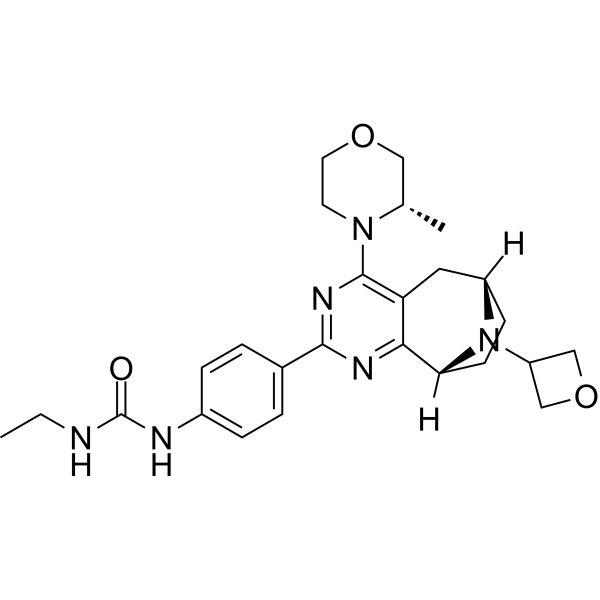
GNE-555
GNE-555 is a selective, metabolically stable mTOR inhibitor (Ki=1.5 nM) that also has good oral bioavailability. GNE-555 exhibits antiproliferative activity on PC3 and MCF-7 cells and can be used in cancer research.
Nur für Forschungszwecke. Wir verkaufen nicht an Patienten.
- CAS. Nr.: 1428902-71-9
- Formel: C26H34N6O3
- Molecular Weight:478.59
-
Speicherung:
Please store the product under the recommended conditions in the Certificate of Analysis.

To place orders, for customer services and technical support, please contact: MedChemExpress USA
Tel: 609-228-6898 E-mail: [email protected] [email protected]


-
 Biologische Aktivität
-
Chemical Information
- Protokoll
- Reinheit & Dokumentation
- Verweise
-
 Help & FAQs




Biologische Aktivität
Beschreibung
Cellular Effect
|
Cell Line

|
Type | Value | Description | References |
|---|---|---|---|---|
| MCF7 | EC50 |
75 nM
Compound: 20, GNE-555
|
Cytotoxicity against human MCF7 neo/Her2 cells after 3 days by CellTiter-Glo assay
Cytotoxicity against human MCF7 neo/Her2 cells after 3 days by CellTiter-Glo assay
|
[PMID: 23473235] |
| PC-3 | EC50 |
29 nM
Compound: 20, GNE-555
|
Cytotoxicity against human PC3 cells after 4 days by CellTiter-Glo assay
Cytotoxicity against human PC3 cells after 4 days by CellTiter-Glo assay
|
[PMID: 23473235] |


Chemical Information
-
CAS. Nr. 1428902-71-9
-
Molecular Weight 478.59
-
Formel C26H34N6O3
-
SMILES
O=C(NC1=CC=C(C2=NC(N3[C@@H](C)COCC3)=C(C[C@]4([H])CC[C@@]5([H])N4C6COC6)C5=N2)C=C1)NCC
-
Versand
Room temperature in continental US; may vary elsewhere.
-
Speicherung
Please store the product under the recommended conditions in the Certificate of Analysis.

Protokoll
-
Protocol for Pharmacokinetic Study
Pharmacokinetic studies quantify how an organism handles a drug over time through absorption, distribution, metabolism, and excretion, and the core experimental readout is the concentration-time profile of parent drug and, when relevant, metabolites in biological matrices such as plasma, whole blood, urine, bile, or tissue. Pharmacokinetic analysis links dose, route, exposure, clearance, half-life, distribution, bioavailability, and systemic exposure to drug efficacy and toxicity hypotheses rather than measuring a signaling pathway directly. The literature links pharmacokinetics to drug-development phenotypes by showing that drug metabolism and pharmacokinetics influence compound progression, exposure-response interpretation, safety margins, dosing strategy, and failure risk during discovery and development. DMPK science contributes to compound optimization by integrating physicochemical properties, in vitro metabolism, transporter behavior, in vivo exposure, and pharmacodynamic contex
-
Cell Viability Determination by MTT Colorimetric Assay
The following protocol uses the MTT colorimetric assay as a classic literature-established method for assessing cell viability/metabolic activity in cultured mammalian cells. MTT[3-(4,5-dimethylthiazol-2-yl)-2,5-diphenyltetrazolium bromide] is reduced by metabolically active cells to a colored formazan product; the amount of formazan is quantified spectrophotometrically and provides an indirect measure of metabolically active viable cells. Importantly, MTT reduction reflects cellular oxidoreductase/metabolic activity rather than an absolute direct count of living cells, so changes in cellular metabolism can alter the signal independently of cell number.


Reinheit & Dokumentation
Verweise
[1]. Estrada AA, et al. Pyrimidoaminotropanes as potent, selective, and efficacious small molecule kinase inhibitors of the mammalian target of rapamycin (mTOR). J Med Chem. 2013 Apr 11;56(7):3090-101. [Content Brief]
[2]. Huang G, et al. Applications of oxetanes in drug discovery and medicinal chemistry. Eur J Med Chem. 2023 Dec 5;261:115802. [Content Brief]

Calculators
Konzentration (Stammlösung) × Volumen (Stammlösung) = Konzentration (Ziellösung) × Volumen (Ziellösung)


GNE-555 Related Classifications
HY-13847 Related Classifications
 Powered by Bioz