



GrTx1
GrTx1 is a peptide toxin originally isolated from the venom of the spider Grammostola rosea. GrTx1 blocks sodium channel, with IC50s of 0.63 μM, 0.23 μM, 0.77 μM, 1.29 μM, 0.63 μM and 0.37 μM for Nav1.1, Nav1.2, Nav1.3, Nav1.4, Nav1.6 and Nav1.7, repectively. GrTx1 can be used for neurological disease research.
Nur für Forschungszwecke. Wir verkaufen nicht an Patienten.
- Formel: C159H243N45O41S8
- Molecular Weight:3697.43
-
Speicherung:
Please store the product under the recommended conditions in the Certificate of Analysis.

To place orders, for customer services and technical support, please contact: MedChemExpress USA
Tel: 609-228-6898 E-mail: [email protected] [email protected]


-
 Biologische Aktivität
-
Chemical Information
- Protokoll
- Reinheit & Dokumentation
- Verweise
-
 Help & FAQs




Biologische Aktivität
Beschreibung
In Vitro
GrTx1 (0-100 μΜ, 3 min) blocks Na+ currents of neuroblastoma F-11 cells with an IC50 of 2.8 μM[1]. GrTx1 (10 μΜ, 3 min) blocks about 85% Na+ currents of neuroblastoma F-11 cells with no effects on common K+ channels, such as Kv1.1 and 1.4[1].
MedChemExpress (MCE) has not independently confirmed the accuracy of these methods. They are for reference only.


Chemical Information
-
Molecular Weight 3697.43
-
Formel C159H243N45O41S8
-
Sequence
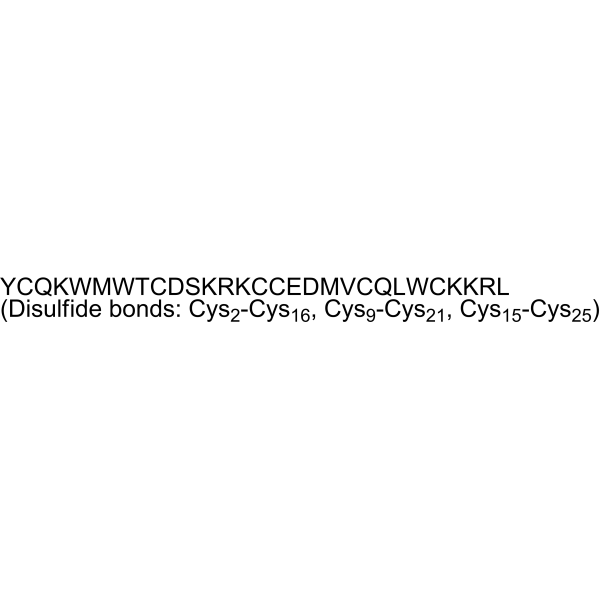
Tyr-Cys-Gln-Lys-Trp-Met-Trp-Thr-Cys-Asp-Ser-Lys-Arg-Lys-Cys-Cys-Glu-Asp-Met-Val-Cys-Gln-Leu-Trp-Cys-Lys-Lys-Arg-Leu (Disulfide bonds: Cys2-Cys16, Cys9-Cys21, Cys15-Cys25)
-
Sequence Shortening
YCQKWMWTCDSKRKCCEDMVCQLWCKKRL (Disulfide bonds: Cys2-Cys16, Cys9-Cys21, Cys15-Cys25)
-
Initial Source
Grammostola rosea
-
Versand
Room temperature in continental US; may vary elsewhere.
-
Speicherung
Please store the product under the recommended conditions in the Certificate of Analysis.


Reinheit & Dokumentation
Verweise
[1]. Clement H,et.al. Isolation and characterization of a novel toxin from the venom of the spider Grammostola rosea that blocks sodium channels. Toxicon. 2007 Jul;50(1):65-74. [Content Brief]
[2]. Redaelli E, et.al. Target promiscuity and heterogeneous effects of tarantula venom peptides affecting Na+ and K+ ion channels. J Biol Chem. 2010 Feb 5;285(6):4130-4142. [Content Brief]

Calculators
Konzentration (Stammlösung) × Volumen (Stammlösung) = Konzentration (Ziellösung) × Volumen (Ziellösung)


GrTx1 Related Classifications
HY-P5164 Related Classifications
 Powered by Bioz