



Kushenol B

Based on 1 Customer Validation
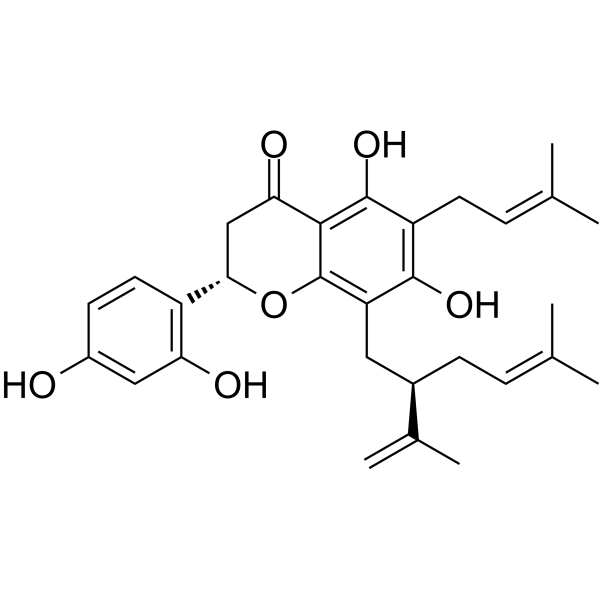
Kushenol B is an isoprenoid flavonoid isolated from S. flavescens, has antimicrobial, anti-inflammatory and antioxidant activities. Kushenol B has inhibitory activity against cAMP phosphodiesterase (PDE), with an IC50 of 31 µM.
Nur für Forschungszwecke. Wir verkaufen nicht an Patienten.
- Reinheit : 96%
- CAS. Nr.: 99217-64-8
- Formel: C30H36O6
- Molecular Weight:492.60
-
Speicherung:
-20°C, protect from light
* In solvent : -80°C, 6 months; -20°C, 1 month (protect from light)

To place orders, for customer services and technical support, please contact: MedChemExpress USA
Tel: 609-228-6898 E-mail: [email protected] [email protected]


-
 Biologische Aktivität
-
Chemical Information
- Protokoll
- Reinheit & Dokumentation
- Verweise
-
 Help & FAQs




Biologische Aktivität
Beschreibung
IC50 & Target
IC50: 31 µM (cAMP PDE)[1]


Chemical Information
-
CAS. Nr. 99217-64-8
-
Appearance Solid
-
Molecular Weight 492.60
-
Formel C30H36O6
-
Color Off-white to light yellow
-
SMILES
C/C(C)=C\C[C@@H](C(C)=C)CC1=C2C(C(C[C@@H](C3=C(C=C(C=C3)O)O)O2)=O)=C(C(C/C=C(C)\C)=C1O)O
-
Structure Classification
-
Initial Source
-
Versand
Room temperature in continental US; may vary elsewhere.
-
Speicherung
-20°C, protect from light
* In solvent : -80°C, 6 months; -20°C, 1 month (protect from light)


Reinheit & Dokumentation
-
Data Sheet (269 KB)
-
SDS (252 KB)
- English - EN (252 KB)
- Français - FR (252 KB)
- Deutsch - DE (252 KB)
- Norwegian - NO (252 KB)
- Español - ES (252 KB)
- Swedish - SV (252 KB)
- Italian - IT (252 KB)
- Korean - KR (252 KB)
- Portuguese - PT (252 KB)
-
Handling Instructions (2659 KB)
Verweise

Calculators
Konzentration (Stammlösung) × Volumen (Stammlösung) = Konzentration (Ziellösung) × Volumen (Ziellösung)


Kushenol B Related Classifications
HY-N8092 Related Classifications
 Powered by Bioz