



PI-103 (Standard)
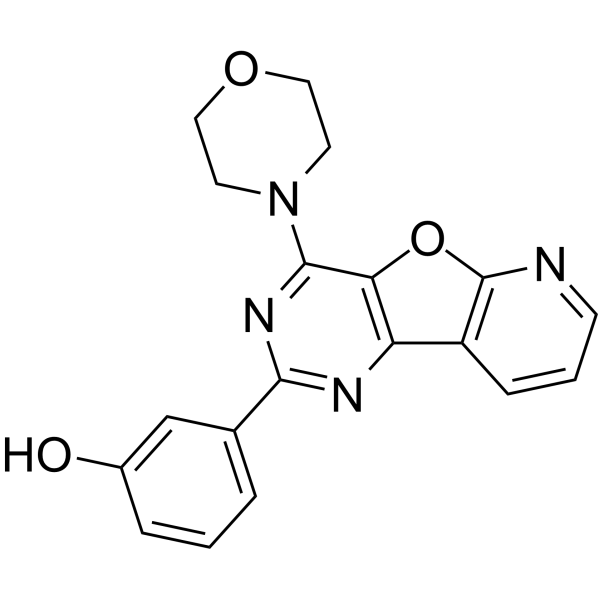
PI-103 (Standard) is the analytical standard of PI-103. This product is intended for research and analytical applications. PI-103 is a potent PI3K and mTOR inhibitor with IC50s of 8 nM, 88 nM, 48 nM, 150 nM, 20 nM, and 83 nM for p110α, p110β, p110δ, p110γ, mTORC1, and mTORC2. PI-103 also inhibits DNA-PK with an IC50 of 2 nM. PI-103 induces autophagy.
Nur für Forschungszwecke. Wir verkaufen nicht an Patienten.
- Reinheit: 98%
- CAS. Nr.: 371935-74-9
- Formel: C19H16N4O3
- Molecular Weight:348.36
-
Speicherung:
Please store the product under the recommended conditions in the Certificate of Analysis.


To place orders, for customer services and technical support, please contact: MedChemExpress USA
Tel: 609-228-6898 E-mail: [email protected] [email protected]


-
 Product Information
-
Chemical Information
- Reinheit & Dokumentation
-
 Help & FAQs





Product Information
Information
Anwendung
The compound is the grade of analytical standard, which is the reference standard supplied assay. It is commonly used in qualitative, quantitative and methodological research experiments in HPLC, GC and MS.


Chemical Information
-
CAS. Nr. 371935-74-9
-
Molecular Weight 348.36
-
Formel C19H16N4O3
-
SMILES
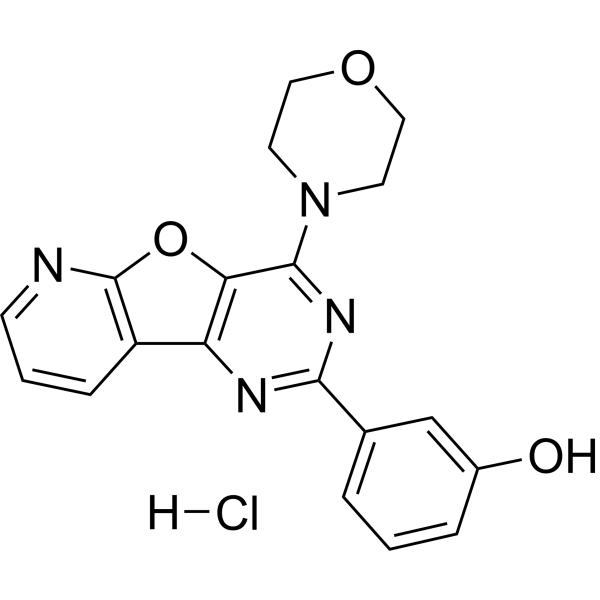
OC1=CC(C2=NC3=C(C(N4CCOCC4)=N2)OC5=C3C=CC=N5)=CC=C1
-
Versand
Room temperature in continental US; may vary elsewhere.
-
Speicherung
Please store the product under the recommended conditions in the Certificate of Analysis.


Reinheit & Dokumentation
Verweise
[1]. Raynaud FI, et al. Biological properties of potent inhibitors of class I phosphatidylinositide 3-kinases: from PI-103through PI-540, PI-620 to the oral agent GDC-0941. Mol Cancer Ther. 2009 Jul;8(7):1725-39. [Content Brief]
[2]. Knight ZA, et al. A pharmacological map of the PI3-K family defines a role for p110 alpha. Cell. 2006 May 19;125(4):733-47. [Content Brief]
[3]. Park S, et al. PI-103, a dual inhibitor of Class IA phosphatidylinositide 3-kinase anLeukemia. 2008 Sep;22(9):1698-706.d mTOR, has antileukemicactivity in AmL. Leukemia. 2008 Sep;22(9):1698-706. [Content Brief]
[4]. López-Fauqued M, et al. The dual PI3K/mTOR inhibitor PI-103 promotes immunosuppression, in vivo tumor growth and increases survival of melanoma cells. Int J Cancer. 2010 Apr 1;126(7):1549-61. [Content Brief]

Calculators
Konzentration (Stammlösung) × Volumen (Stammlösung) = Konzentration (Ziellösung) × Volumen (Ziellösung)


PI-103 (Standard) Related Classifications
HY-10115R Related Classifications
 Powered by Bioz