

11 Results for "

Ras function

" in MedChemExpress (MCE) Product Catalog:
Products (11)

11 Results for "Ras function" in MCE Product Catalog:

1
1 Cited Publications
Art. -Nr.: HY-158107
CAS. Nr.: 2893809-51-1
Reinheit:  98.90%
Target:  

Ras

Forschungsgebiete:  

Cancer

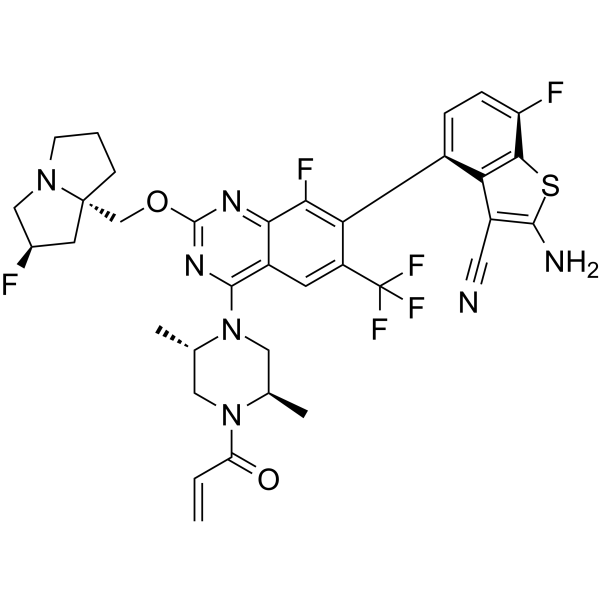
BBO-8520 is a direct small molecule covalent inhibitor targeting KRAS G12C with high oral availability. BBO-8520 has the characteristics of KRAS G12C (OFF) inhibitor and the function of blocking KRAS G12C (ON) signal. BBO-8520 inhibits cell proliferation by inhibiting KRAS G12C (ON) by binding GTP protein. BBO-8520 can block RAS-RAF1 interaction and return KRAS G12C to the inactive (OFF) state. BBO-8520 can be used for the research of cancer .
loading...
    loading...
1
1 Cited Publications
Art. -Nr.: HY-P5982
PTPσ Inhibitor, ISP is a PTPσ intracellular wedge domain mimetic peptide containing a TAT cell-penetrating domain, which acts as a PTPσ inhibitor. PTPσ Inhibitor, ISP binds to and inhibits PTPσ, thereby relieving CSPG-mediated axonal growth inhibition. PTPσ Inhibitor, ISP enhances CSPG degradation by promoting the secretion of Cathepsin B or MMP-2, and promotes DRG axonal growth, OPC migration and remyelination. PTPσ Inhibitor, ISP promotes nerve regeneration and improves sensory, motor and urinary functions in animal models of spinal cord injury, dorsal root injury and multiple sclerosis. PTPσ Inhibitor, ISP also increases the phosphorylation of ERK and AKT in colorectal cancer cells. PTPσ Inhibitor, ISP can be used in studies related to PTPσ/CSPG signaling, nerve regeneration, demyelinating diseases and RAS/ERK signaling .
loading...
    loading...
Art. -Nr.: HY-16111
CAS. Nr.: 195987-41-8
Forschungsgebiete:  

Cancer

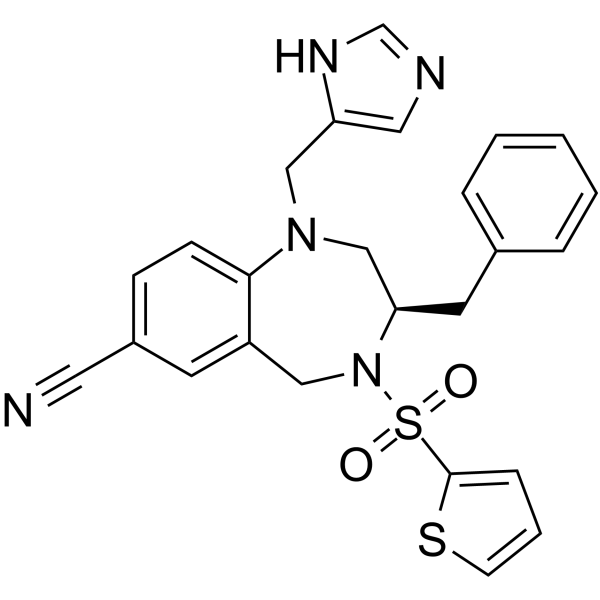
BMS-214662 is a farnesyl transferase inhibitor. BMS-214662 can effectively block the localization and function of Ras protein in the cell membrane by inhibiting the pro-group modification of Ras protein, thereby exerting anti-tumor activity. BMS-214662 has an IC50 value of 1.3 nM for H-Ras and 8.4 nM for K-Ras. BMS-214662 can be used to study Ras-related tumor diseases .
loading...
    loading...
Art. -Nr.: HY-135700
CAS. Nr.: 19115-49-2
Reinheit:  ≥98.0%
Mevalonolactone is an intermediate metabolite in the eukaryotic mevalonate pathway, serving as the stable δ-lactone form of mevalonate with oral activity. Mevalonolactone exhibits binding affinity for ZNF384 (Ka = 12.6 μM) and inhibitory activity against aconitase (aconitase). Mevalonolactone promotes the nuclear localization of ZNF384 and enhances its binding to the GGPPS promoter. Mevalonolactone induces insulin resistance, disrupts glucose and lipid metabolism, enhances the isoprenylation of K-Ras, and inhibits the activation of the insulin signaling pathway. Mevalonolactone inhibits polypeptide synthesis of HMG-CoA reductase in isolated rat hepatocytes, promotes its degradation, and reduces its enzymatic activity. Mevalonolactone impairs mitochondrial function in rat brains. Mevalonolactone promotes the development of metabolically unhealthy obesity. Mevalonolactone can be used in research related to metabolically abnormal obesity, mevalonic aciduria, HMGCR-related limb-girdle myopathy, and statin-induced myopathy .
loading...
    loading...
Art. -Nr.: HY-16111A
CAS. Nr.: 195981-08-9
Forschungsgebiete:  

Cancer

BMS-214662 hydrochloride is an inhibitor of farnesyltransferase (Farnesyl Transferase). BMS-214662 hydrochloride can effectively block the localization and function of Ras proteins on the cell membrane by inhibiting the prenylation modification of Ras proteins, thereby exerting anti-tumor activity. The IC50 value of BMS-214662 hydrochloride for H-Ras is 1.3 nM, and for K-Ras it is 8.4 nM. BMS-214662 hydrochloride can be used in the research of tumor diseases related to Ras .
loading...
    loading...
Art. -Nr.: HY-174306
Forschungsgebiete:  

Metabolic Disease

MARY1 is a selective 5-HT2BR antagonist with an IC50 of 380 nM and a Ki of 764 nM (human 5-HT2BR). MARY1 induces renal mitochondrial biogenesis (MB) and enhances renal mitochondrial function by increasing mitochondrial respiratory capacity, mitochondrial protein levels, and mitochondrial number in renal proximal tubular cells (RPTCs). MARY1 induces MB through 5-HT2BR and dual PI3K/AKT and RAS/MEK/ERK cell signaling pathways in RPTCs. MARY1 can be used to study renal diseases associated with metabolic and mitochondrial dysfunction .
loading...
    loading...
Art. -Nr.: HY-E70609
Target:  

PI3K

Forschungsgebiete:  

Inflammation/Immunology Cancer

PIK3CG Recombinant Human Active Lipid Kinase belongs to PI3K enzyme family that is directly regulated by Gβγ and Ras in the G protein coupled receptor (GPCR) pathway. PIK3CG has the function of regulating cellular inflammation and immunity. PIK3CG is also a potential target for the treatment of a few malignant tumors such as acute lymphoblastic leukemia, medulloblastoma, claudin-low breast cancer (CLBC) and Kaposi sarcoma .
loading...
    loading...
Art. -Nr.: HY-158107A
CAS. Nr.: 2893809-52-2
Target:  

Drug Isomer Ras

Forschungsgebiete:  

Cancer

(4R)-BBO-8520 (Compound 314), an isomer of BBO-8520 (HY-158107), is a selective KRAS G12C inhibitor. BBO-8520 has the characteristics of KRAS G12C (OFF) inhibitor and the function of blocking KRAS G12C (ON) signal. BBO-8520 inhibits cell proliferation by inhibiting KRAS G12C (ON) by binding GTP protein. BBO-8520 can block RAS-RAF1 interaction and return KRAS G12C to the inactive (OFF) state. (4R)-BBO-8520 can be used for the research of cancer .
loading...
    loading...
Art. -Nr.: HY-186321
CAS. Nr.: 501124-40-9
Synonyms: KF25706
Target:  

HSP Raf Src CDK MDM-2/p53 Ras

Forschungsgebiete:  

Cancer

Radicicol 6-oxime (KF25706) is an Hsp90 inhibitor with an EC50 of 5.5 nM against human Hsp90. Radicicol 6-oxime binds to Hsp90 and disrupts its chaperone function, leading to destabilization and depletion of Hsp90-associated signaling molecules. Radicicol 6-oxime depletes Hsp90-associated signaling proteins such as Raf-1, v-src, p185erbB2, Cdk4, and mutant p53, thereby inhibiting K-ras and v-src signaling pathways. Radicicol 6-oxime exhibits antiproliferative activity against various tumor cells. Radicicol 6-oxime inhibits tumor growth in mouse tumor xenograft models. Radicicol 6-oxime can be used for research on breast cancer, colon cancer, and vulvar epidermoid carcinoma .
loading...
    loading...
Art. -Nr.: HY-107855B
CAS. Nr.: 19022-60-7
Synonyms: (+)-Mevalonolactone; (S)-Mevalolactone
L-Mevalonolactone ((+)-Mevalonolactone) is the L-isomer of Mevalonolactone (HY-135700). Mevalonolactone is an intermediate metabolite in the eukaryotic mevalonate pathway, serving as the stable δ-lactone form of mevalonate with oral activity. Mevalonolactone exhibits binding affinity for ZNF384 (Ka = 12.6 μM) and inhibitory activity against aconitase (aconitase). Mevalonolactone promotes the nuclear localization of ZNF384 and enhances its binding to the GGPPS promoter. Mevalonolactone induces insulin resistance, disrupts glucose and lipid metabolism, enhances the isoprenylation of K-Ras, and inhibits the activation of the insulin signaling pathway. Mevalonolactone inhibits polypeptide synthesis of HMG-CoA reductase in isolated rat hepatocytes, promotes its degradation, and reduces its enzymatic activity. Mevalonolactone impairs mitochondrial function in rat brains. Mevalonolactone promotes the development of metabolically unhealthy obesity. Mevalonolactone can be used in research related to metabolically abnormal obesity, mevalonic aciduria, HMGCR-related limb-girdle myopathy, and statin-induced myopathy .
loading...
    loading...
Art. -Nr.: HY-135700S
Mevalonolactone- 13C is the 13C-labeled Mevalonolactone (HY-135700). Mevalonolactone is an intermediate metabolite in the eukaryotic mevalonate pathway, serving as the stable δ-lactone form of mevalonate with oral activity. Mevalonolactone exhibits binding affinity for ZNF384 (Ka = 12.6 μM) and inhibitory activity against aconitase (aconitase). Mevalonolactone promotes the nuclear localization of ZNF384 and enhances its binding to the GGPPS promoter. Mevalonolactone induces insulin resistance, disrupts glucose and lipid metabolism, enhances the isoprenylation of K-Ras, and inhibits the activation of the insulin signaling pathway. Mevalonolactone inhibits polypeptide synthesis of HMG-CoA reductase in isolated rat hepatocytes, promotes its degradation, and reduces its enzymatic activity. Mevalonolactone impairs mitochondrial function in rat brains. Mevalonolactone promotes the development of metabolically unhealthy obesity. Mevalonolactone can be used in research related to metabolically abnormal obesity, mevalonic aciduria, HMGCR-related limb-girdle myopathy, and statin-induced myopathy .
loading...
    loading...
  • 1
