



Apafant (Standard)
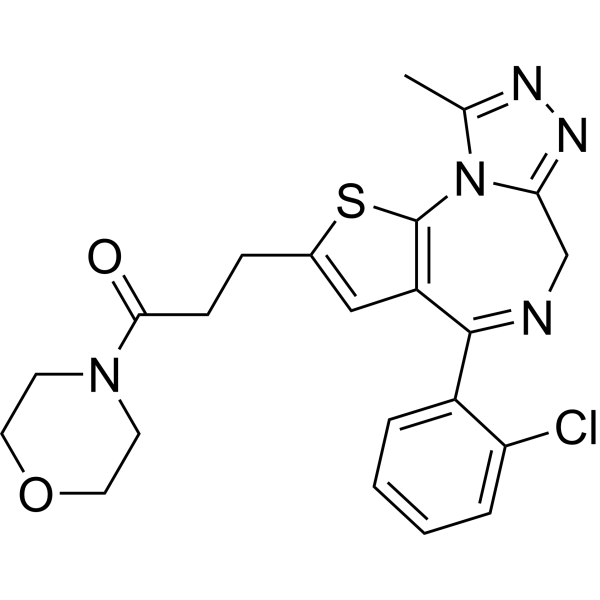
Apafant (Standard) is the analytical standard of Apafant (HY-108634). This product is intended for research and analytical applications. Apafant (WEB 2086), a chemical probe, is a potent platelet-activating factor (PAF) antagonist, inhibits PAF binding to human PAF receptors with a Ki of 9.9 nM. Apafant increases the gene expression of PAF-r, α-globin, β-globin, decreases the c-myb gene expression. Apafant shows a protective effect on alkyl-PAF-mediated lethalit.
Nos produits utilisent uniquement pour la recherche. Nous ne vendons pas aux patients.
- CAS No.: 105219-56-5
- Formule: C22H22ClN5O2S
- Masse moléculaire:455.96
-
Stockage:
Please store the product under the recommended conditions in the Certificate of Analysis.


To place orders, for customer services and technical support, please contact: MedChemExpress USA
Tel: 609-228-6898 E-mail: [email protected] [email protected]


-
 Product Information
-
Chemical Information
- Pureté et documentation
-
 Help & FAQs


-
HY-108634
ApafantPAF Receptor Antagonist -
HY-108635
C16-PAFPAFR Activator -
HY-109897
CV-6209PAF Antagonist -
HY-137257
Carbamyl-PAFPAF receptor Agonist -

HY-108635R
C16-PAF (Standard)PAFR Activator -

HY-101004
PCA 4248 -
HY-19354
AglafolinePlatelet Aggregation Inhibitor -
HY-108908A
ModipafantPAF Antagonist -

HY-132210
rel-(2R,4R)-2,4-Bis(3,4,5-trimethoxyphenyl)-1,3-dioxolanePAFR Antagonist -

HY-126551
Butenoyl-PAFPhospholipid Analogs -
HY-U00040
PAF-AN-1


Product Information
Information
Application
The compound is the grade of analytical standard, which is the reference standard supplied assay. It is commonly used in qualitative, quantitative and methodological research experiments in HPLC, GC and MS.


Chemical Information
-
CAS No. 105219-56-5
-
Masse moléculaire 455.96
-
Formule C22H22ClN5O2S
-
SMILES
O=C(N1CCOCC1)CCC(S2)=CC3=C2N4C(CN=C3C5=CC=CC=C5Cl)=NN=C4C
-
Synonyms
WEB 2086 (Standard)
-
Livraison
Room temperature in continental US; may vary elsewhere.
-
Stockage
Please store the product under the recommended conditions in the Certificate of Analysis.


Pureté et documentation
Références
[1]. Kato M, et al. Apafant, a potent platelet-activating factor antagonist, blocks eosinophil activation and is effective in the chronic phase of experimental allergic conjunctivitis in guinea pigs. J Pharmacol Sci. 2004 Aug;95(4):435-42. [Content Brief]
[2]. Cellai C, Laurenzana A, Vannucchi AM, Della Malva N, Bianchi L, Paoletti F. Specific PAF antagonist WEB-2086 induces terminal differentiation of murine and human leukemia cells. FASEB J. 2002 May;16(7):733-5. [Content Brief]
[3]. Chaithra VH, et al. Modulation of inflammatory platelet-activating factor (PAF) receptor by the acyl analogue of PAF. J Lipid Res. 2018 Nov;59(11):2063-2074. [Content Brief]

Calculators
Concentration (start) × Volume (start) = Concentration (final) × Volume (final)


Apafant (Standard) Related Classifications
HY-108634R Related Classifications
 Powered by Bioz