



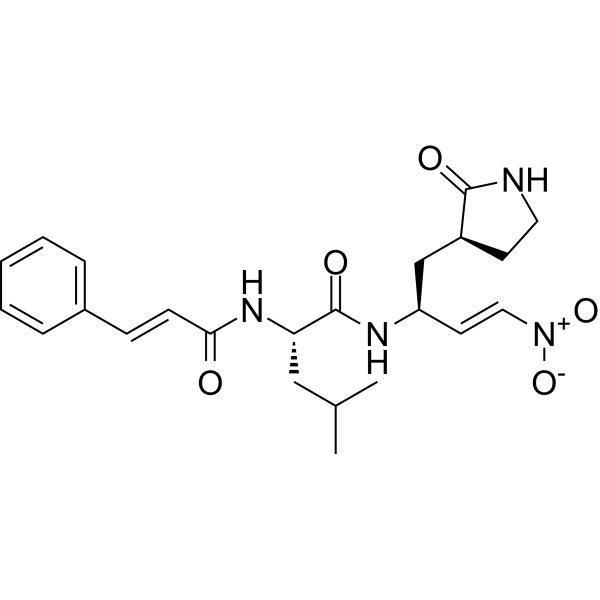
FGA145
FGA145 is a dual, selective inhibitor for Mpro and human Cathepsin L, with Kis of 3.71 μM, 9.82 μM and 53 nM, for Mal-Mpro, pET21-Mpro and Cathepsin L, respectively. FGA145 reveals a multitarget effects in the antiviral activity.
Nos produits utilisent uniquement pour la recherche. Nous ne vendons pas aux patients.
- Formule: C23H30N4O5
- Masse moléculaire:442.51
-
Stockage:
Please store the product under the recommended conditions in the Certificate of Analysis.

To place orders, for customer services and technical support, please contact: MedChemExpress USA
Tel: 609-228-6898 E-mail: [email protected] [email protected]


-
 Activité biologique
-
Chemical Information
- Protocole
- Pureté et documentation
- Références
-
 Help & FAQs


Voir tous les produits spécifiques à Isoform Cathepsin
More

Activité biologique
Description
IC50 & Target
|
cathepsin L 53 nM (Ki) |
Cathepsin B 206 nM (Ki) |
In Vitro
FGA145 reveals weak antiviral activity against SARS-CoV-2 with EC50 of 11.7 μM with low cytotoxicity in Huh-7-ACE2 cells (CC50 over 100 μM)[1].
FGA145 exhibits inhibitory properties towards cysteine proteases RhD, CRZ, Cat L and Cat B, with Kis of 1.63, 12.6, 53 and 206 nM[1].
MedChemExpress (MCE) has not independently confirmed the accuracy of these methods. They are for reference only.
-
Cell Line:Huh-7-ACE2
-
Concentration:0-100 μM
-
Incubation Time:24 h
-
Result:Exhibited a CC50 of over 100 μM.


Chemical Information
-
Masse moléculaire 442.51
-
Formule C23H30N4O5
-
SMILES
O=C(N[C@@H](C[C@@H]1CCNC1=O)/C=C/[N+]([O-])=O)[C@H](CC(C)C)NC(/C=C/C2=CC=CC=C2)=O
-
Livraison
Room temperature in continental US; may vary elsewhere.
-
Stockage
Please store the product under the recommended conditions in the Certificate of Analysis.


Pureté et documentation
Références

Calculators
Concentration (start) × Volume (start) = Concentration (final) × Volume (final)


FGA145 Related Classifications
HY-161244 Related Classifications
 Powered by Bioz