



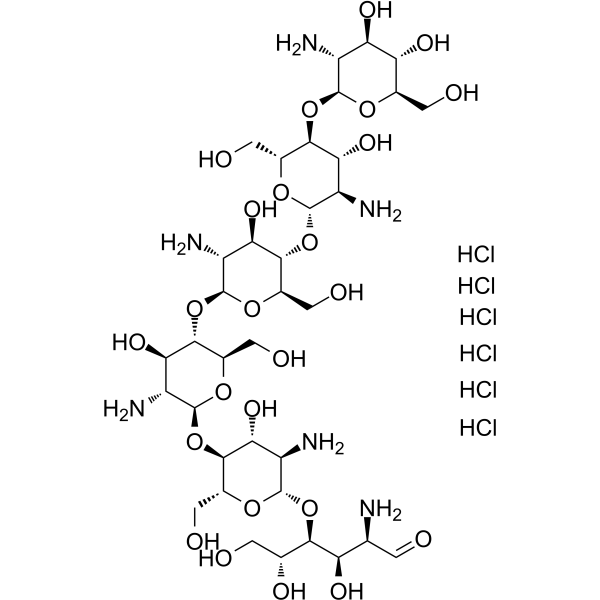
Chitohexaose hexahydrochloride

Based on 1 Customer Validation
Chitohexaose hexahydrochloride is a small molecular polysaccharide. Chitohexaose hexahydrochloride inhibits the binding of AgW to TLR4. Chitohexaose hexahydrochloride upregulates IL-10, inhibits LPS-induced upregulation of ROS, induces alternative activation of macrophages/monocytes, and suppresses LPS-induced production of TNF-α, IL-1β and IL-6. Chitohexaose hexahydrochloride reverses the mortality of mice challenged with APAP or LPS. Chitohexaose hexahydrochloride can be used in research related to Acetaminophen (HY-66005)-induced hepatotoxicity and endotoxemia.
For research use only. We do not sell to patients.
- Purity : 95.0%
- CAS No.: 127171-88-4
- Formula: C36H74Cl6N6O25
- Molecular Weight:1203.72
-
Storage:
-20°C, sealed storage, away from moisture
* In solvent : -80°C, 6 months; -20°C, 1 month (sealed storage, away from moisture)

To place orders, for customer services and technical support, please contact: MedChemExpress USA
Tel: 609-228-6898 E-mail: [email protected] [email protected]


-
 Biological Activity
-
Chemical Information
-
Solvent & Solubility
- Purity & Documentation
- References
-
 Help & FAQs




Biological Activity
Description
IC50 & Target
[1]|
TLR4 |
IL-10 |
IL-1β |
IL-6 |
In Vitro
Chitohexaose (48 h) does not activate the canonical inflammatory pathway in bone marrow-derived macrophages (BMDMs) from BALB/c mice, but potently inhibits LPS-induced production of proinflammatory mediators and reactive oxygen species (ROS). Meanwhile, it induces alternative activation of macrophages by upregulating Ym-1, Arginase-1, and interleukin-10 (IL-10)[2].
Chitohexaose (10 μg/mL; 48 h) does not trigger inflammatory activation in PBMC-derived monocytes, but inhibits LPS-induced proinflammatory cytokine production and induces alternative activation by promoting IL-10 release and arginase activity[2].
MedChemExpress (MCE) has not independently confirmed the accuracy of these methods. They are for reference only.
In Vivo
Chitohexaose (10 mg/kg; i.p.; single dose; administered concurrently with APAP + LPS) reduces the mortality rate of acute liver failure induced by APAP + LPS in male C57BL/6 mice; when administered as a single i.p. dose of 10 mg/kg concurrently with the toxin combination, it achieves a 50% survival rate in mice, while also reducing liver enzyme levels and alleviating systemic inflammation[1].
Chitohexaose (250 μg; i.p.) inhibits lipopolysaccharide (LPS)-induced production of proinflammatory mediators and increases the level of the anti-inflammatory cytokine IL-10 in BALB/c mice with endotoxemia[2].
MedChemExpress (MCE) has not independently confirmed the accuracy of these methods. They are for reference only.
-
Animal Model:C57BL/6 (male, 8-10 weeks old, acute liver failure induced by intraperitoneal acetaminophen injection after 18-hour starvation)[1]
-
Dosage:10 mg/kg (simultaneous with APAP; 6 hours post-APAP; 6 and 18 hours post-APAP)
-
Administration:i.p.; single dose (simultaneous with APAP, 6 hours post-APAP); two doses (6 and 18 hours post-APAP)
-
Result:Achieved 20% mouse survival with single dose administered simultaneously with APAP.
Achieved 50% mouse survival with single dose administered 6 hours post-APAP.
Achieved 83% mouse survival with two doses administered 6 and 18 hours post-APAP (no survival in APAP-only controls).
Reduced centrilobular hepatic necrosis area from 50.14% to 30.07% with treatment at 6 hours post-APAP.
Reduced TUNEL-positive cells per high-power field from 77.73 to 22.67 with treatment at 6 hours post-APAP.
Reduced APAP-induced pro-IL-1β liver mRNA expression from a 117-fold increase to a 67-fold increase relative to vehicle controls.
Reduced APAP-induced cleaved caspase-1 liver expression (P < 0.05).
Increased peritoneal neutrophil percentage at 12 hours post-APAP (P < 0.01).
Elevated peritoneal levels of chemokines KC, eotaxin, MCP-1, and MIP-1a relative to APAP-only controls.
-
Animal Model:C57BL/6 (male, 8-10 weeks old, acute liver failure induced by simultaneous intraperitoneal injection of acetaminophen and LPS)[1]
-
Dosage:10 mg/kg
-
Administration:i.p.; single dose; simultaneous with APAP + LPS
-
Result:Achieved 50% mouse survival (no survival in APAP + LPS-only controls).
Reduced plasma AST and ALT levels relative to APAP + LPS-only controls.
Reduced liver necrotic area (non-significant reduction).
Marginally reduced elevated plasma levels of IL-1β, IL-6, IL-17, and MCP-1 relative to APAP + LPS-only controls.
Significantly increased plasma G-CSF levels relative to APAP + LPS-only controls.
Reduced APAP + LPS-induced pro-IL-1β liver mRNA expression (non-significant reduction).


Chemical Information
-
CAS No. 127171-88-4
-
Appearance Solid
-
Molecular Weight 1203.72
-
Formula C36H74Cl6N6O25
-
Color White to off-white
-
SMILES
OC[C@@H](O[C@H]1O[C@@H]([C@@H]([C@H]2N)O)[C@H](O[C@H]2O[C@H]([C@H](O)CO)[C@H](O)[C@@H](N)C=O)CO)[C@H]([C@@H]([C@H]1N)O)O[C@@H]([C@@H]([C@H]3O)N)O[C@@H]([C@H]3O[C@@H]([C@@H]([C@H]4O)N)O[C@@H]([C@H]4O[C@@H]([C@@H]([C@H]5O)N)O[C@@H]([C@H]5O)CO)CO)CO.Cl.Cl.Cl.Cl.Cl.Cl
-
Structure Classification
-
Initial Source
parasite
-
Shipping
Room temperature in continental US; may vary elsewhere.
-
Storage
-20°C, sealed storage, away from moisture
* In solvent : -80°C, 6 months; -20°C, 1 month (sealed storage, away from moisture)


Solvent & Solubility
In Vitro:
H2O : 25 mg/mL (20.77 mM; Need ultrasonic)
Please refer to the solubility information to select the appropriate solvent. Once prepared, please aliquot and store the solution to prevent product inactivation from repeated freeze-thaw cycles.
Storage method and period of stock solution: -80°C, 6 months; -20°C, 1 month (sealed storage, away from moisture). When stored at -80°C, please use it within 6 months. When stored at -20°C, please use it within 1 month.
* Note: If you choose water as the stock solution, please dilute it to the working solution, then filter and sterilize it with a 0.22 μm filter before use.
Please refer to the solubility information to select the appropriate solvent. Once prepared, please aliquot and store the solution to prevent product inactivation from repeated freeze-thaw cycles.
Storage method and period of stock solution: -80°C, 6 months; -20°C, 1 month (sealed storage, away from moisture). When stored at -80°C, please use it within 6 months. When stored at -20°C, please use it within 1 month.
* Note: If you choose water as the stock solution, please dilute it to the working solution, then filter and sterilize it with a 0.22 μm filter before use.
Concentration (start) × Volume (start) = Concentration (final) × Volume (final)


Purity & Documentation
-
Data Sheet (286 KB)
-
SDS (252 KB)
- English - EN (252 KB)
- Français - FR (252 KB)
- Deutsch - DE (252 KB)
- Norwegian - NO (252 KB)
- Español - ES (252 KB)
- Swedish - SV (252 KB)
- Italian - IT (252 KB)
- Korean - KR (252 KB)
- Portuguese - PT (252 KB)
-
Handling Instructions (2659 KB)
References
[1]. Barman PK, et al. Chitohexaose protects against acetaminophen-induced hepatotoxicity in mice. Cell Death Dis. 2016;7(5):e2224. Published 2016 May 12. [Content Brief]
[2]. Panda SK, et al. Chitohexaose activates macrophages by alternate pathway through TLR4 and blocks endotoxemia. PLoS Pathog. 2012;8(5):e1002717. [Content Brief]


Complete Stock Solution Preparation Table
Please refer to the solubility information to select the appropriate solvent. Once prepared, please aliquot and store the solution to prevent product inactivation from repeated freeze-thaw cycles.
Storage method and period of stock solution: -80°C, 6 months; -20°C, 1 month (sealed storage, away from moisture). When stored at -80°C, please use it within 6 months. When stored at -20°C, please use it within 1 month.
| Optional Solvent | Concentration Solvent Mass | 1 mg | 5 mg | 10 mg | 25 mg |
|---|---|---|---|---|---|
| H2O | 1 mM | 0.8308 mL | 4.1538 mL | 8.3076 mL | 20.7690 mL |
| 5 mM | 0.1662 mL | 0.8308 mL | 1.6615 mL | 4.1538 mL | |
| 10 mM | 0.0831 mL | 0.4154 mL | 0.8308 mL | 2.0769 mL | |
| 15 mM | 0.0554 mL | 0.2769 mL | 0.5538 mL | 1.3846 mL | |
| 20 mM | 0.0415 mL | 0.2077 mL | 0.4154 mL | 1.0384 mL |
* Note: If you choose water as the stock solution, please dilute it to the working solution, then filter and sterilize it with a 0.22 μm filter before use.


Chitohexaose hexahydrochloride Related Classifications
HY-N7697C Related Classifications
 Powered by Bioz