



Envelope glycoprotein gp120 Protein, HIV (Q9DKG6, HEK293, His)
Based on 1 publication(s) in Google Scholar
The envelope glycoprotein gp120 protein facilitates viral capture and dissemination by dendritic cells and endothelial cells by attaching the virus to host lymphocytes through binding to the CD4 receptor. HIV exploits the migratory properties of dendritic cells to access CD4+ T cells, leading to infection. Envelope glycoprotein gp120 Protein, HIV (Q9DKG6, HEK293, His) is the recombinant Virus-derived Envelope glycoprotein gp120 protein, expressed by HEK293 , with C-8*His labeled tag.
- Species: Virus
- Source: HEK293
-
Storage:Stored at -20°C for 2 years from date of receipt. After reconstitution, it is stable at 4°C for 1 week or -20°C for longer (with carrier protein). It is recommended to freeze aliquots at -20°C or -80°C for extended storage.


To place orders, for customer services and technical support, please contact: MedChemExpress USA
Tel: 609-228-6898 E-mail: [email protected] [email protected]


-
 Biological Activity
-
Technical Parameters
-
Product Properties
- Documentation
- Help & FAQs




Biological Activity
Description
The envelope glycoprotein gp120 protein facilitates viral capture and dissemination by dendritic cells and endothelial cells by attaching the virus to host lymphocytes through binding to the CD4 receptor. HIV exploits the migratory properties of dendritic cells to access CD4+ T cells, leading to infection. Envelope glycoprotein gp120 Protein, HIV (Q9DKG6, HEK293, His) is the recombinant Virus-derived Envelope glycoprotein gp120 protein, expressed by HEK293 , with C-8*His labeled tag.
Background
Envelope glycoprotein gp160 undergoes oligomerization predominantly into trimers in the host endoplasmic reticulum, followed by transit to the host Golgi for glycosylation completion. Subsequently, gp160 is proteolytically cleaved in the trans-Golgi by cellular furin or furin-like proteases, resulting in the activation and generation of gp120 and gp41. Surface protein gp120 serves as a critical mediator in the viral life cycle, initially attaching the virus to host lymphoid cells through binding to the primary receptor CD4. This interaction induces a structural rearrangement, creating a high-affinity binding site for chemokine coreceptors such as CXCR4 and/or CCR5. Additionally, gp120 acts as a ligand for CD209/DC-SIGN on dendritic cells (DCs) and CLEC4M/DC-SIGNR on endothelial cells, facilitating viral capture at mucosal surfaces and subsequent transmission to permissive cells. This interaction with DCs allows HIV to exploit the migration properties of dendritic cells, gaining access to CD4+ T-cells in lymph nodes. Virus transmission to T-cells can occur in trans (viral capture and transmission) or in cis (following productive DCs infection), contributing to a robust infection. In trans infection, virions bound to DCs remain infectious over days, possibly protected in non-lysosomal acidic organelles within DCs, enhancing viral infectious potential during migration from the periphery to lymphoid tissues. Upon arrival at lymphoid tissues, intact virions recycle back to the DCs' cell surface, facilitating virus transmission to CD4+ T-cells.
Verified Bioactivity
Measured in a cell proliferation assay using U87 human glioma cell. The ED50 this effect is 82.60 ng/mL, corresponding to a specific activity is 1.211×10⁴ units/mg.
MCE Validation Data
-
Purity - SDS-PAGE
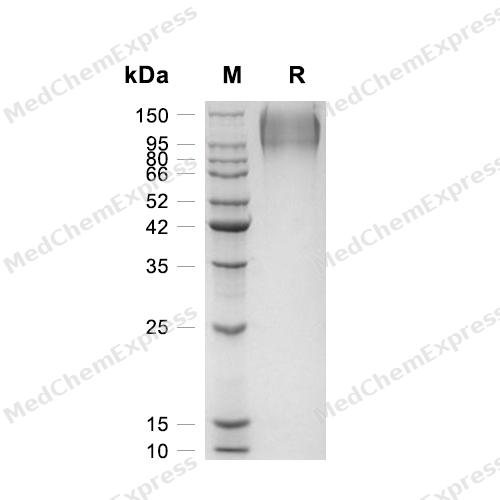
Purity - SDS-PAGE


Publications (1)
-
Journal Impact Factor
-
Most Recent
-
PLoS Pathog
PDE4B deficiency aids macrophage differentiation and contributes to Cryptococcus neoformans brain infection. [Abstract]2026 Mar 10;22(3):e1014040. PMID: 41805786


Technical Parameters
-
Species Virus
-
Source HEK293
-
Tag C-8*His
-
Accession
Q9DKG6 (S30-E498)
-
Molecular Construction
-
N-term
-
HIV-1 gp120 (S30-E498)
Accession # Q9DKG6 -
8*His
-
C-term
-
-
Protein Length
Partial
-
Synonyms
Envelope glycoprotein gp160; Env polyprotein; Surface protein gp120; SU; Glycoprotein 120; gp120; Transmembrane protein gp41; TM; Glycoprotein 41; gp41 ; env
-
AA Sequence
SDNLWVTVYYGVPVWRDADTTLFCASDAKAHETEVHNVWATHACVPTDPNPQEIHLENVTENFNMWRNNMVEQMQEDVISLWDQSLKPCVKLTPLCVTLNCTNANWTNSNNTTNGPNKIGNITDEVKNCTFNMTTELKDKKQKVHALFYKLDIVQINSSEYRLINCNTSVIKQACPKISFDPIPIHYCTPAGYAILKCNDKNFNGTGPCKNVSSVQCTHGIKPVVSTQLLLNGSLAEEEIIIRSENLTNNAKTIIVHLNKSVEINCTRPSNNTRTSITMGPGQVFYRTGDIIGDIRKAYCEINGIKWNEVLVQVTGKLKEHFNKTIIFQPPSGGDLEIITHHFSCRGEFFYCNTTKLFNNTCIGNTSMEGCNNTIILPCKIKQIINMWQGVGQAMYAPPISGRINCVSNITGILLTRDGGADNNTTNETFRPGGGNIKDNWRSELYKYKVVEIEPLGIAPTRAKRRVVE
-
Molecular Weight
Approximately 90-140 kDa, based on SDS-PAGE under reducing conditions.
-
Purity
≥ 95%, as determined by reducing SDS-PAGE.


Product Properties
Lyophilized powder
1.Lyophilized from a 0.22 μm filtered solution of PBS, pH 7.4.
2.Lyophilized from a 0.22 μm filtered solution of 20 mM PB, 150 mM NaCl, pH 7.4.
Please refer to the lot-specific COA for specific buffer information.
<1 EU/μg, determined by LAL method.
It is not recommended to reconstitute to a concentration less than 100 μg/mL in ddH2O. For long term storage it is recommended to add a carrier protein (0.1% BSA, 5% HSA, 10% FBS or 5% Trehalose).
Stored at -20°C for 2 years from date of receipt. After reconstitution, it is stable at 4°C for 1 week or -20°C for longer (with carrier protein). It is recommended to freeze aliquots at -20°C or -80°C for extended storage.
Room temperature in continental US; may vary elsewhere.


Documentation
-
Data Sheet (239 KB)
-
SDS (252 KB)
- English - EN (252 KB)
- Français - FR (252 KB)
- Deutsch - DE (252 KB)
- Norwegian - NO (252 KB)
- Español - ES (252 KB)
- Swedish - SV (252 KB)
- Italian - IT (252 KB)
- Korean - KR (252 KB)
- Portuguese - PT (252 KB)
-
Handling Instructions (2659 KB)

Calculators
Concentration (start) × Volume (start) = Concentration (final) × Volume (final)


 Powered by Bioz

