



D-Erythrose (50%w/w in water)

Based on 1 Customer Validation
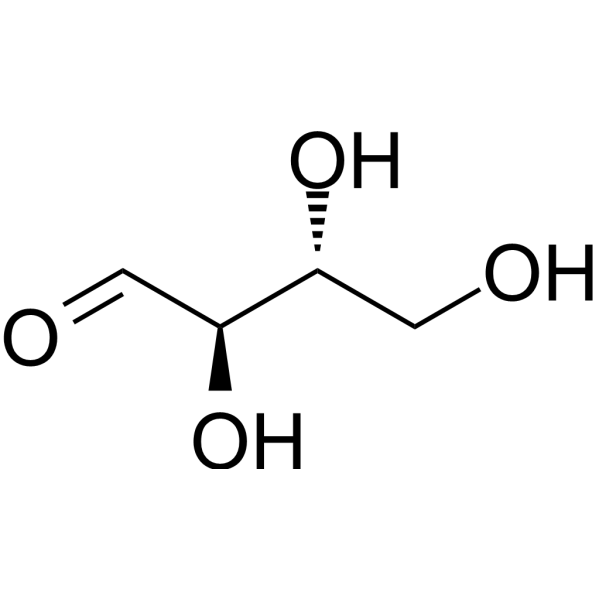
D-Erythrose is a four-carbon sugar classified as an aldose. D-Erythrose has unique chemical properties that make it an important intermediate in various metabolic pathways, especially in the biosynthesis of amino acids and nucleotides. It also plays a role in the pentose phosphate pathway, which generates reducing equivalents for biosynthetic reactions and cellular defense against oxidative damage.
For research use only. We do not sell to patients.
- Purity : 95.41%
- CAS No.: 583-50-6
- Formula: C4H8O4
- Molecular Weight:120.10
-
Storage:
Solution, -20°C, 2 years

To place orders, for customer services and technical support, please contact: MedChemExpress USA
Tel: 609-228-6898 E-mail: [email protected] [email protected]


-
 Biological Activity
-
Chemical Information
-
Solvent & Solubility
- Protocols
- Purity & Documentation
-
 Help & FAQs




Biological Activity
Description
In Vitro
D-Erythrose is a biochemical reagent that can be used as a biological material or organic compound for life science related research.
MedChemExpress (MCE) has not independently confirmed the accuracy of these methods. They are for reference only.


Chemical Information
-
CAS No. 583-50-6
-
Appearance Liquid
-
Molecular Weight 120.10
-
Formula C4H8O4
-
Color Colorless to light yellow
-
SMILES
O=C[C@@H]([C@@H](CO)O)O
-
Shipping
Room temperature in continental US; may vary elsewhere.
-
Storage
Solution, -20°C, 2 years


Solvent & Solubility
In Vitro:
H2O : 175 mg/mL (1457.12 mM; Need ultrasonic)


Purity & Documentation
-
Data Sheet (242 KB)
-
SDS (394 KB)
- English - EN (394 KB)
- Français - FR (394 KB)
- Deutsch - DE (394 KB)
- Norwegian - NO (394 KB)
- Español - ES (394 KB)
- Swedish - SV (394 KB)
- Italian - IT (394 KB)
- Korean - KR (394 KB)
- Portuguese - PT (394 KB)
-
Handling Instructions (2659 KB)

Calculators
Concentration (start) × Volume (start) = Concentration (final) × Volume (final)


Complete Stock Solution Preparation Table
Please refer to the solubility information to select the appropriate solvent. Once prepared, please aliquot and store the solution to prevent product inactivation from repeated freeze-thaw cycles.
Storage method and period of stock solution: -80°C, 6 months; -20°C, 1 month. When stored at -80°C, please use it within 6 months. When stored at -20°C, please use it within 1 month.
| Optional Solvent | Concentration Solvent Mass | 1 mg | 5 mg | 10 mg | 25 mg |
|---|---|---|---|---|---|
| H2O | 1 mM | 8.3264 mL | 41.6320 mL | 83.2639 mL | 208.1599 mL |
| 5 mM | 1.6653 mL | 8.3264 mL | 16.6528 mL | 41.6320 mL | |
| 10 mM | 0.8326 mL | 4.1632 mL | 8.3264 mL | 20.8160 mL | |
| 15 mM | 0.5551 mL | 2.7755 mL | 5.5509 mL | 13.8773 mL | |
| 20 mM | 0.4163 mL | 2.0816 mL | 4.1632 mL | 10.4080 mL | |
| 25 mM | 0.3331 mL | 1.6653 mL | 3.3306 mL | 8.3264 mL | |
| 30 mM | 0.2775 mL | 1.3877 mL | 2.7755 mL | 6.9387 mL | |
| 40 mM | 0.2082 mL | 1.0408 mL | 2.0816 mL | 5.2040 mL | |
| 50 mM | 0.1665 mL | 0.8326 mL | 1.6653 mL | 4.1632 mL | |
| 60 mM | 0.1388 mL | 0.6939 mL | 1.3877 mL | 3.4693 mL | |
| 80 mM | 0.1041 mL | 0.5204 mL | 1.0408 mL | 2.6020 mL | |
| 100 mM | 0.0833 mL | 0.4163 mL | 0.8326 mL | 2.0816 mL |
* Note: If you choose water as the stock solution, please dilute it to the working solution, then filter and sterilize it with a 0.22 μm filter before use.


D-Erythrose (50%w/w in water) Related Classifications
HY-116956 Related Classifications
 Powered by Bioz